Ford may now be widely considered ‘a bakkie brand’, but its recently launched compact crossover – the Puma – heralds the return of the Blue Oval’s best passenger-car values…
South Africa has one of the most loyal, competitively traded and profitable bakkie markets globally. And Ford is a major presence in it, with the Ranger.
But there was a time when bakkies and ladder-frame SUVs weren’t Ford’s entire business. Suppose you are old enough to remember the Escort, Sierra, Sapphire, Telstar, TX5, Mondeo, Fiesta and Focus. In that case, you’ll recall that Ford passenger cars were regarded as “reasonably priced, yet involving to drive”.
It’s a pity Ford chose not to continue with the Fiesta and Focus in our market. Those hatchback platforms strike a fine balance between ride quality and driving dynamics, which has been a hallmark of European-engineered Ford models for decades. But, as the hatchback market devolved into a bargain segment (dominated by VW’s locally built continuation cars and Suzuki and Hyundai’s keenly-priced imports from India), there’s no business case for Fiesta or Focus in Mzansi. Globally, Fiesta’s lifecycle will end soon.
Without hatchbacks and their corresponding crossovers or SUVs, Ford has a problem. The bakkie market can never account for all South African new-vehicle sales, and not everyone can afford a Ranger double-cab as their family vehicle. Or wants one, for that matter.
The most affordable “reasonable” specification Ranger double-cab is the XLT 4×2, priced at R632 000 (November 2023). Without Kuga or EcoSport, Ford is short on customer alternatives for South African buyers who don’t want to deal with the parking or garaging issues of a double-cab bakkie.
Ford needs ‘passenger cars’
Despite Ranger’s success, Ford dealers jealously observe the sales volumes that Toyota achieves with the Corolla Cross and Volkswagen does with the Polo Vivo – they’re 2 of South Africa’s most popular affordable cars, for which Ford doesn’t have a counter.
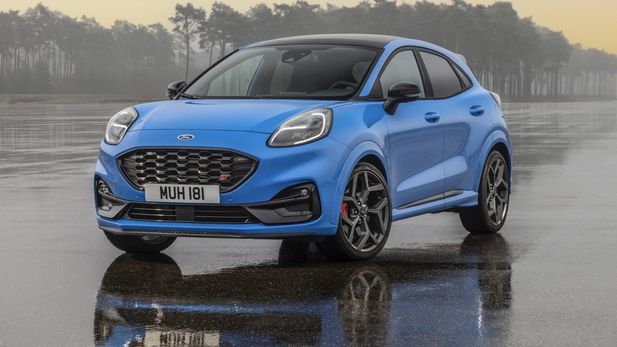
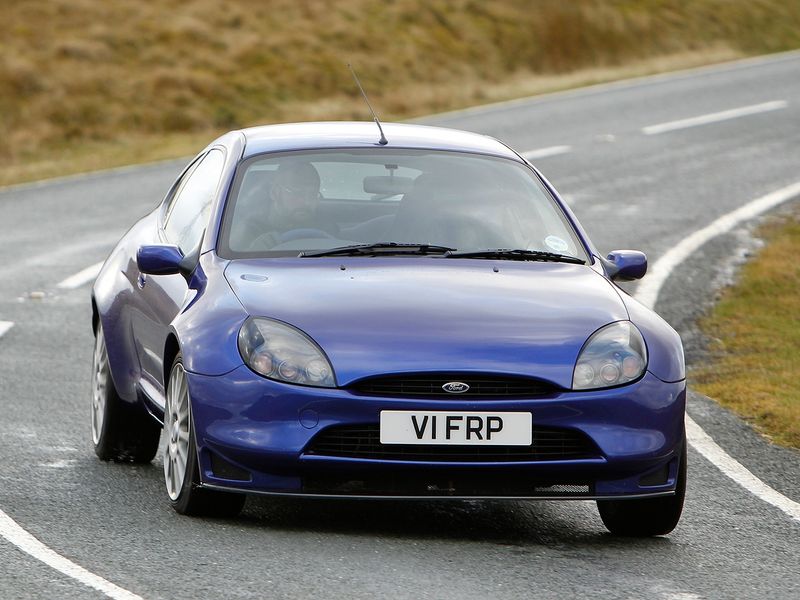
Ford’s solution? The Puma. If your blood is blue, you’ll know the 2nd-gen Puma, a compact crossover that Ford launched globally in 2019, was preceded by a very competent front-wheel-drive coupe, built from 1997 to 2002. South Africa was never considered for the Puma coupe, because hot hatches were more in-demand than front-wheel-drive coupes. But the 2nd-generation Puma is available at your local Ford dealership, priced at R569 900 for the Titanium grade and R613 900 for an ST-Line Vignale.
With 1 drivetrain option and only 2 specification grades, the Puma has a very narrow model range in South Africa. Still, it is a curiously symbolic car for Ford and local followers of the Dearborn-based brand.

Why the Fiesta is missed
Ford’s decision to exit the hatchback business in South Africa made business sense, but it upset loyal brand followers. Ford’s hatchback legacy in South Africa traces back to the 1980s and cars like Escort, Sierra, Laser, Fiesta and Focus built legacy and brand affinity.
There was disappointment when Ford decided not to offer the facelifted version of the 7th-gen Fiesta in South Africa. Why? Because the Fiesta is a great driver’s car, regardless of specification.
Since the 1990s, European engineering teams have developed Ford’s compact cars prioritizing ride and handling. The result was hatchbacks with excellent high-speed tracking stability, even when rolling at speed over poorly surfaced South African roads.
By the time Ford’s 6th-gen Fiesta was ready for replacement, there was little argument against it being the best driver’s car in its class – superior to German, Korean and Japanese rivals. The 7th-gen Fiesta was even better, and although it failed to emulate its predecessor’s sales success, Ford fans were left frustrated when the (by then, admittedly pricey) compact hatchback was withdrawn from our market.

Puma is the ‘new’ Fiesta
With the introduction of Puma, Ford is re-entering the South African passenger car segment with a European-specification vehicle, built on arguably its best platform.
The Puma shares its vehicle architecture with the Fiesta, with the notable difference being a 95-mm longer wheelbase, which endows the crossover with more cabin space. Built on Ford’s B2E platform, Puma leverages Fiesta’s excellent ride and handling characteristics in a crossover configuration.
“But wasn’t EcoSport also built on the Fiesta platform?” Yes, the EcoSport used the same platform, but its suspension setup was more rudimentary, with monotube dampers, whereas Puma uses Hitachi twin-tube frequency reactive shock absorbers. On South Africa’s, um, textured road surfaces, the Puma’s more sophisticated suspension makes a difference regarding ride comfort, tracking stability and cornering grip, especially when rolling over mid-corner bumps and imperfections.

Are we getting the best engines for the Puma?
We’ve mentioned Volkswagen’s dominance in the shrinking local hatchback market as one of the reasons that Ford didn’t continue to offer the Fiesta in South Africa. But another reason was local fuel quality limiting available engine choices. That does beg the question: what has happened since the Fiesta was discontinued and now? Zilch, because South African fuel quality remains deeply problematic.
Engine choice is potentially the issue with Puma. Its price-to-performance ratio is low, with a much narrower powertrain offering than Volkswagen offers in the T-Cross, for example.
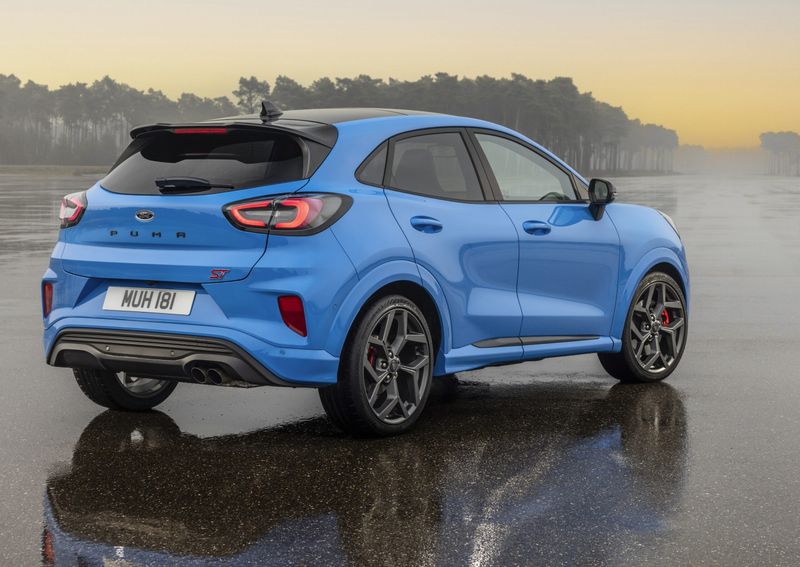
There is only one engine option, Ford’s familiar 1.0-litre turbopetrol “Ecoboost” triple, which also powered the EcoSport. It produces peak outputs of 92 kW and 170 Nm, plus delivers confident throttle responses. But like all moderately boosted 1.0-litre engines, it’s always on-boost and actual world fuel consumption is heavier than many customers anticipate for an engine of such modest capacity.
Power outputs and the ST option
In the T-Cross, Volkswagen’s equivalent 1.0-litre triple is less powerful than the Puma’s engine, at 85 kW, but has 30 Nm more torque. In addition, VW offers a 1.5-litre engine option, too, with outputs of 110 kW and 250 Nm, making the T-Cross more powerful and responsive than the Puma at a comparable price.
But surely there are better engine options for Puma? Well, there are. A hybridised version of the 1.0-litre turbopetrol is available in other RHD markets, such as the UK, offering Puma drivers 114 kW/240 Nm or 125 kW/248 Nm. Perhaps the most compelling drivetrain option is the Puma ST; it features the legacy Fiesta 1.5-litre turbopetrol engine (with 147 kW and 320 Nm) mated with a 6-speed manual gearbox.
Even if they are mild-hybrid versions with tiny battery packs, imported hybrids trigger a significant tariff cost, and it’s likely the 114- or 125 kW Pumas would have priced way too near to R700 000.
Ford’s Puma ST combines a 147 kW engine and 6-speed manual gearbox, but would legacy Ford hot hatchback customers be keen on it, even if the price was beyond R700 000? It remains an untested question for now, but a very tempting one…
The comeback of a Ford driver’s car
The Puma is entering a challenging market with established rivals. In a sense, Puma needs to be many more things in South Africa than in other markets where it is sold. Puma is partly a Fiesta legacy car and a junior Kuga replacement (Mzansi is one of the very few markets in which the 3rd-gen Kuga isn’t sold).
If you buy a crossover purely considering price and engine performance, Volkswagen’s T-Cross 1.5TSI 110 KW offers more kilowatts for your Rands.
The Omoda C5 and Haval Jolion are larger than Puma, with superior standard equipment levels and much cheaper pricing, but Ford’s compact crossover offers far excellent dynamic driving qualities.
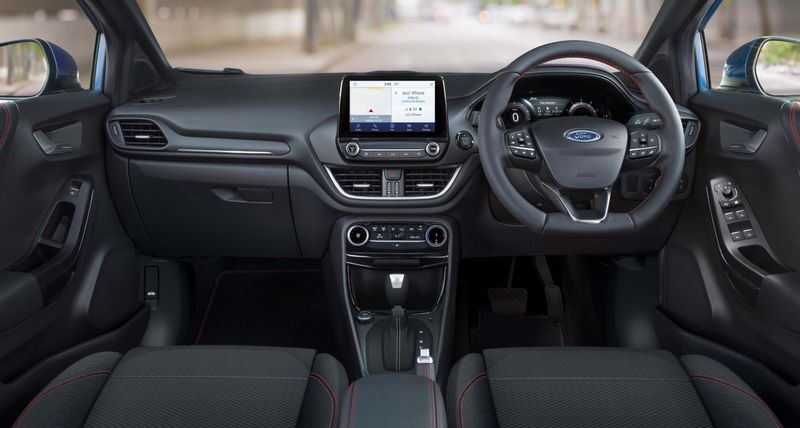
With a 2-derivative range, Ford is being conservative with Puma. But Ford fans will be heartened by having the option of a proper European-designed, engineered and assembled family car, that isn’t a bakkie or large SUV.
Related content:
Who really rules the bakkie world?
Fuel price therapy – what should we do?
When big tyres do bad things to good bakkies
Can Land Rover thrive without the Land Rover brand?
Is LPG worth its near 40% fuel-cost saving?
How much will 9th-gen Hilux be like the Tacoma?
Lance Branquinho

Lance Branquinho is a Namibian-born writer and photographer who has won numerous motoring journalism awards. He once smuggled parts to South America, in a minor contribution to help Giniel de Villiers finish on the podium at the Dakar. He fears for the eventual collapse of the air-cooled Porsche 911 market – and keenly awaits, in vain, the return of the brand's 928.