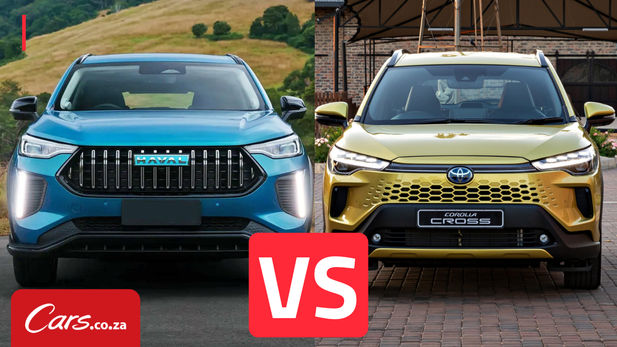
The Toyota Corolla Cross Hybrid is currently South Africa’s most popular hybrid car but the arrival of the Haval Jolion Pro Hybrid will undoubtedly give local buyers something to think about. Which one of these hybrid cars is the better buy? This comparative article will help you make up your mind!
Should you buy the Haval Jolion Pro Hybrid or rather opt for the locally built Toyota Corolla Cross Hybrid?
The current trend is that more and more car buyers in South Africa are considering and opting for hybrid cars.
Toyota’s hybrid technology is well-established and the Toyota Corolla Cross Hybrid’s domination has mostly gone unchallenged but the arrival of the Haval Jolion Pro Hybrid has given local buyers something to think about.
How do these 2 hybrid cars stack up against each other?
The main aim of this article is to help you, the consumer, make an informed buying decision. To help you do this, we will provide you with the need-to-know information and insight based on available vehicle information and our experience with the cars in question.
This article will cover key aspects including Engine Performance, Efficiency & Handling, Interior Features & Safety, Dimensions & Practicality and Pricing and Warranty details.
If at the end of this article, you are still undecided as to ‘What To Buy’, you are more than welcome to reach out to us for additional information or advice via X, Facebook or Instagram and our experienced test team will gladly assist you.
You can also browse through our used car listings for Toyota Corolla Cross Hybrid and the Haval Jolion Hybrid.
What To Buy – Haval Jolion Hybrid or Toyota Corolla Cross Hybrid?
Engine Performance, Efficiency and Ride Quality
| Haval Jolion Pro Hybrid | Toyota Corolla Cross Hybrid | |
| Powertrain | 1.5-litre naturally-aspirated petrol + front electric motor | 1.8-litre naturally-aspirated petrol + front electric motor |
| Battery | 1.6 kWh | 1.3 kWh |
| Power Output | 140 kW | 90 kW |
| Torque Output | 375 Nm | 142 Nm |
| Transmission | CVT Automatic | CVT Automatic |
| Fuel Consumption (claimed) | 5.1L/100km | 4.3 L/100km |
| Real-world fuel economy(based on Cars.co.za testing) | 5.8 – 7.4 L/100km | 3.8 – 5.5 L/100km |
Haval Jolion Pro Hybrid
On paper, as clearly highlighted in the table above, the Haval Jolion Pro Hybrid offers significantly more power and torque than its rival, the Toyota Corolla Cross Hybrid. In fact, the Haval offers 50 kW and 233Nm more! Take into account that Haval simply combines its ICE engine output with its electric motor output when stating figures (total system output). The ‘on the wheels’ output of the Jolion is unclear but certainly more than the Corolla Cross.
That’s a significant gain. However, the trade-off is that the Jolion Hybrid, comparatively, uses more fuel over time. Haval claims 5.1L/100km which is respectable but in the real world you can expect to see figures anywhere between 5.8 and 7.4 L/100km depending on whether you are driving in an urban or highway environment and of course, your driving style. Even so, that fuel consumption is an improvement over the ICE-powered Jolion which averages out above 8.5 L/100km.
With healthy power and torque on tap, the Jolion Hybrid delivers excellent overall performance. Acceleration to highway speed is good and there’s enough grunt to execute quick overtakes on the highway without much hassle at all. More so, the Jolion Hybrid’s powertrain runs smoothly and quietly which is to say that it’s very refined and composed and the change-over from EV to ICE operation is virtually imperceptible to the driver. Overall, the performance of the Haval Jolion hybrid is impressive and buyers should have very little to complain about in this regard. A total of 4 driving modes are available to the driver including Standard, Eco, Sport and Snow.
Buyers will have to decide if they want or need the additional power or torque that the Jolion Hybrid offers, and importantly, if the higher asking price (see more below) justifies that want/need.
Toyota Corolla Cross Hybrid
The Toyota Corolla Cross’ performance, by comparison, is a bit more pedestrian and perhaps not as urgent and forthcoming as its new, more powerful Chinese rival. Nonetheless, the Corolla Cross Hybrid still performs relatively well and while its ride quality is impressive, its engine and CVT is a bit more vocal (nosier) under load or when tackling steeper inclines.
Nonetheless, a major draw card for opting for the Corolla Cross is efficiency. During our test, we saw figures as low as 3.8 L/100km in urban driving situations with an impressive average of 5.5 L/100 km! Toyota claims an average of 4.3 L/100km.
Muck like the Jolion Hybrid, the Corolla Cross Hybrid is also able to seamlessly switch between electric and engine propulsion based on factors such as the driving situation and inputs from the driver. More so, both cars are what can be referred to as closed-loop hybrids which means that the battery is recuperated charge the battery and so these vehicles are not Plug-In Hybrids, but rather self-charging hybrids.
The Toyota Corolla Cross Hybrid has 4 driving modes to choose from including Normal, EV, Eco and Power.
While both these cars are naturally aspirated, buyers can expect overall performance to be negatively impacted at altitude (Gauteng) but the Jolion Hybrid (with its higher outputs) will almost certainly cope better at altitude when fully loaded.
Even so, at the price (see more below), the Corolla Cross’ performance will be adequate for most compact hybrid buyers with its efficiency being a notable factor to keep in mind considering the current cost of petrol in South Africa.
Interior Execution, Features and Safety
For this section, we will compare key specifications of the equivalent top-spec derivatives from each model range.
You can, however, use our handy Cars.co.za Compare Tool to compare any vehicle derivative you like.
| Haval Jolion Pro Hybrid Super Luxury | Toyota Corolla Cross Hybrid XR | |
| Infotainment system | 12.3-inch touchscreen | 10.1-inch touchscreen |
| Digital instrument cluster | 7-inch digital colour LCD, Head-up display | 12.3-inch multi-information display |
| Android Auto and Apple CarPlay, Bluetooth, voice control, USB, wireless charging | Yes to all. 2 USB-A ports front and rear | Yes, 1 front USB port, 2 rear USB ports, wireless charging is optional |
| Rear View Camera | Yes, 360-degree camera with a panoramic view | Yes, panoramic view |
| Cruise Control | Yes, adaptive with traffic jam assist | Yes, adaptive |
| Air Conditioning | Dual Zone Climate Control | Dual Zone Climate Control |
| Panoramic Sunroof | Yes | No |
| Front and rear park distance control | Rear only | Front and rear |
| Upholstery / electric seats | Artificial leather, electric adjustment for driver seat, heated front seats | Leather, electric adjustment for driver seat |
| Safety Features | 6 airbags, ABS with EBD, brake assist, electronic stability control with traction control, hill hold control, lane departure warning with lane keeping assist, blind spot warning, traffic sign recognition, tyre pressure monitoring | 7 airbags, ABS with EBD, brake assist, electronic stability control, hill hold control, lane departure warning with lane keeping assist, blind spot warning |
Feature Summary
Haval’s strategy of offering feature-loaded cabins is evident yet again in the Jolion Hybrid and for the most part, there’s not much missing on the spec sheet. However, with the absence of reach adjustable steering, some buyers will find it more difficult to find their ideal driving positions. The infotainment system has some operating quirks but the cabin design is both modern and aesthetically pleasing. Overall, the Jolion Hybrid’s cabin is hard to fault and most buyers should be satisfied with the general perceived build quality on offer.
Comparatively, the Corolla Cross’ interior is perhaps more conservative in style but true to form, the Toyota’s fit and finish is excellent and more so, it’s also fairly generously equipped with standard features. The facelifted Toyota Corolla Cross now features a 360-degree camera and larger infortainment system and a new instrument cluster.
Despite the specification and styling differences, both cabins are of good quality and if you’re looking to buy either of these cars, we suggest that you book a test drive appointment at your nearest Haval or Toyota dealership and experience the cabins in the flesh. That’s by far the best way to better understand what you personally like and what you don’t.
Practicality
| Haval Jolion Pro Hybrid | Toyota Corolla Cross Hybrid | |
| Length | 4 470 mm | 4 460 mm |
| Width | 1 898 mm | 1 825 mm |
| Height | 1 625 mm | 1 620 mm |
| Wheelbase | 2 700 mm | 2 640 mm |
| Ground Clearance | 168 mm | 161 mm |
| Rear Seating Configuration | 60:40 split | 60:40 split |
| Load Capacity | 255-916 L | 440 L |
Practicality Summary
As the table above highlights, the Jolion Hybrid has a slightly larger footprint over its Corolla Cross Hybrid rival but importantly, it has a 60 mm longer wheelbase. That’s important because the wheelbase directly translates into more cabin space, particularly for rear passengers. Therefore, leg-, knee- and headroom is generous in the Jolion Pro Hybrid.
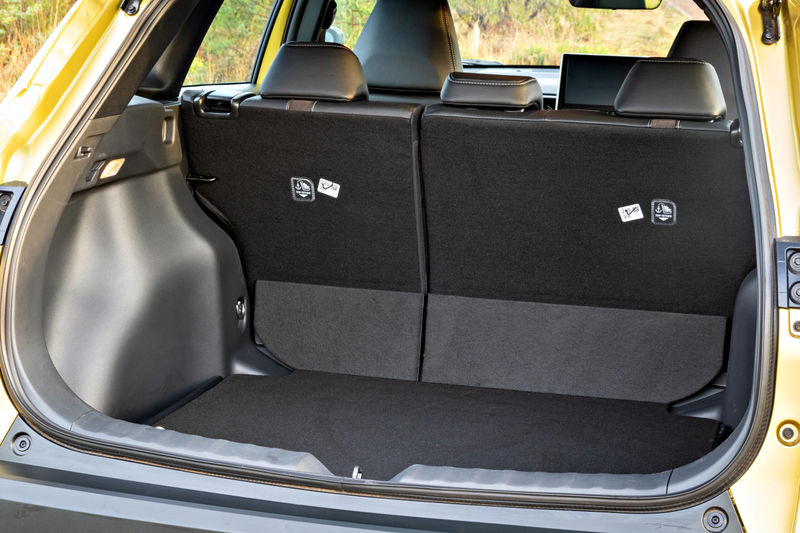
However, where the Jolion Hybrid falls short is in the load bay. Due to battery position, the Jolion Pro Hybrid’s boot is shallow and is only claimed to offer 255 litres, which is less than a Volkswagen Polo (351 litres)! Worse still, the Haval is NOT equipped with a spare wheel, not even a biscuit spare.
In the Corolla Cross Hybrid and despite its slightly shorter wheelbase, rear passengers are still afforded good rear legroom and fortunately, the load bay isn’t compromised. Toyota claims 440 litres of load space and buyers will be pleased to know that a biscuit spare wheel is present beneath the boot floor should you have a flat tyre on your travels.
The Corolla Cross Hybrid, therefore, scores a few important practicality points against the Jolion Hybrid.
What does the Haval Jolion Hybrid and Toyota Corolla Cross Cost in South Africa?
*Pricing is accurate as of June 2025
| Model | Price | Model | Price | |
| Toyota Corolla Cross Hybrid XS | R494 400 | |||
| Haval Jolion Pro Hybrid Super Luxury | R519 950 | Toyota Corolla Cross Hybrid XR | R545 200 | |
| Vehicle Warranty | 5-year/100 000 km | 3-year/100 000 km | ||
| Battery Warranty | 8-year / 150 000 km | 8-year / 195 000 km | ||
| Service Plan | 4 services / 60 000 km | 6 services / 90 000 km |
Buy a Toyota Corolla Cross Hybrid
Haval Jolion Hybrid or Toyota Corolla Cross Hybrid – Which should you buy?
This comparative exercise highlights some significant and critical factors that buyers need to consider before making their final buying decision.
Improved fuel economy is one of the main reasons why anyone would consider buying a hybrid car and even though the Haval Jolion Pro Hybrid does offer considerably more power and torque it comes at the expense of higher fuel economy which ultimately defeats the point of a hybrid. When our test period came to an end, the Jolion Hybrid indicated 7.4 L/100km on the instrument cluster! Comparatively, the Corolla Cross Hybrid averaged 5.5 L/100km and is therefore clearly more efficient for day-to-day use.
The Haval Jolion Hybrid takes another hit to its ego with its compromised load bay size and lack of a spare wheel, something that’s likely to deter some buyers.
If for whatever reason you are dead set on driving a Haval Jolion Pro Hybrid then you should also consider the larger, fully-loaded Haval H6 Hybrid priced from R682 950.
Toyota has a considerable price advantage over its Chinese rival since the Corolla Cross is locally produced in Prospecton, Durban, whereas Haval is at the mercy of higher import tax imposed on New Energy Vehicles (NEVs) which is also why Electric Vehicles (EVs) are so prohibitively expensive in South Africa, all thanks to the South African government. Haval is mulling the idea of local production which could make its vehicles significantly cheaper in the future.
Frequently Asked Questions
Is the Haval Jolion a good car to buy?
According to Cars.co.za, the Haval Jolion is considered a good car to buy as it is a popular choice in the compact SUV segment. It offers an appealing blend of style, standard features, practicality, and value-for-money.
Is the Jolion a fuel-efficient car?
While Haval claims a fuel consumption range of 5.1-8.1 L/100km, the article notes that the car has been criticised for higher-than-expected fuel consumption in real-world driving situations.
Is the Haval Jolion all-wheel-drive?
No, the article specifies that the Haval Jolion is offered exclusively as a front-wheel-drive car.
Related Content
Haval Jolion (2025) Specs & Price in South Africa
Haval Cars for Sale in South Africa (2025)
Reviews
Haval Jolion HEV Review – Pricing, fuel consumption test, specs and practicality
Comparison articles
Haval Jolion vs Jolion Pro: What’s the Difference?
Haval Jolion Hybrid Vs Toyota Corolla Cross Hybrid: Which is the better buy?
Haval Jolion Vs Toyota Corolla Cross – Which should you buy?
Buyer’s Guide
Gero Lilleike

Gero Lilleike is a published writer and photographer with most of his work appearing in the fields of travel and motoring. Gero has worked as a motoring journalist for Cars.co.za for the past 8 years and takes every opportunity to go on an adventure whether it be offroad or in the ocean. For Gero, a car's worth is measured by how many surfboards it's able to carry.