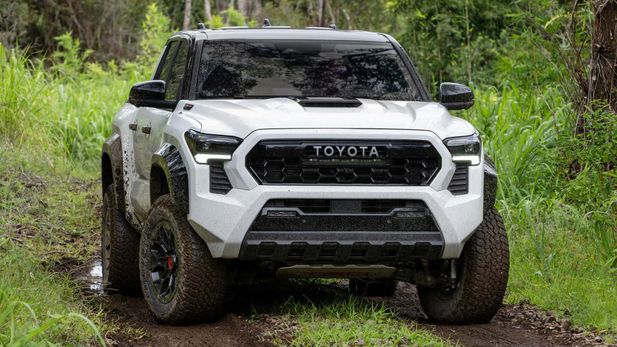
The Hilux and its US cousin – the Tacoma – could become much more alike in future, but how many of the Tacoma’s best bits might we see in the 9th-gen Hilux?
The only Toyota bakkie that has more legacy than the Hilux is the Land Cruiser pick-up. But the Toyota design that offers us the best clue to the 9th-gen Hilux is Toyota’s youngest bakkie nameplate – Tacoma.
Although it remains a tantalisingly left-hand-drive-only bakkie, which precludes it from being offered in the local market, the Tacoma – especially its latest version – has wowed American bakkie followers.
Toyota’s bakkie business is enormously successful. All around the globe. The Hilux dominates the entire South African new-vehicle market and, in the world’s most competitive bakkie market, the United States of America, the Tacoma has been the best-selling “mid-sized” pick-up truck (bakkie) for decades.
Despite its many successes, however, Toyota is under enormous powertrain development pressure to deliver electric vehicles. A consequence of that is building smarter with its available vehicle platforms, and this is where the 2024 Tacoma is a very symbolic vehicle for Toytoa’s bakkie business.
Unlike previous North American Toyota bakkies, the new Tacoma rides on a platform familiar to South Africans: TNGA-F. It’s broadly the same platform that underpins the Land Cruiser 300, and Tacoma is the first Toyota bakkie to offer hybridisation, which is an important clue to the 9th-gen Hilux’s configuration.
Electric… everything!
Electric power steering is ubiquitous in the passenger car segment, but the bakkie market persists with hydraulic assistance. Why? A hydraulic setup facilitates better terrain feedback – and more accurate steering corrections – in sand driving. The new Tacoma’s steering, however, is electrically assisted.
The evolution from hydraulic- to electric power steering might irk some 4×4 traditionalists, but there are clear advantages to the Tacoma having the latter. Beyond the dilution of steering feedback in specific terrain types, the configuration change from hydraulic- to electric steering has allowed Toyota engineers to increase the Tacoma’s front-end chassis rigidity. An additional chassis cross member should give the Tacoma better high-speed lane-changing dynamics and greater resistance to pothole strike damage.
With the Tacoma proving the validity of electric power steering, it’s nearly guaranteed that the 9th-gen Hilux will adopt an electric steering setup too. An underappreciated benefit of electric power steering is the diversity of driver assistance features that it enables, especially at parking speeds. Considering that (increasingly sizeable) bakkies are a nightmare to park in Sandton City or the Cape Town CDB, it would be terrific to have a Hilux with electric power steering, let alone automated parallel parking functionality.
Petrol hybrids or turbodiesels?
Toyota doesn’t sell any turbodiesel-powered bakkies in America, which explains why Tacoma engines have traditionally been of little interest to South African bakkie buyers. But that’s changing rapidly.
The Hilux and its Fortuner adventure-SUV sibling will soon integrate mild hybridity. And although these powertrains are becoming available at a very mature stage in the current Hilux and Fortuner lifecycle, expect hybridisation to feature strongly for the 9th-gen Hilux. And it might not be a turbodiesel motor!
Evaluate the global market for hybrid vehicles; you’ll notice the absence of diesels. Hybrid drivetrains work best with linear engines, such as naturally aspirated petrol powerplants. The least appropriate engine type for any hybrid powertrain is an atmospheric diesel, with turbodiesels being better, but certainly not ideal. That’s why hybrid power units feature petrol-fed internal combustion engines.
The unavailability of turbodiesel hybrids creates an issue for Hilux product planners. Almost all of the current double-cab Hiluxes are turbodiesel-powered, so what will happen in future? Ford’s Ranger gives us a clue. Despite Ranger’s local demand being diesel-biased too, the Raptor has a turbopetrol motor. Expect Toyota to do the same; the 9th-gen Hilux may use the Tacoma’s 2.4-litre turbopetrol hybrid.
Big numbers from the turbocharged 2.4-litre 4-pot
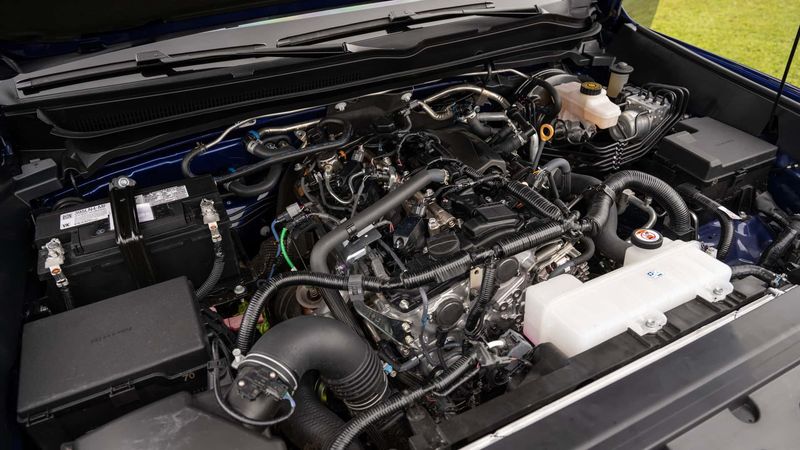
Available in 4 power ratings, the Tacoma’s 2.4-litre 4-cylinder turbopetrol iForce engine is impressive. As a power- and drivetrain, it addresses the Hilux’s powertrain shortcomings: lack of high-speed overtaking power and -gearing. Anyone who has driven a Hilux 2.8 GD-6 equipped with a 6-speed manual knows it has great gearing for off-road driving and dirt-road cruising, but the top gear is a very tall overdrive ratio. When you engage it, you could be forgiven for thinking you’ve accidentally brushed the brake pedal…
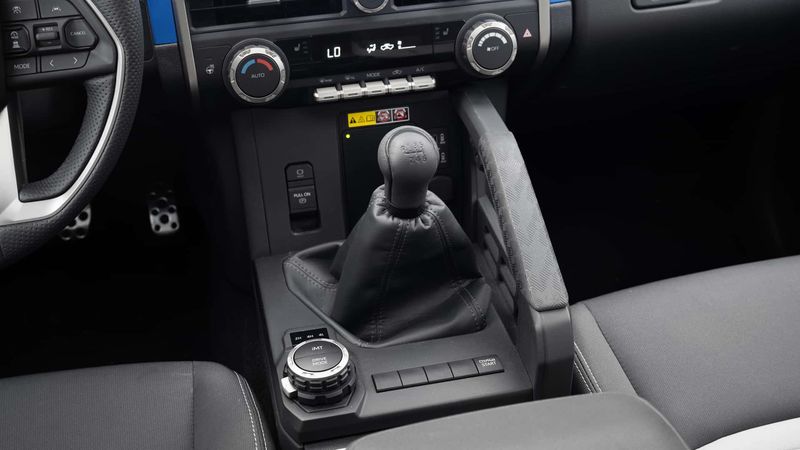
The Tacoma’s 2.4-litre iForce engines offer all the power Hilux owners could desire for highway cruising, plus additional gears. With Ranger and Amarok offering 10-speed automatic transmissions, Hilux would benefit from the Tacoma’s 8-speed set-up, compared with the current slightly limited 6-speed auto box. For Hilux drivers who prefer to self-shift and value the control of a manual ‘box for precision off-roading (especially in sand), the option of a 2.4-litre turbopetrol engine with a 6-speed manual will be enticing.
The 2.4-litre iForce engine is limited to 420 Nm, which is a comparable peak-torque output to a current Hilux 2.8-litre turbodiesel. However, its peak power number is a meaty 200 kW, which should offer dramatically better overtaking acceleration than Toyota SA’s current crop of 4-cylinder turbodiesels.
9th-gen Hilux could have a much better ride quality
Virtually all double-cab bakkies have a ride quality issue. The reason is simple: bakkies feature a suspension configuration to handle their peak load box rating. And when they aren’t laden, they are entirely over-sprung… and ride awfully. With double-cab bakkies having become family cars instead of workhorses, they are never laden to capacity, and their harsh ride qualities are illogical and unnecessary.
The solution is to replace the leaf-sprung rear axle with a multi-link setup. When Nissan did this with its 3rd-gen Navara, it achieved very little market reward, but could Toyota do better with the next Hilux?
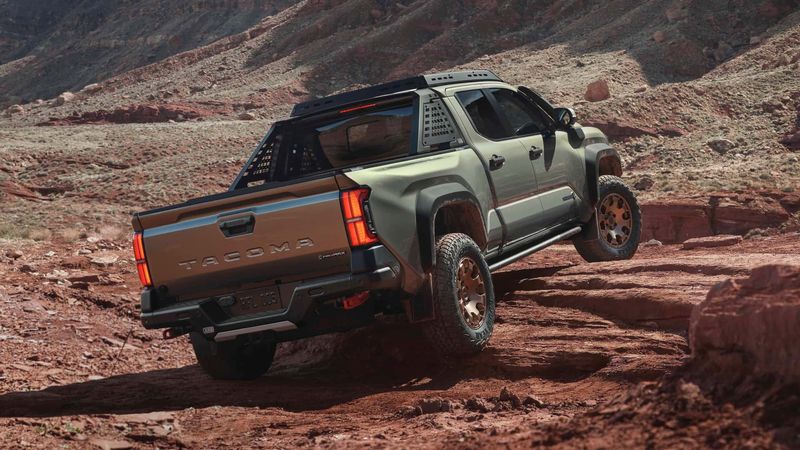
Toyota offers 2 suspension options to support the new Tacoma’s rear axle: underslung leaf springs or a multi-link setup. Ford’s Ranger has proven how a rear suspension configuration change can dramatically improve a double-cab’s ride quality. Anyone who has driven (or been a passenger in) a standard Ranger and Raptor, will attest to the latter’s superior ride quality, admittedly at the cost of reduced loadability.
Still, many upper-echelon Hilux double-cab owners aren’t interested in ever carrying the maximum load capacity of their bakkies and would prefer better ride quality on all road surfaces. A “luxury-spec” Hilux, with Tacoma-type multi-link rear suspension, would be popular among urban double-cab buyers.
Expect a much smarter cabin in 9th-gen Hilux
When the current iteration of the Hilux was launched in 2016, bakkies did not feature large touchscreen infotainment systems – let alone small-item storage spaces and non-slip surfaces. But that’s changed.
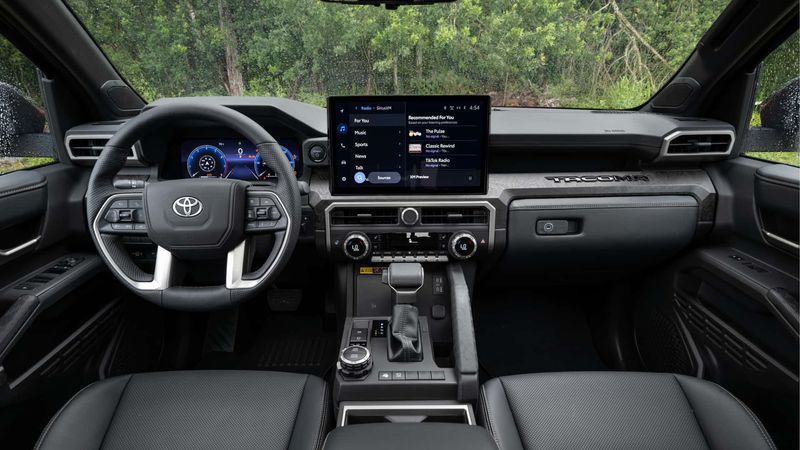
The new Tacoma features a huge (14-inch) optional touchscreen, but retains conventional dials for many functions, including climate control; there are many small item storage spaces – with non-slip surfacing!
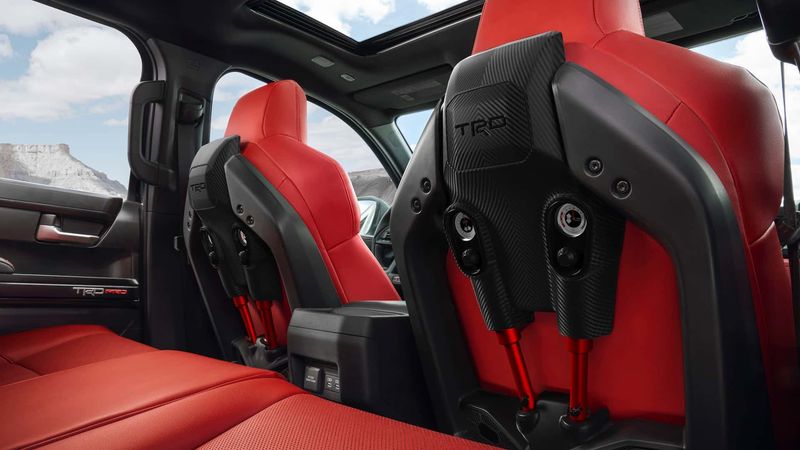
The most impressive things in the Tacoma’s cabin (that may be of interest to Hilux owners) are its seats. The TRD version offers suspension-strut seatbacks to cushion passengers when the bakkie, um, lands.
Not everything available on the new Tacoma will be transplanted to the 9th-gen Hilux, but these two Toyota bakkie platforms are aligning ever closer. And that’s great news for South African bakkie buyers.
Related content:
Has Eskom made new-car emissions tax redundant?
Would you buy a brand-new ‘old’ Toyota bakkie?
Did Mazda give the CX-60 the wrong engine?
Is Isuzu’s 6-cylinder turbodiesel hiding in plain view?
Why you don’t need a double-cab 4×4 with low range
Lance Branquinho

Lance Branquinho is a Namibian-born writer and photographer who has won numerous motoring journalism awards. He once smuggled parts to South America, in a minor contribution to help Giniel de Villiers finish on the podium at the Dakar. He fears for the eventual collapse of the air-cooled Porsche 911 market – and keenly awaits, in vain, the return of the brand's 928.