The rising price of fuel not only eats into disposable income – it pushes up the costs of goods and services. Driving battery-electric cars is a sure-fire way to avoid “the forecourts”, but they’re prohibitively expensive… Fortunately, there are several highly fuel-efficient small-capacity petrol and hybrid cars on the new-vehicle market!
PARTNERED CONTENT
Adopting a frugal driving style can dramatically improve your vehicle’s fuel consumption and, therefore, save you a considerable amount of money, but driving a vehicle that is inherently light on fuel is another way to reduce your monthly fuel bill. For the benefit of motorists who cannot afford to purchase a battery-electric vehicle, motus.cars, supported by Motus Ford (previously Imperial Ford), brings you a list of the 30 most fuel-efficient petrol cars (under R500 000) in the SA new-vehicle market.
Read: “How to stay ahead of fuel price increases”.
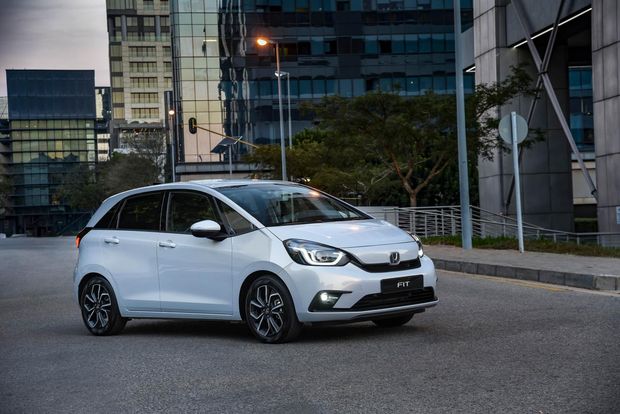
The new Honda Fit (previously Jazz) is cheap to run in petrol or hybrid guise.
Pathways to lower consumption
The motor industry has become obsessed with “efficiency” as it manages its transition from internal-combustion engines (ICE) to all-electric propulsion. However, “efficiency” is not a new concept; manufacturers have been endeavouring to lower fuel consumption ever since governments began instituting emissions standards in the Nineties. As a rule of thumb, smaller vehicles tend to be more fuel-efficient than their larger counterparts because they have comparatively low kerb weights and are fitted with smaller-capacity engines, let alone fewer features (all of which add bulk), as well as narrower tyres. Conversely, the bigger and heavier a car is, the larger its engine and the higher its fuel consumptions tend to be.
There is a case to be made to upgrade to a modern car just because it’s statistically likely to be more fuel-efficient than its immediate predecessors. Modern small cars aren’t just “econoboxes”; they utilise some of the latest engine technology – several of them have small-capacity motors with turbocharging (it enables them to deliver what torque they produce at low revs), but quite a few of them are still naturally aspirated. Non-turbo engines tend to feature on cars that cost less than, or just over, R200 000 (from new) in our list, such as (but not limited to) the Renault Kwid and Triber, 5 of the Suzuki models we’ve listed, Honda Amaze and Ballade, Hyundai Grand i10, Kia Picanto and the Toyota Agya.
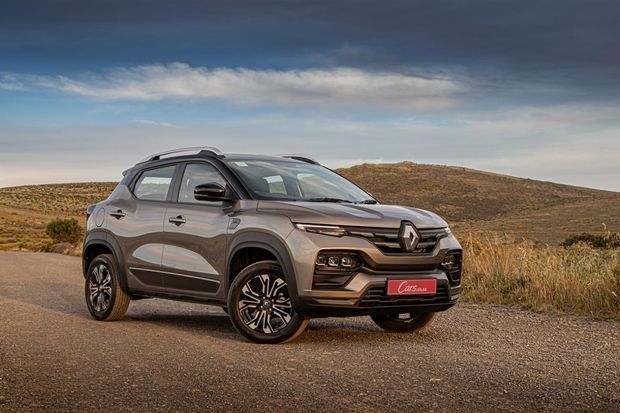
The Renault Kiger (and its Nissan Magnite cousin) utilise small-capacity turbocharged engines.
As for the small-capacity turbocharged engines, they feature on most compact hatchbacks on this Top 30 list, but also on several of the compact family cars, such as the Ford EcoSport, Volkswagen T-Cross, Renault Kiger and Nissan Magnite.
But how do bigger vehicles, such as the Toyota Corolla and Corolla Cross, boast admirably low claimed consumption figures of 3.5- and 4.3 L/100 km? Until recently, the answer would have been: “they’re probably turbodiesels”. But no, whereas diesel engines are likely to remain the powerplants of choice for bakkies and off-roaders, they’ve fallen out of favour for passenger cars because of concern over the particulates they emit (over and above other harmful gases).
Instead, the Toyota Corolla 1.8 Hybrid XS, Toyota Corolla Cross 1.8 Hybrid XS and the Honda Fit Hybrid employ hybrid technology, which combines an internal combustion engine with an electric motor mated with a high-voltage battery, which has a particularly high energy density to facilitate more rapid self-charging. These models rely on electric power for executing pull-aways, creeping along in congested traffic and, if necessary, supplementing the petrol engine’s propulsion.
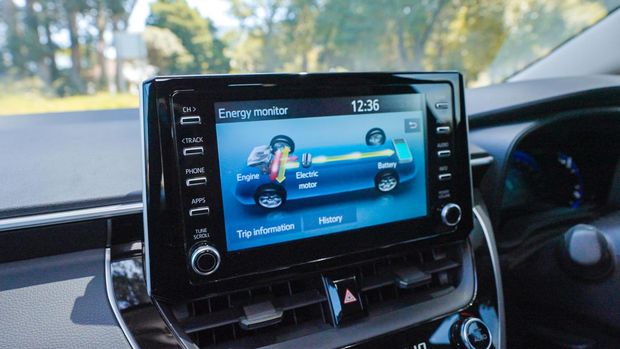
The Eco readout on the Corolla Hybrid’s infotainment screen shows the flow of energy in the power unit.
They’re conventional hybrids (not plug-ins, of which there are quite a few on the market – but they’re far more expensive than R500k), which means their batteries are replenished only by harvesting kinetic energy (regenerative braking). To put it simply, when a hybrid car coasts it uses its own momentum through the drivetrain to spin a generator that generates electricity, which, in turn, feeds into the high-voltage hybrid battery. It’s like free petrol, or, more accurately, free energy.
The recent spate of fuel-price increases has only increased consumer interest in “electrified vehicles”. In many overseas markets, hybrids are the most popular derivatives (in terms of sales) in their respective model ranges and, until recently, Toyota, which has promoted petrol-electric technology since it launched the pioneering Prius two decades ago, has sold as many hybrid versions of the new Toyota Corolla Cross as it has of conventionally powered derivatives…
Seeing as it may take a while before battery-electric vehicles (with no combustion engine element) will become a common sight on South African roads (due to a number of factors), “hybrid” seems to be the efficiency tech in the ascendancy.
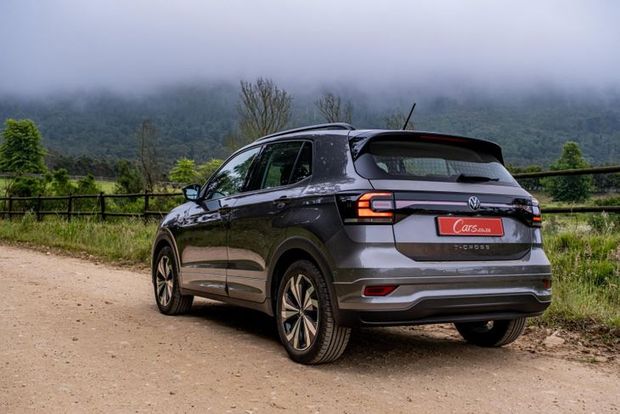
The Volkswagen T-Cross 1.0TSI 70kW Comfortline is the 10th-most efficient petrol car.
Top 30 fuel-efficient petrol cars under R500k
This list was compiled in May 2022. Figures are determined by manufacturers’ claimed fuel consumption figures and, for the sake of brevity, we’ve only listed the most affordable version of each model.
| Toyota Corolla 1.8 Hybrid XS | R439 000 | 3.5 L/100 km |
| Honda Fit Hybrid | R498 600 | 3.7 L/100 km |
| Fiat 500 TwinAir Dolcevita | R286 900 | 3.8 L/100 km |
| Suzuki Celerio 1.0 GL auto | R209 900 | 4.2 L/100 km |
| Toyota Corolla Cross 1.8 Hybrid XS | R425 400 | 4.3 L/100 km |
| Renault Kwid Dynamique Auto | R190 400 | 4.4 L/100 km |
| VW Polo Vivo 1.0TSI GT | R317 400 | 4.6 L/100 km |
| Audi A1 Sportback 30TFSI | R456 900 | 4.8 L/100 km |
| Toyota Agya 1.0 | R192 300 | 4.8 L/100 km |
| VW T-Cross 1.0TSI 70kW Comfortline | R368 900 | 4.8 L/100 km |
| Suzuki Dzire 1.2 GA | R189 900 | 4.9 L/100 km |
| Suzuki Ignis 1.2 GLX auto | R253 900 | 4.9 L/100 km |
| Suzuki S-Presso 1.0 GL | R156 900 | 4.9 L/100 km |
| Suzuki Swift 1.2 GA | R189 900 | 4.9 L/100 km |
| Kia Picanto 1.0 Start | R195 995 | 5.0 L/100 km |
| Renault Kiger 1.0 Turbo Zen | R259 900 | 5.0 L/100 km |
| Nissan Micra 84kW turbo Acenta Plus | R379 900 | 5.0 L/100 km |
| Opel Crossland 1.2 | R329 900 | 5.1 L/100 km |
| Suzuki Baleno 1.4 GL | R227 900 | 5.1 L/100 km |
| Nissan Magnite 1.0 Turbo Acenta | R287 700 | 5.3 L/100 km |
| VW Polo hatch 1.0TSI 70kW | R315 000 | 5.3 L/100 km |
| Ford EcoSport 1.0T Trend | R358 700 | 5.4 L/100 km |
| Hyundai Grand i10 Motion | R204 900 | 5.4 L/100 km |
| Toyota Starlet 1.5 Xi | R226 200 | 5.4 L/100 km |
| Honda Ballade 1.5 Comfort | R365 900 | 5.5 L/100 km |
| Renault Triber | R193 400 | 5.5 L/100 km |
| Suzuki Ciaz 1.5 GL | R251 900 | 5.5 L/100 km |
| Honda Amaze 1.2 Trend | R226 200 | 5.6 L/100 km |
| Mini Cooper Hatch 3-door | R434 209 | 5.6 L/100 km |
| Citroen C3 1.2 Feel | R289 900 | 5.7 L/100 km |
| Fiat Tipo sedan 1.4 | R307 900 | 5.7 L/100 km |
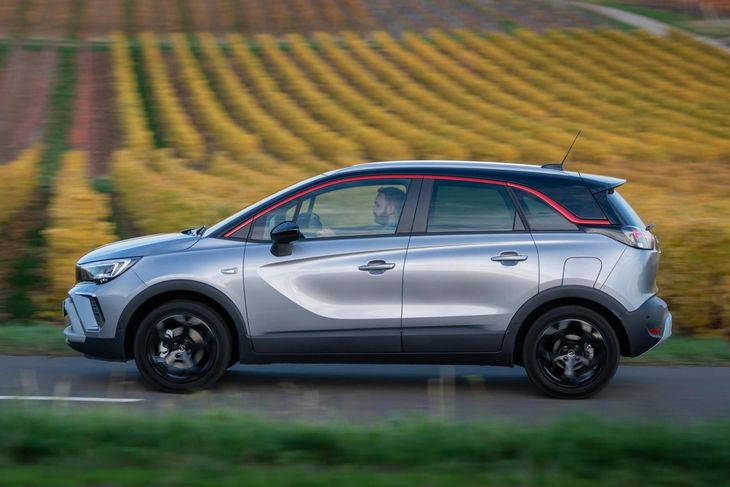
The Opel Crossland 1.2 people-mover has a claimed consumption of only 5.1 L/100 km.
Practical ways to save fuel
Don’t let it idle – Drive off immediately after starting the car in the morning. Do not let it idle for any length of time, especially when the engine is below normal operating temperature. This will reduce the amount of time the engine has to inhale the over-rich fuel mixture required for starting and idling. Such a mixture is wasteful and contaminates the oil to such an extent that prolonged idling can ruin an engine. Go slow at first, to allow the engine, gearbox and final drive to warm up.
Go with the flow – Drive at a reasonable pace in town. Stay with the traffic, because if you slow down too much you will not only be an obstruction but you may also have to change down to a lower gear. A lower gear usually, but not always, means your vehicle will use more fuel.
Easy on the throttle – Accelerate slowly and use the lower gears when you start from a speed below 1 500 rpm to avoid over-stressing the engine. Large throttle openings will obviously increase the fuel flow rate.

If you stick to the speed limit you will avoid incurring fines – and excessive fuel consumption.
Drive (slightly) slower – Reduce your habitual cruising speed by 10 kph. This will result in a measurable drop in fuel consumption because the air resistance increases dramatically with an increase in speed.
Anticipate the traffic – Try to brake as little as possible. Braking converts the car’s momentum into heat energy. When you accelerate again the engine has to supply the lost energy to get the vehicle back up to speed again.
Avoid roof racks and trailers – Carry excess luggage inside the car as much as possible. A roof rack or a trailer increases the air resistance dramatically but an increase in weight only increases the amount of fuel being used by a significant amount while you accelerate, not while you’re cruising.
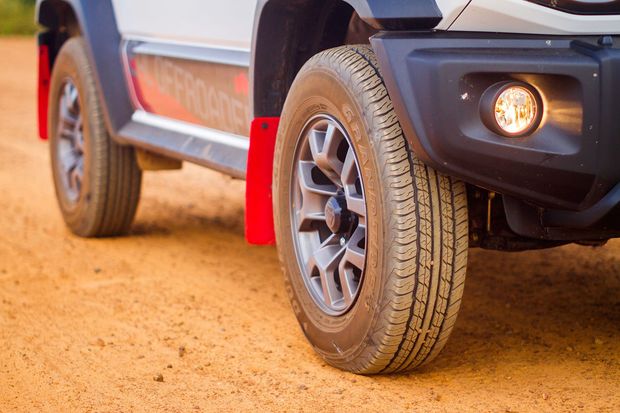
Remember to check your car’s tyre pressures regularly.
Check your tyre pressures every two weeks – Soft tyres not only have a negative effect on fuel consumption but are also a major cause of blowouts.
Look after your car – Have your car serviced regularly to ensure it is in optimal working condition.
Keep score – A record of fuel consumption using the tank-full to tank-full method is a good way to remind yourself about saving fuel. This system works fairly well if you do not let the pump attendant trickle fuel in after the automatic pump was activated. Investigate any unreasonable change in fuel consumption.
Windows shut – Driving with open windows or activating the air-con will increase your fuel consumption by a few per cent but you must be fanatic about reducing consumption to drive like that.

Visit motus.cars for more info, tips and, if you’re thinking of selling your car (or trading it in on a new one), let motus.cars provide you with a vehicle evaluation. You can also join the conversation on Facebook and YouTube.
Related content:
5 tips for first-time car buyers
About to take a test drive? 8 things to check
5 things your mechanic wishes you knew
Service- and Maintenance Plans: The differences
Looking to trade in your car? What you need to know