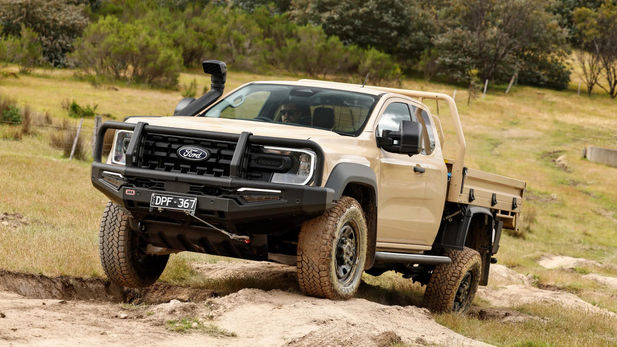
Everyone knows about the Ranger-versus-Hilux battle. But there is a much bigger bakkie comparison loading (bigger in more ways than one, in fact)… Cue the upcoming Ford Ranger Super Duty taking on Toyota’s Land Cruiser 79.
Local demand for luxury and high-performance bakkies keeps on growing. South Africans love bakkies. Many double-cab owners are people who would have bought a German luxury sedan or a high-performance hatchback a decade ago.
That market shift has meant that whatever bakkie product planning teams imagine usually gets approved. The result? An amazing diversity of bakkie models.
In the late 2000s, nobody could have imagined something like a Ranger Raptor, a Hilux GR-S or Chinese double-cab bakkies with more luxury features than a C-Class.
Of course, there are those buyers who still need a hardcore commercial bakkie. Their choice will soon become a lot harder when Ford launches the Ranger Super Duty. But first, let’s spotlight the original (and most revered) working bakkie.
All those farmers can’t be wrong
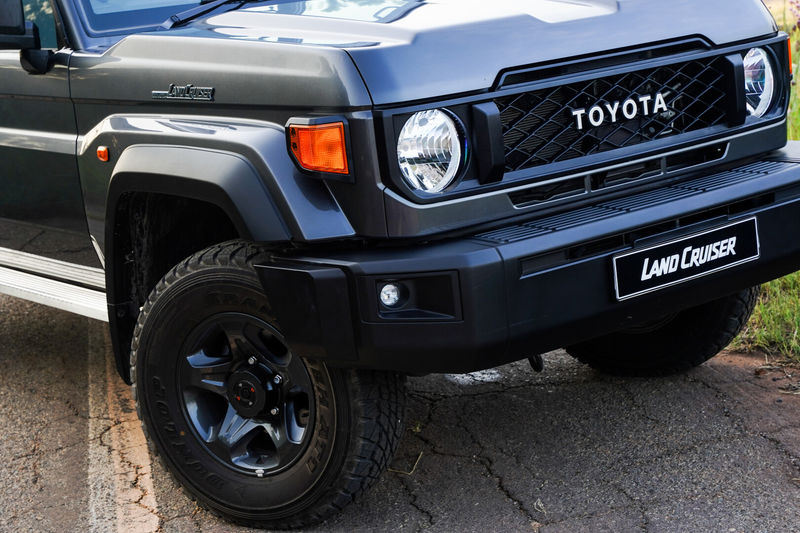
There’s a blindspot in the bakkie development story – many of the newer luxury and high-performance double cabs sacrifice payload for comfort and stability. It’s a worthwhile sacrifice for double-cab owners who live in urban security estates to make, as they never really tax their bakkies’ load capacity. But it’s a problem for hardcore commercial bakkie buyers.
If your bakkie is engineered to carry more than 1 000 kg on the back, the worse its ride quality and handling will be. That’s why a Ranger Raptor, with some of the most sophisticated suspension ever fitted to a bakkie and amazing all-terrain handling dynamics, has a payload of just 670 kg… When engineers reduce the load capacity of a double-cab bakkie, they can enhance its ride quality by making the suspension more supple.
Somewhat ironically, bakkies with the best load-carrying ability and durability are often the least comfortable to drive. The Toyota Land Cruiser 79 single- and double-cab bakkies have asymmetric front-to-rear axle widths, truly terrible ride quality, poor brakes, and generally awful on-road handling. But the aged design is also robust, with an overbuilt steel ladder frame platform that can handle heavy loads.
If you’re a farmer who doesn’t want to do two journeys to town to get agri-chemicals or feed, you really value payload. And that’s why the Land Cruiser 79 bakkie is so popular among South African farmers: it has a higher functional payload than almost any other bakkie on sale. (Not to mention its popularity is also thanks to its renowned reliability and Toyota’s famed aftersales service.)
Search for a Land Cruiser 79 on Cars.co.za
Ford will target the Land Cruiser 79 market with the Ranger Super Duty
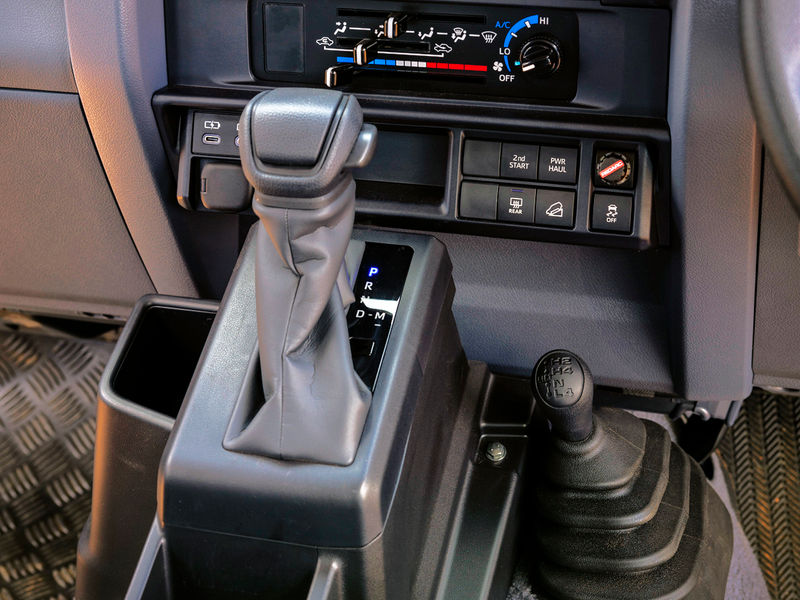
Ford knows that Toyota’s Land Cruiser 79 has the valuable farm and mining bakkie market nearly all to itself. But, if you look at the 79 series’, ahem, robust pricing, it’s a market ready for creative disruption. If farmers and mining companies are willing to pay R1m-plus for 1990s bakkie technology, surely there’s scope for a more modern, yet equally capable, newcomer to disrupt the market?
With the Ranger Super Duty, Ford believes it’s created just that bakkie.
Search for a Land Cruiser 79 on Cars.co.za
Do farmers want comfort? Yes, they do
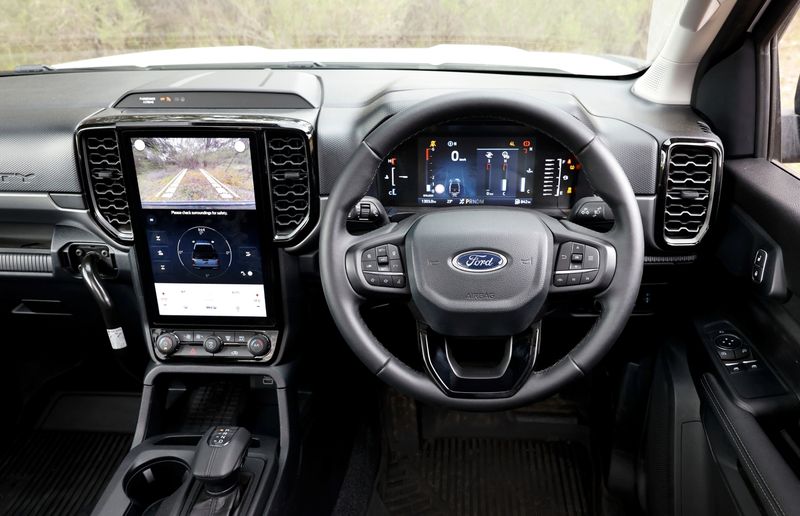
The Ranger Super Duty is an upgrade of the current Ranger T6.1 underpinnings, which is one of the most modern and comfortable bakkie platforms in production.
That means the Super Duty has a modern cabin with comfortable seating, proper ergonomics, sound deadening and vibration damping. Those comfort features make a huge difference when journeying long distances on demanding dirt roads.
The Land Cruiser 79 is a tough vehicle, and for expedition overlanding beyond South Africa’s borders, its simple mechanics and proven toughness serve a purpose. But it’s fatiguing vehicle to drive on both gravel and tar for more than an hour or 2, especially if you use it for work purposes day in and day out.
That’s where the Super Duty is vastly superior to the Land Cruiser 79.
Super Duty by name … and purpose
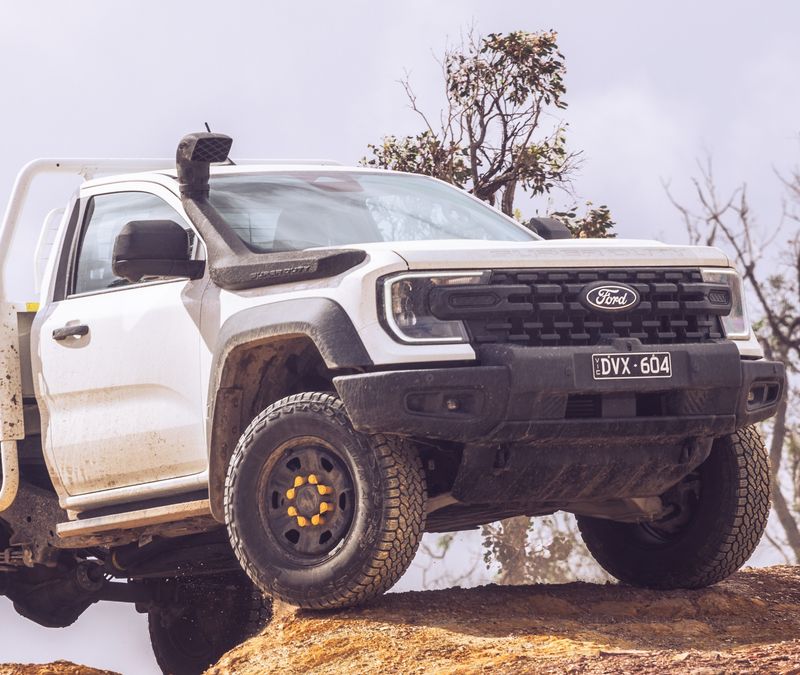
No brand has ever successfully challenged the 79. Nissan tried with the Patrol bakkie, but it was very niche in South Africa. With the Super Duty, Ford has invested in upgrading the features that really matter, creating a Land Cruiser 79 rival that is superior in nearly every technical benchmark.
The Super Duty chassis is much stronger than the Land Cruiser 79’s. Everything that matters has been upgraded to commercial-vehicle spec, like the wheels.
For hardcore 4×4 driving and work vehicles, steel wheels matter. When you’re operating a bakkie at peak load on corrugated dirt roads, or driving into town on a rural tar road with potholes, a fully loaded bakkie hitting a pothole can easily suffer a damaged alloy wheel.
Some models in the Land Cruiser 79 range have steel wheels, as does the Super Duty. But the Super Duty features an 8-stud hub. If you’ve ever glanced sideways in traffic when an 18-wheeler truck rig is next to you, you’ll notice how many bolts secure a wheel. More bolts mean better load distribution (most bakkies feature 6 studs).
It’s clear the Super Duty has been engineered to carry its maximum payload with confidence, even on the harshest South African corrugated dirt roads.
There’s no arguing with the numbers
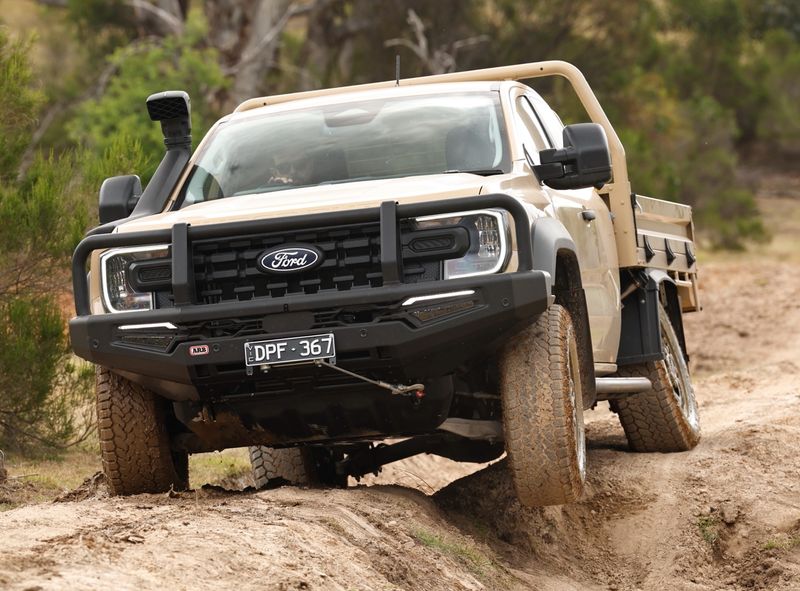
If you need a bakkie to (legally) carry a lot of stuff and tow oversized trailers, the Super Duty is significantly superior to the Land Cruiser 79.
The single-cab Land Cruiser 79 is available with three engine options, and because all three engines weigh differently, it has slight differences in payload capacity. The Land Cruiser 79 with the best payload capacity is the 4.0 V6 petrol, which is rated at 1 185 kg. Ford’s Ranger Super Duty single cab has a payload rating of 1 982 kg!
There’s a lot of discussion in the local motoring market about payload at the moment. The popularity of crossover SUVs has lulled buyers into a false sense of security about how much they can actually take on a road trip.
For farmers and commercial bakkie buyers, payload matters. When you need to take equipment into isolated, hard-to-reach places where only a hardcore 4×4 bakkie can operate, you don’t want to make 2 journeys when a single will do. With the Ranger Super Duty, Ford has created a solution that’s literally twice as good as the established market leader at moving what’s needed to places where it’s difficult to get to.
Search for a Ford bakkie on Cars.co.za
Towing ability: Super Duty versus Land Cruiser
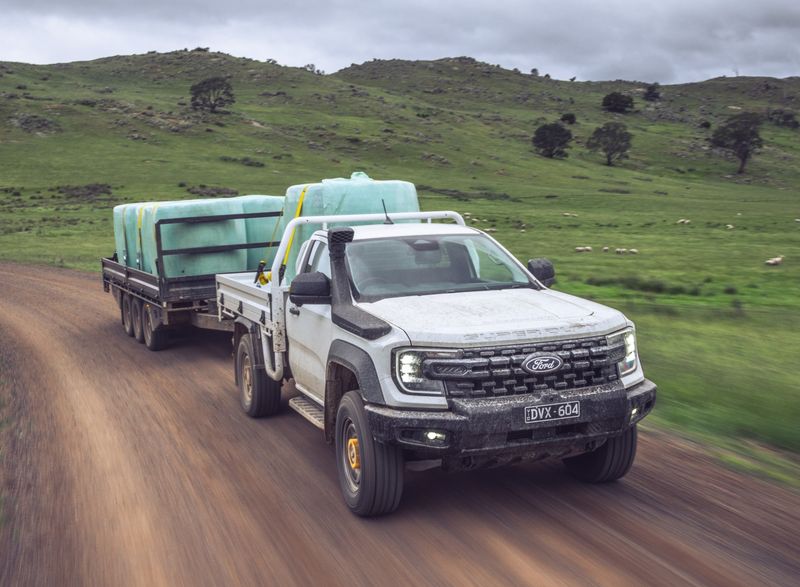
Towing is another area where the Land Cruiser 79 single cab has earned its keep among the farming community. It has a braked towing capacity of 3 500 kg, which is impressive. However, that figure is soundly trumped by the Super Duty’s gargantuan 4 500 kg…
The Ford also has trailer sway control (TSC) programmed into its ESP system. This is a huge help if your heavy trailer starts yawing in a crosswind or rolls over highway surface imperfections at speed while going downhill. The Land Cruiser 79? Don’t expect TSC, or even stability control on some derivatives.
Surely the Super Duty isn’t perfect?
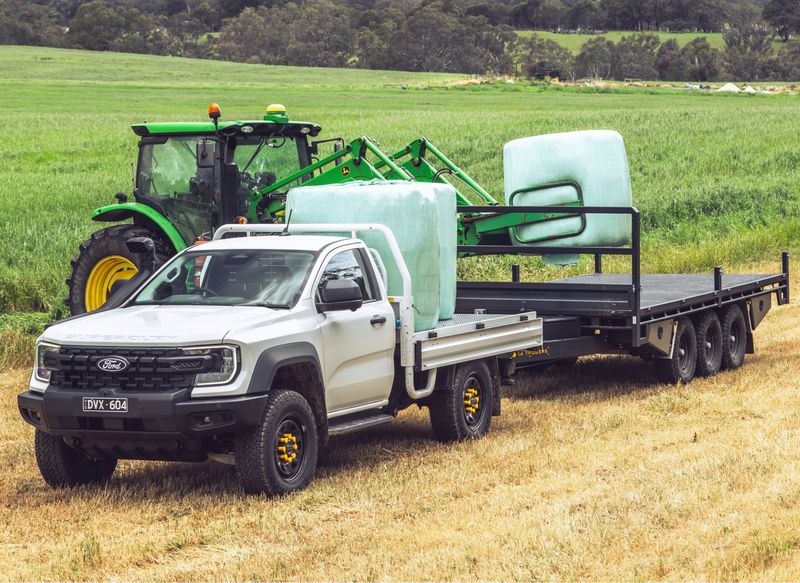
Ford’s engineers have over-developed the Super Duty’s chassis, suspension and wheel hubs. There’s no arguing how well it is configured to carry more load than a Land Cruiser 79. But, when a vehicle has a total CGM of 8 000 kg, strong engine outputs become a crucial requirement.
There’s just no getting over the power-to-weight reality of carrying and hauling all that mass. The Super Duty is powered by a detuned version of Ford’s 3.0 V6 turbodiesel. It’s a proven engine, but 154 kW divided by 8 000 kg equals a power-to-weight ratio of just 19.25 kW/ton. That’s half of what you’d have in a Hyundai i10. And that means you really need to think about maintaining momentum on long, steepening gradients when driving a Ford Super Duty that is fully loaded (the 600 Nm of torque will help, however).
There are also a couple of operational issues with the Super Duty. Because of its amazing load capacities, you can’t drive one with a standard driver’s licence. That might not be an issue for Ford’s South African target market, which is mostly farmers, because most farmers have licences to operate trucks, too.
What might be less appealing for farmers is that the Ranger Super Duty’s diesel engine needs AdBlue. That’s an additional top-up and maintenance admin that some farmers might just find annoying.
Ultimately, however, having to top up an AdBlue tank every now and then seems like a paltry consideration when so much counts in the Super Duty’s favour. We can’t wait to see how commercial buyers and farmers respond to Ford’s answer to the venerable Land Cruiser 79.