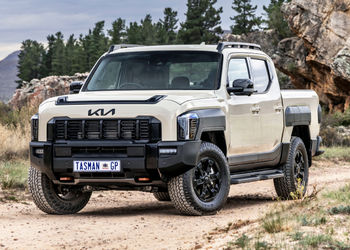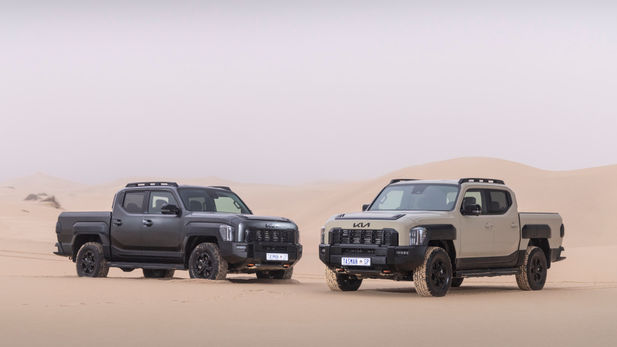
Too many people are talking about what the new Kia bakkie looks like. But it’s the Tasman’s technical spec that really matters, especially its 4-cylinder diesel engine and clever AWD system…
Bakkie buyers might desire V8-powered Land Cruiser 79s and V6 Rangers but the truth is the 4-cylinder turbodiesel engine is what drives most double cab bakkies in South Africa. And that market just got a lot more interesting with the entry of a niche player – the Tasman.
When you think of large double cab bakkies, you never think of Kia. It’s ironic because Kia has had a bakkie model in its product range for a long time: the K2700. It might technically be a compact flatbed truck but if you look in our listings, you’ll discover that it’s officially called a pick-up and you can drive one with a standard licence.
Kia has significant brand equity in South Africa, especially for design. Since the late 2000s, it’s marketed some of the most strikingly penned vehicles available in South Africa under R1m. Design is everything for Kia. With the Tasman double cab, however, it’s gone beyond bold.
The local double cab bakkie market is very profitable, but it’s also hugely competitive. Kia knows the risks. It has seen Mazda retire the BT-50 from South Africa after decades of bakkie success. Kia knows the Tasman has a daring design and will be a niche bakkie. That could be an issue, because the only niche bakkies that work are those with extreme off-road ability, like a Jeep Gladiator.
Forget about the Tasman’s looks
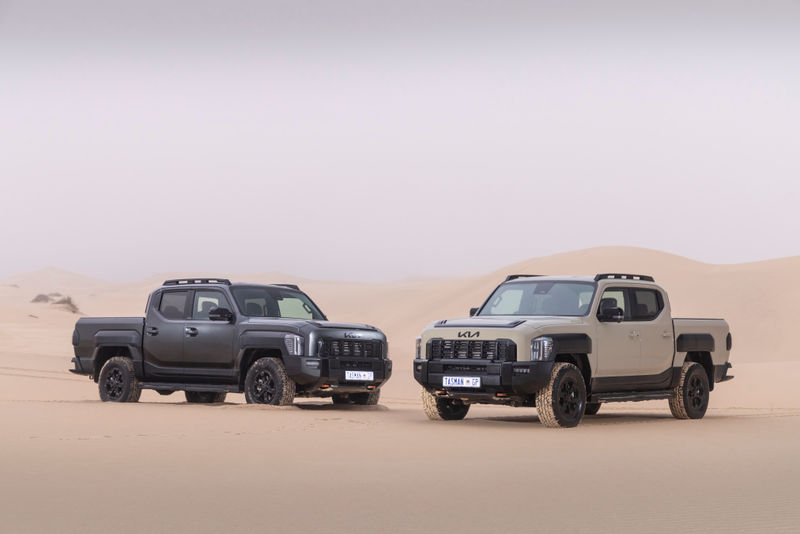
There are more opinions about the Tasman’s design than there are unplayed songs in your gigabytes of playlists. But Kias are always supposed to look different.
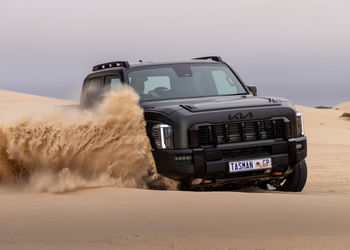
We’ve touched on the issue before but this Korean double-cab bakkie is designed for real all-terrain driving. It’s not a Chinese lifestyle bakkie with all the infotainment kit and cabin luxury; it offers exploration-grade off-road ability.
Australian and South African are twin global bakkie markets. The same terrain, heat and driving behaviours mean that what works for one country works for the other. And that’s important because Kia effectively allowed its Australian office to develop the Tasman.
What the Australian engineering influence means is for all the comments about its design, there’s deep bakkie thinking behind it all, influenced by the world’s highest-volume Land Cruiser 70 Series market. And that is a detail not many people realise but one which his very obvious when you look at the specification and ability of the Tasman Pro 4×4 version.
The headlamps are strange, but they have a much smaller surface area than conventional bakkie headlamps. Why? Well, stone chips… Anyone regularly driving through urban roadworks or on a rural dirt road knows that following or approaching vehicles have a miraculous ability to project stones directly into your headlamps.
Because the Tasman’s headlamps aren’t positioned at the leading edges of its front structure and are smaller in surface area, the risk of stone chip damage is dramatically reduced. Yes, it looks weird. But it has real-world benefits.
It’s all about the Tasman engine
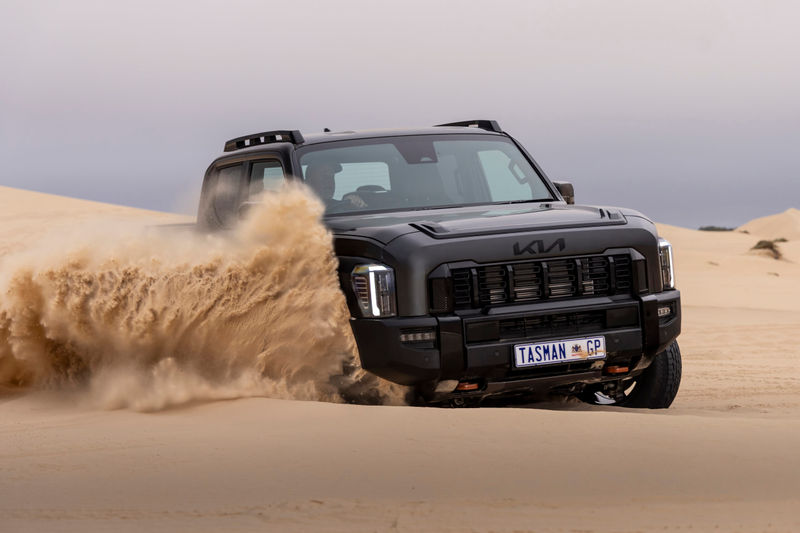
Design doesn’t really influence bakkie sales, however… The Ranger is arguably a better-looking bakkie than the Hilux but that hasn’t eroded Toyota’s dominance.
What South African bakkie buyers really value is powertrain ability, specifically 4-cylinder turbodiesels. The Hilux has remained South Africa’s dominant bakkie without a V6 turbodiesel engine.
The Tasman has a very good 4-cylinder turbodiesel engine. It’s proven itself in the Carnival and Sorento. It also expertly balances the need for performance, economy and smoothness. The demands on double-cab bakkie engines have changed significantly as they’ve become the family vehicle of choice for lots of middle-class South Africans.
Most double-cab bakkies spend a lot of time in an urban commute crawling in traffic, and that means that transmission shift quality and engine smoothness matter a lot more than they did in the early 2000s. Back then, bakkie buyers were mostly adventure 4×4 enthusiasts or commercial customers who had a much higher tolerance for diesel engine noise and vibration, or the lack of automatic transmissions.
The Tasman’s engine might be under-appreciated because it’s not a high-power V6 turbodiesel. When you analyse the numbers, however, this could be nearly the ideal double cab bakkie engine for South African buyers.
Buy a new or used double cab bakkie on Cars.co.za
Is this then the 4-cylinder to have?
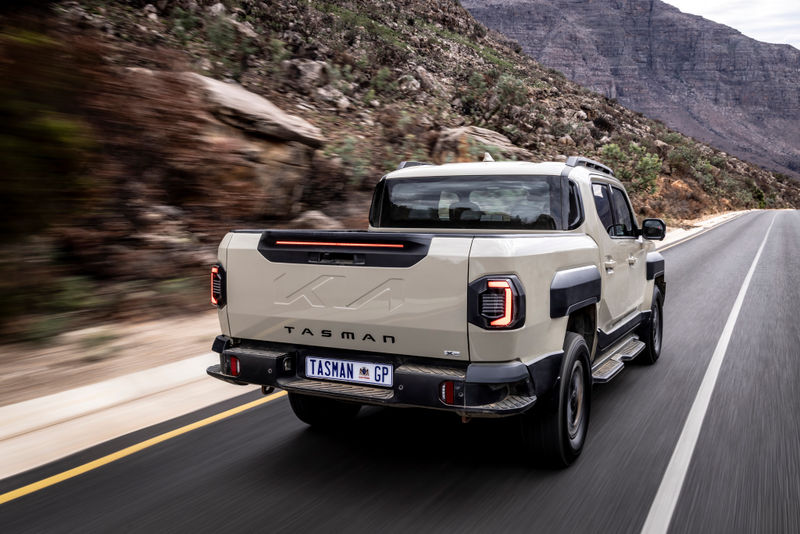
Kia invested a lot of money developing the original 2.2 CRDi engine architecture. It had big plans for this engine knowing it could power everything from SUVs to MPVs and eventually double-cab bakkies.
Rated at 154 kW, the Tasman’s turbodiesel engine is a contender for the best 4-cylinder in South Africa’s double-cab segment. Because it’s also used in the premium-placed Sorento and Carnival, it is engineered to be smooth.
Do a spec comparison with other 4-cylinder diesel engines in the double cab segment and the Tasman mostly makes a lot more power. Ford’s reconfigured Ranger 2.0 SiT engines produce only 125 kW. Even Isuzu’s 3.0-litre turbodiesel, despite being much larger in capacity than the Tasman engine, makes just 140 kWless power, at 140 kW.
The carry-over Hilux 2.8-litre turbodiesel engines have the potential to make 165 kW, more than the Tasman’s, but these aren’t the smoothest or quietest double cab powertrains. And the standard Hilux 2.8 still has a 150 kW engine.
The Tasman gives you AWD when you need it
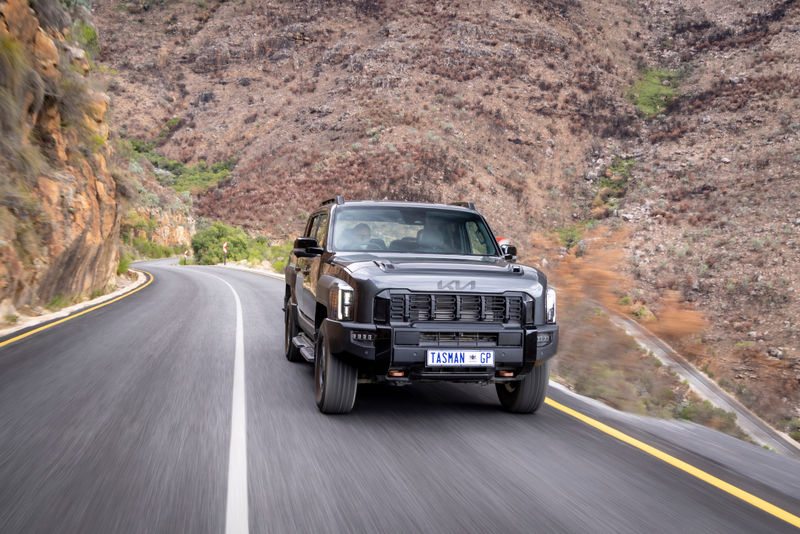
Then there is the Tasman’s drivetrain advantage. Unlike the Hilux and D-Max, the Kia double cab can operate in all-wheel drive on tar roads. “So what?” Using the Tasman’s 4A setting is a big advantage. It’s especially beneficial when you are towing a heavy trailer or caravan up a steep mountain pass, in pouring rain, and need to keep traction through a tight, off-camber corner.
For high-speed dirt-road driving, the Tasman’s drivetrain is much better than the ageing Hilux and D-Max’s. The Isuzu and Toyota bakkies allow only a 50/50 transfer case lock-up in 4H, which can create a lot of understeer when you try to go around a high-speed dirt-road corner in 4H.
The Tasman’s 4A system, meanwhile, varies the torque between the front and rear axles. This gives you much better steering input and responses when driving at high speeds on loose dirt road surfaces. Especially so when you need to round corners.
With the Hilux or D-Max, you just don’t have true all-wheel drive or the security of traction and steering authority around long corners and on dirt roads. The Tasman, however, gives you that confidence. And that’s a massive feather in its cap.
Buy a new or used double cab bakkie on Cars.co.za