
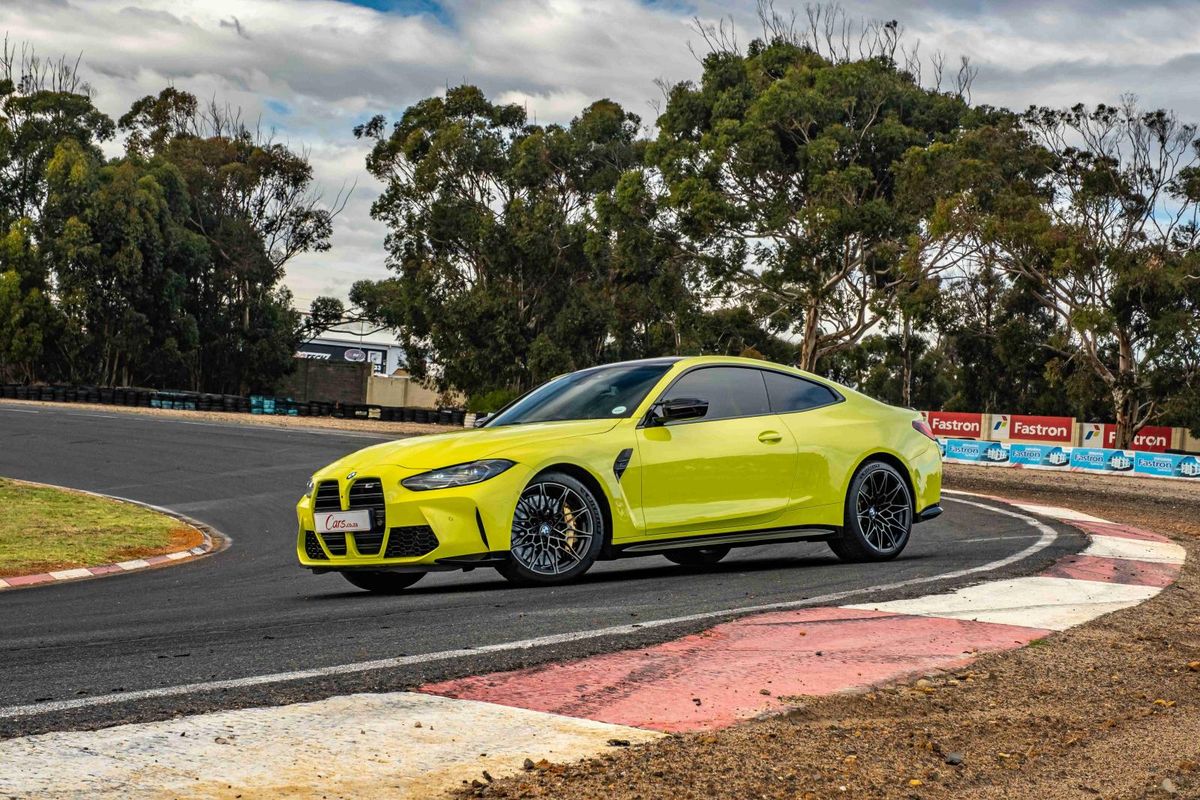
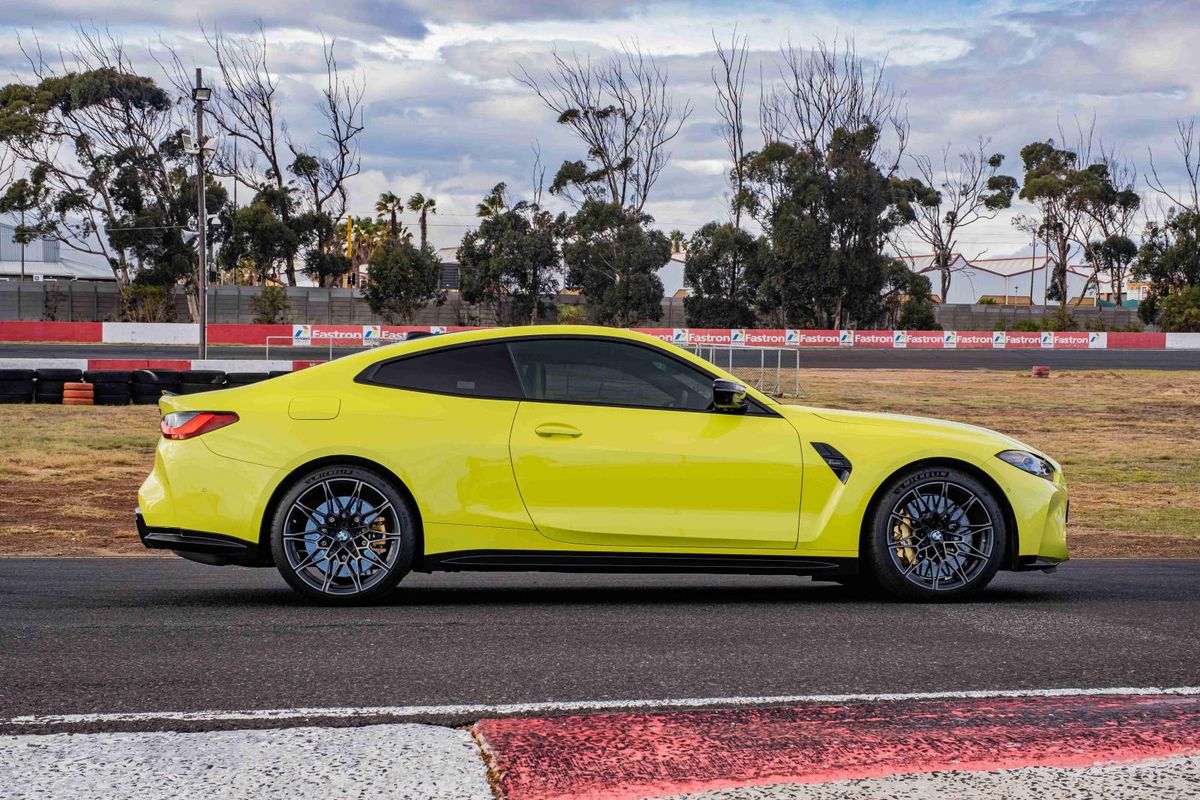
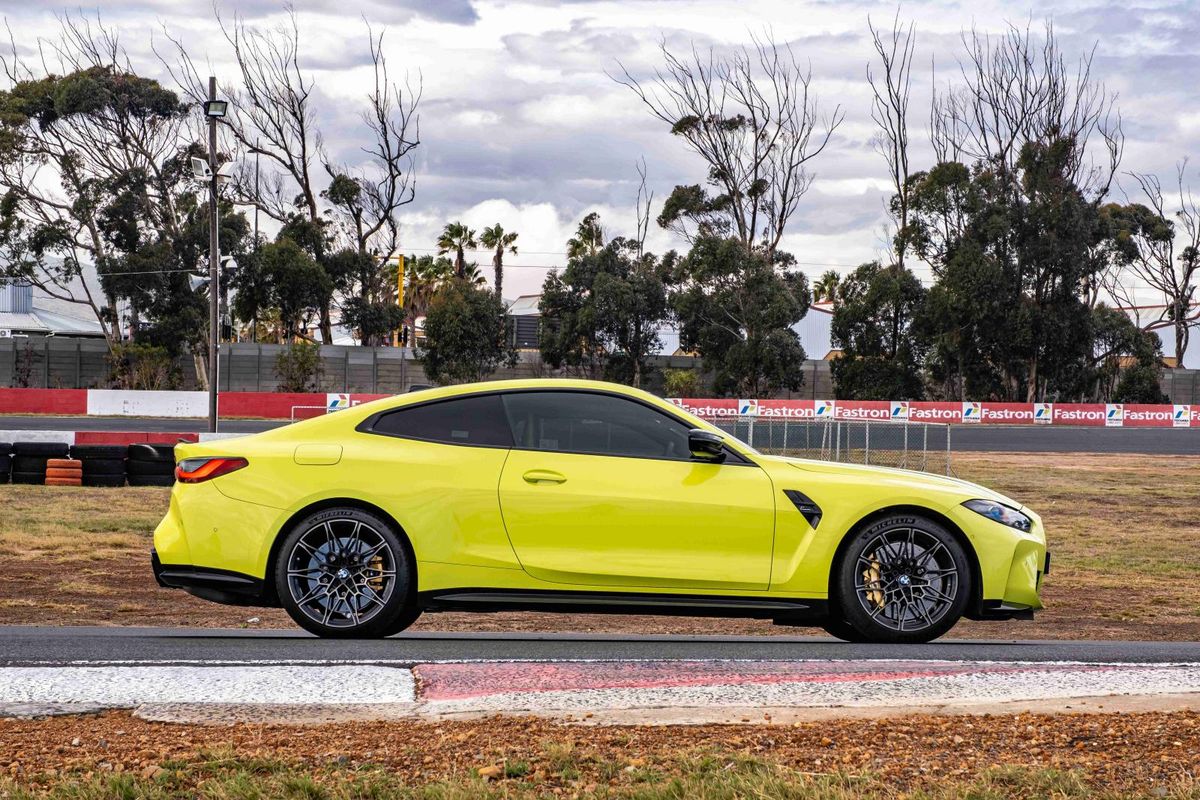
The BMW M4 Competition is endowed with head-turning looks and its twin-turbo inline 6-cylinder engine produces suitably succulent power outputs. The newcomer can certainly achieve no-less-than-astonishing velocities, but is it still a visceral driver’s car and does its overall package add up to a worthwhile purchasing proposition? We recently put the M4 Competition to the test to find out if BMW’s M Division has created its sharpest performance coupe yet…
Just how good is the 2021 BMW M4 Competition? This review will cover key aspects of the M4 to help you make an informed buying decision.
We Like: Engine performance, dynamic handling ability, day-to-day useability, kerb appeal
We Don’t Like: Not cheap, but what new car is?
Fast Facts
- Model Tested: BMW M4 Competition
- Price: R1 959 182 before options (May 2021)
- Engine: 3.0-litre, 6-cylinder, twin-turbocharged petrol engine
- Power/Torque: 375 kW @ 6 250 rpm / 650 Nm @ 2 750–5 500 rpm
- Transmission: 8-speed automatic
- Fuel consumption: 10.2 L/100km (claimed)
- 0-100 kph: 3.9 seconds (claimed)
- Top speed: 250 kph (limited)
Serious about buying?
BMW dealerships regularly offer great deals on new cars. See New Car Specials here!
How good does the new BMW M4 look?
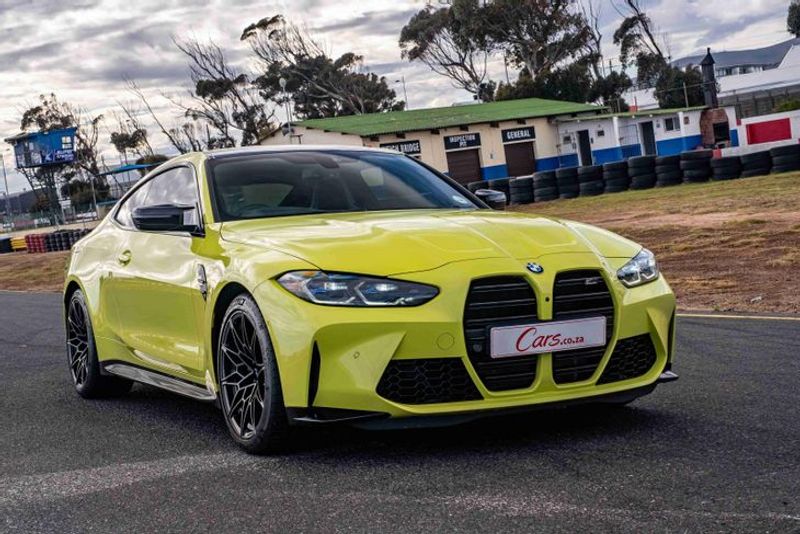
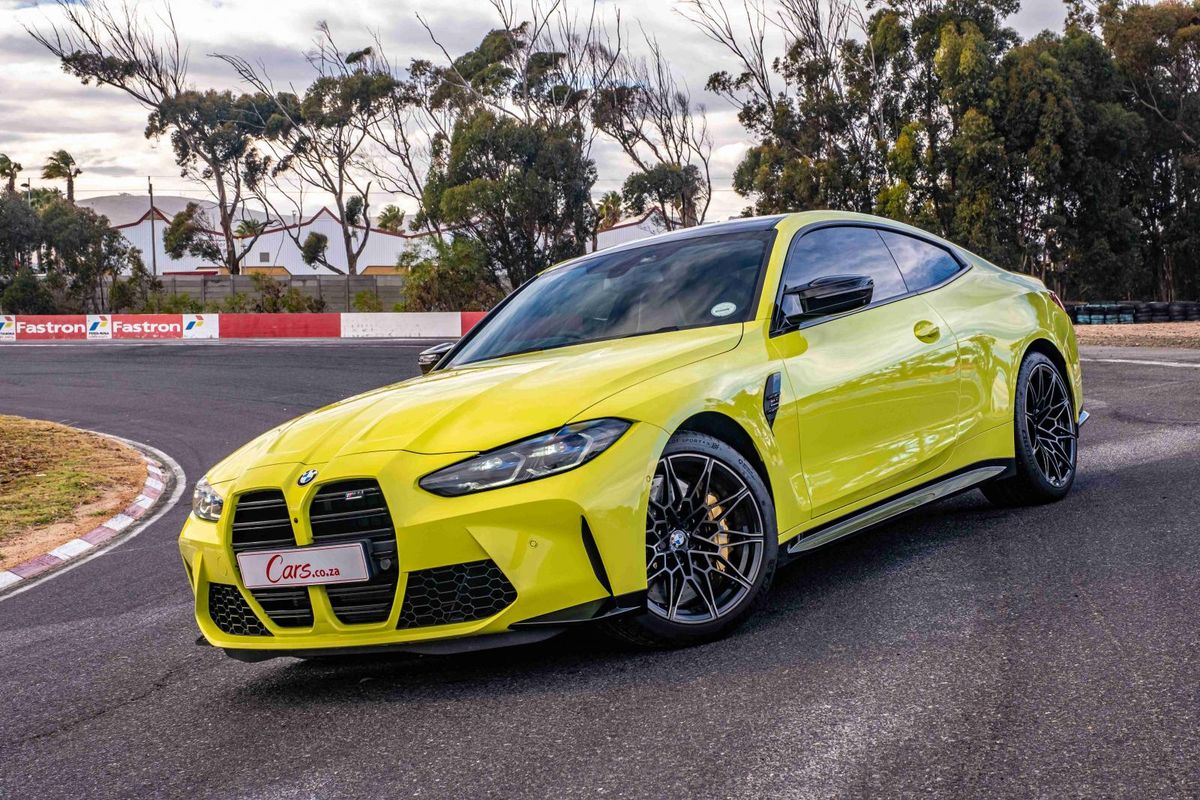
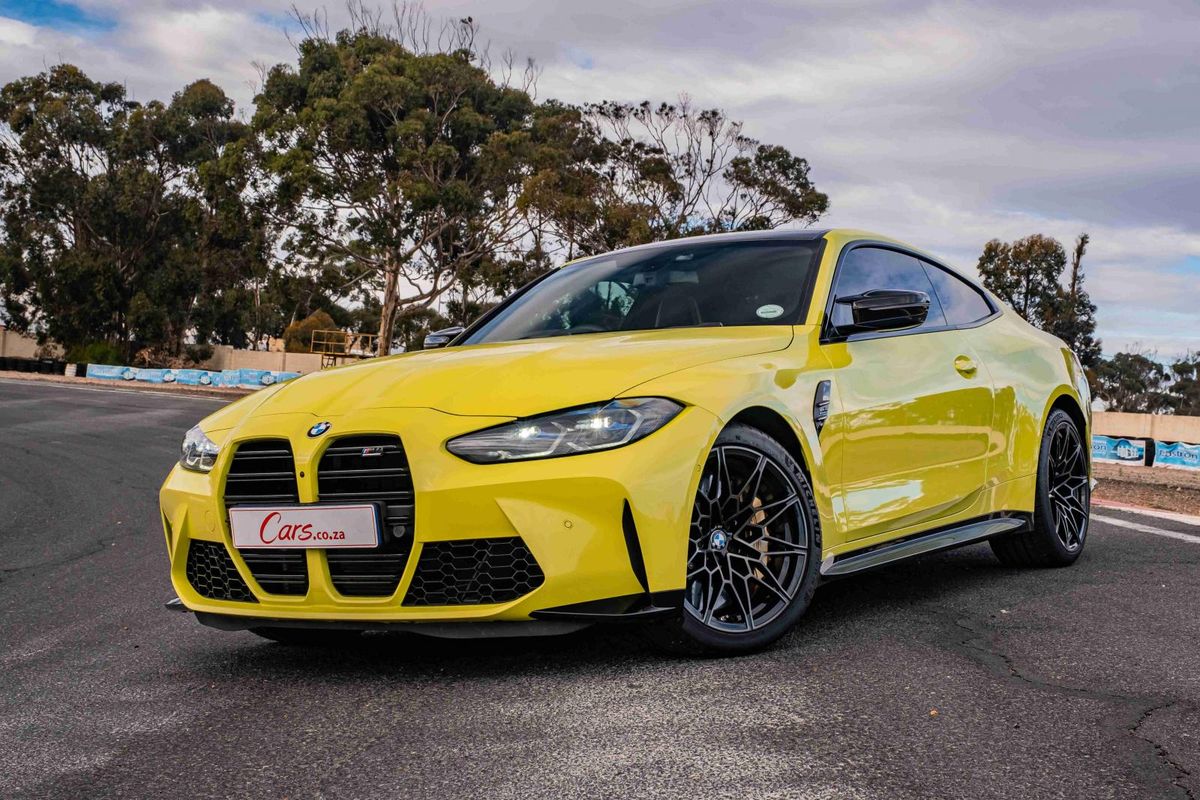
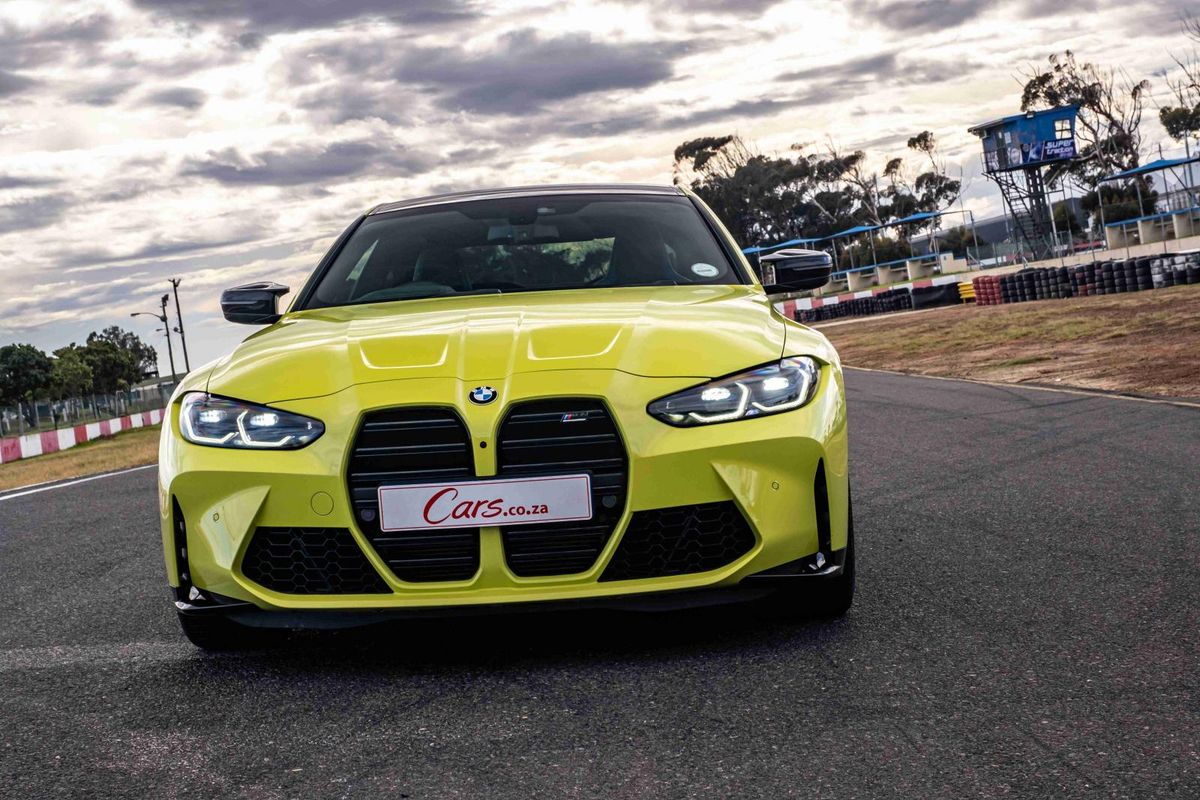
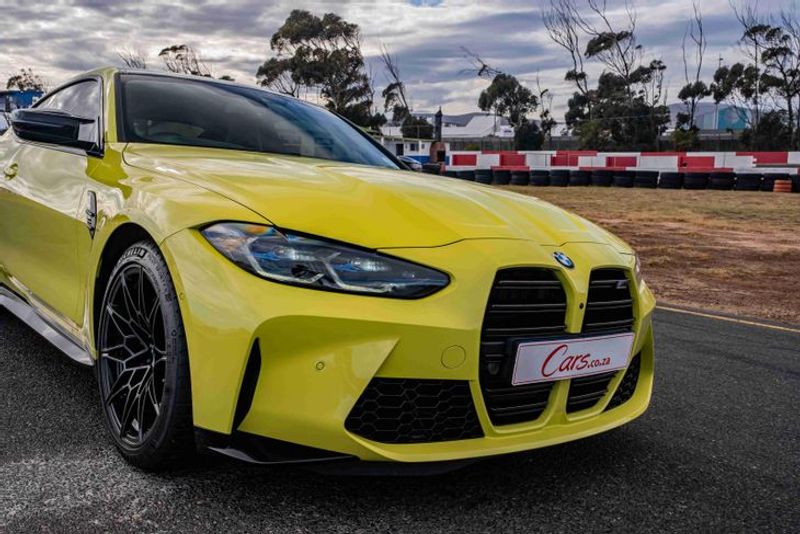
BMW’s new oversize kidney grille still divides opinion, but there’s no denying that the M4 Competition has mega kerb appeal.
The G82 BMW M4 Competition Coupe and its G80 M3 Competition sedan sibling arrived in South Africa earlier this year and while much has been said and written about the pair’s new oversized (and tall) kidney grilles, we were understandably excited to get to grips with the new M4 Competition when it recently joined our test fleet. BMW’s dynamic duo are historically regarded the best driver’s cars that the Munich-based firm’s M Division has ever produced, barring, arguably, the outgoing BMW M2 and more hardcore M2 CS. Naturally then, the new-generation M3 and M4 have big performance shoes to fill.
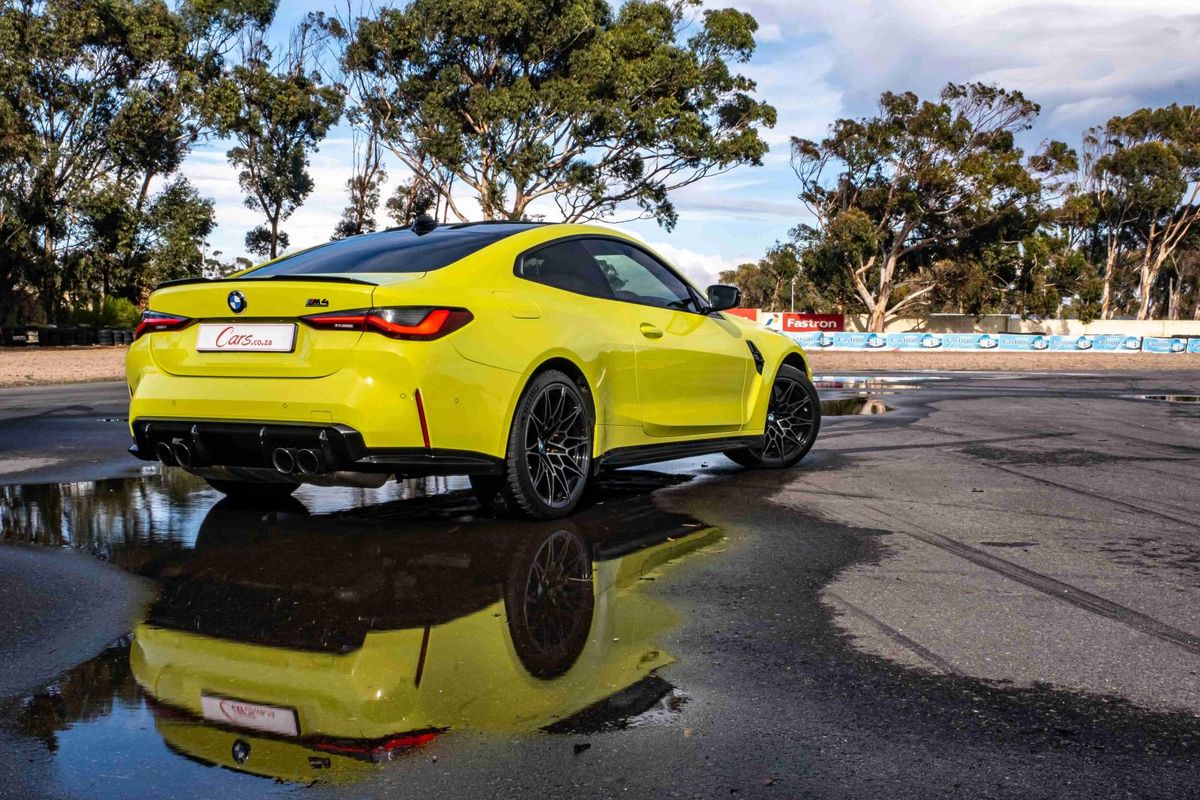
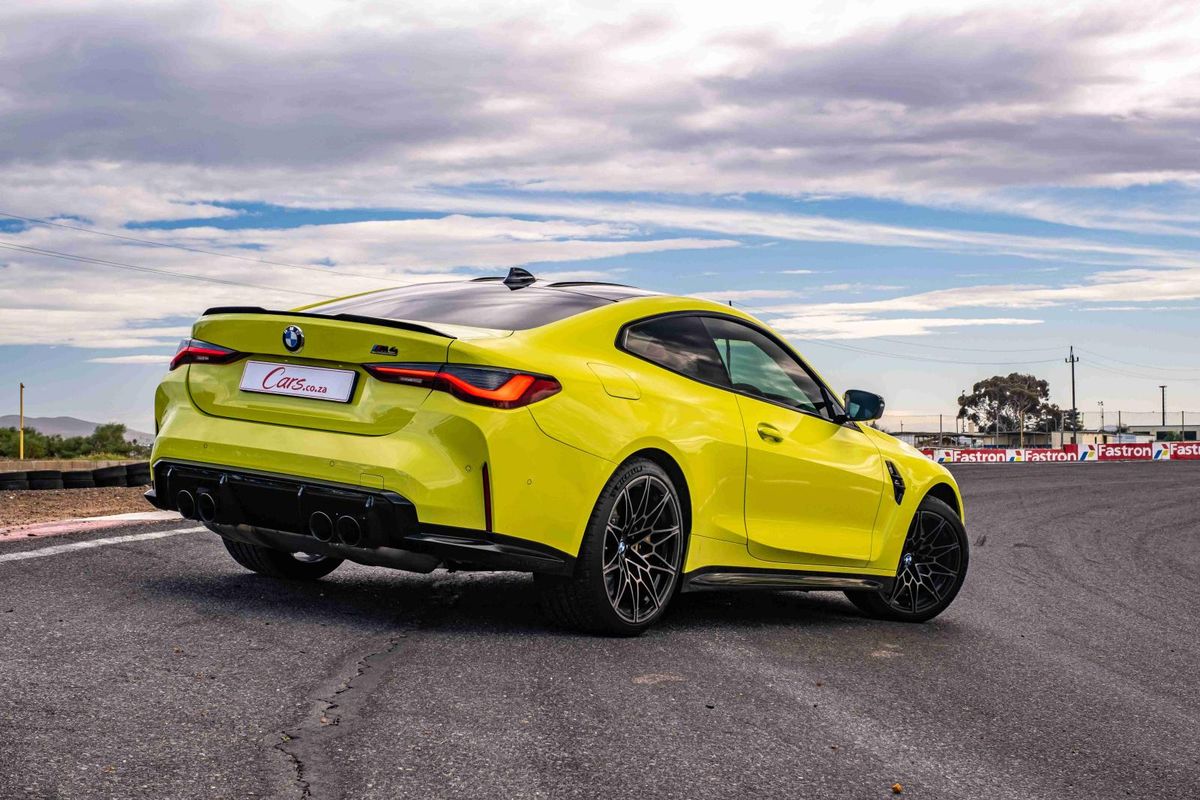
If that grille design bothers you, get over it! There’s nothing subtle about this car and if you love drawing (and getting) attention then you will love the M4 Competition! A variety of exterior hues are on offer, but this bright and bold Sao Paulo Yellow paint job generates almost as much public attention as those large “nostrils” emblazoned on the front of the car. We think the M4’s grille looks brash and purposeful in the metal, especially in conjunction with the model’s sculpted, muscular bonnet and slim LaserLight LED headlights. In fact, from all angles, the new M4 Competition screams performance!
All-wheel-drive M xDrive versions of the M3 and M4 have been revealed and will arrive on the local market later this year, but this M4 Competition promises delectable rear-wheel-drive thrills and notable handling performance. Just how good is the new M4 Competition and does the overall package justify its near R2-million price tag? Let’s take a closer look at what the new M4 Competition has to offer…
What’s the interior of the M4 Competition like?
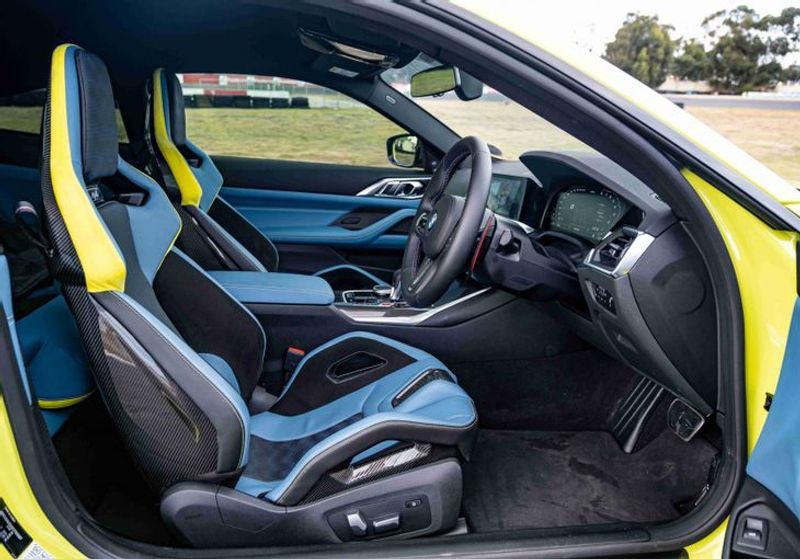
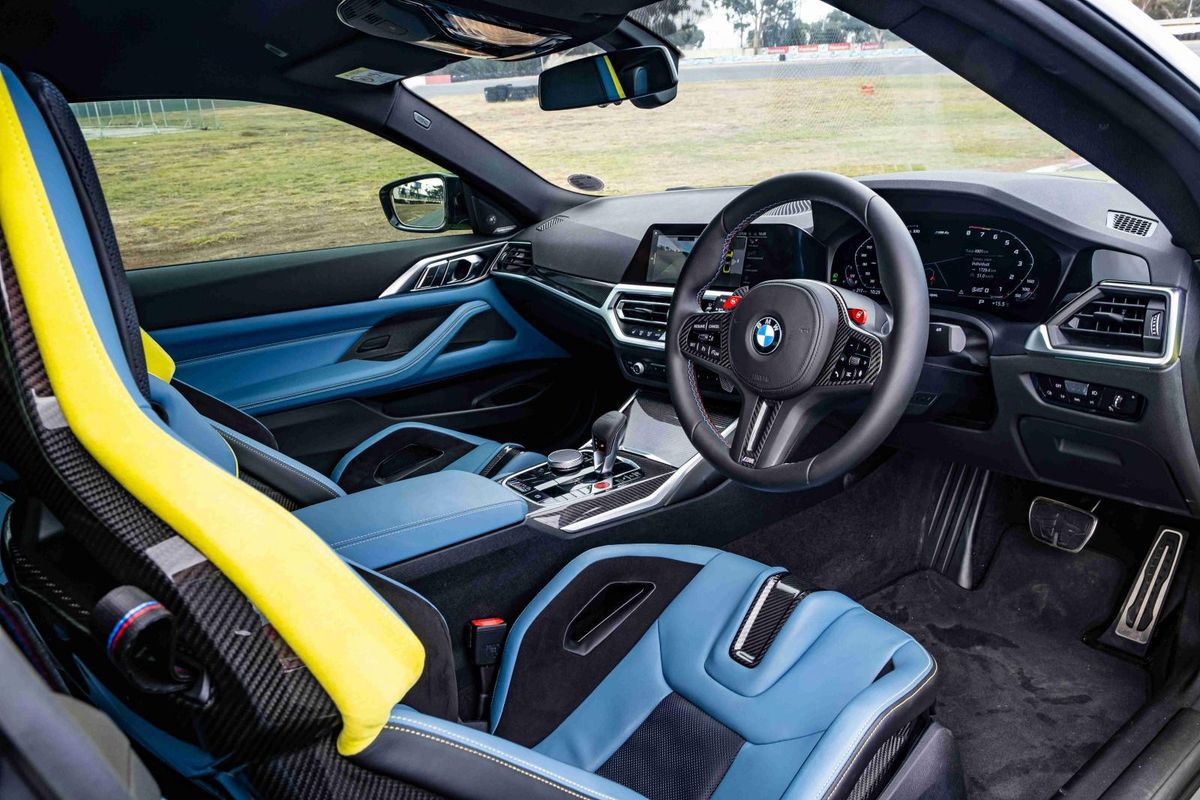
The optional M carbon bucket seats add a sense of drama to the M4 Competition’s overtly sporty interior.
The interior of the M4 Competition is suitably sporty to match the “high drama” of its extroverted exterior design and the slim-fit and optionally-available M Carbon bucket seats (R82 500) fitted to this test unit are said to be almost 10 kg lighter than the standard front sports seats. In this fine example, the seats are wrapped in a Yas Marina Blue and Black Merino leather combination with the beefy bolsters finished in Alcantara. The M Carbon seats provide excellent support but be warned: larger drivers or front passengers might find them too slim and figure-hugging, almost to the point of being uncomfortable. If you’re, um, “big-boned”, rather opt for the standard seats. The pronounced bolsters also make it awkward to get in and out of the M4 Competition, but with some practice, you soon get the hang of it.
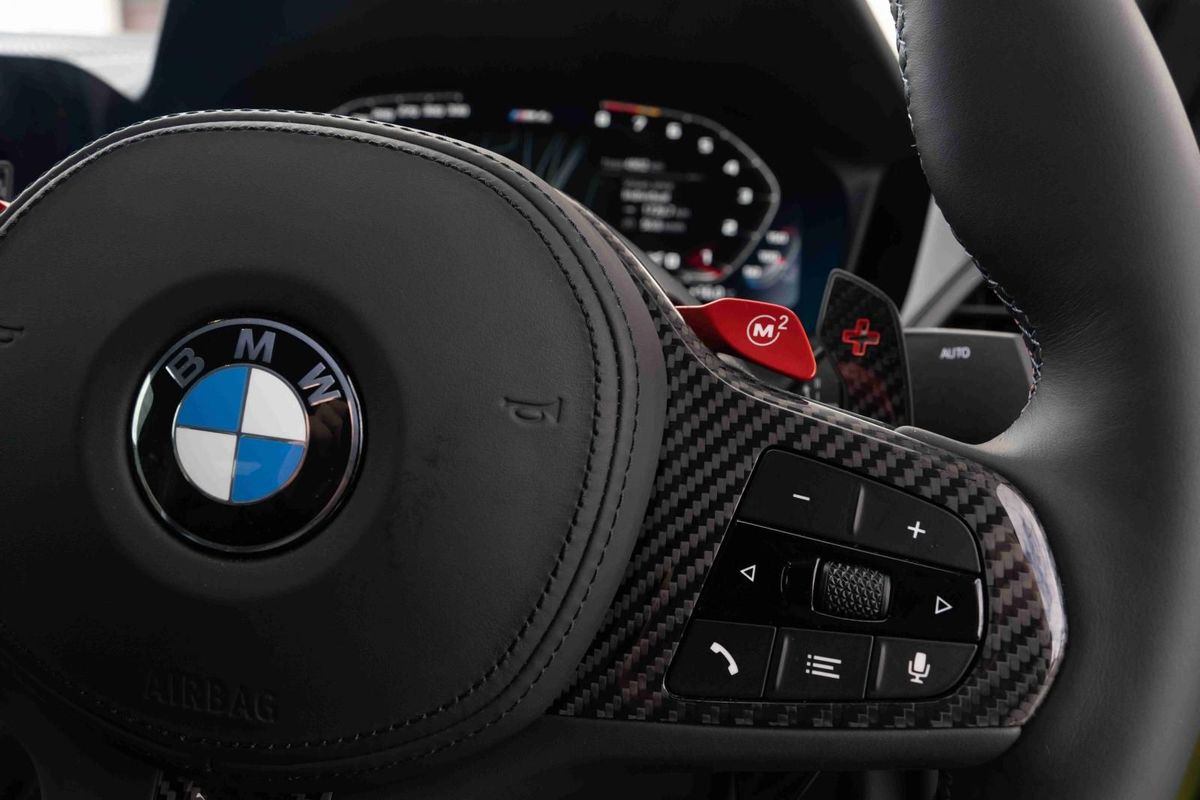
Numerous M4 badges are dotted around the cabin to remind you that you are NOT sitting in a more affordable and demure 4 Series derivative and carbon-fibre trim features on the centre console, steering wheel and dashboard, which add to the purposeful look. Also, note the generously proportioned carbon-fibre shift paddles on the M steering wheel. The tiller is thick-rimmed and feels substantial (as well as grippy), while the familiar red M1 and M2 hot buttons provide easy access to your preferred performance settings, which you can configure to your liking via the M Menu in the car’s infotainment system.
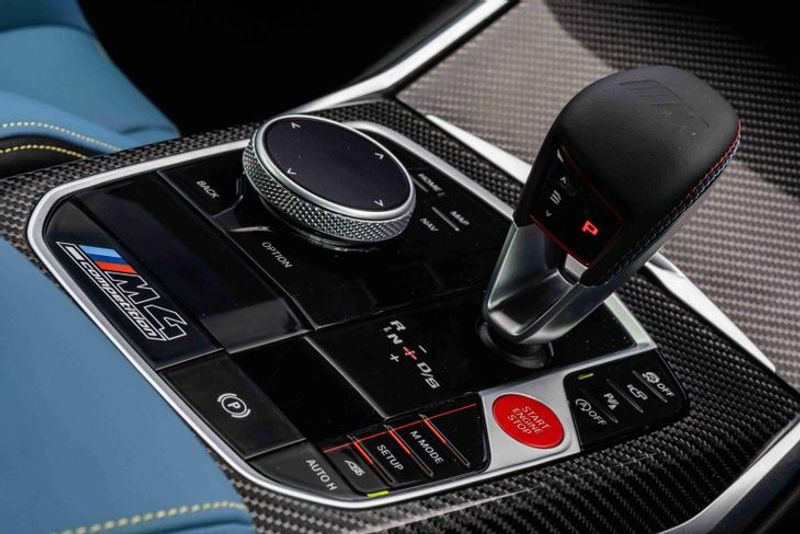
The driver now has more control and flexibility to adjust key performance settings in the new M4 Competition.
The M4 Competition offers a trio of M Modes (Road, Sport and Track) to suit your driving intent, but the driver can fine-tune the vehicle’s performance settings by pressing the “Setup” button in the centre console. In this menu, you can choose your desired settings for the engine, transmission, chassis, steering, brakes and exhaust. This is also where you can manually tweak the 10-step M Traction Control (with DSC off) setting to achieve perfect dynamic performance (and drifts) to suit the conditions in which you are driving. Furthermore, in conjunction with M Dynamic Mode (MDM), controlled drifts can be perfected and dialled in with confidence – on the safety of a track or skid pan, of course… Another nifty feature is the M Drift Analyser, which will analyse, measure and rate the quality of your drifts!
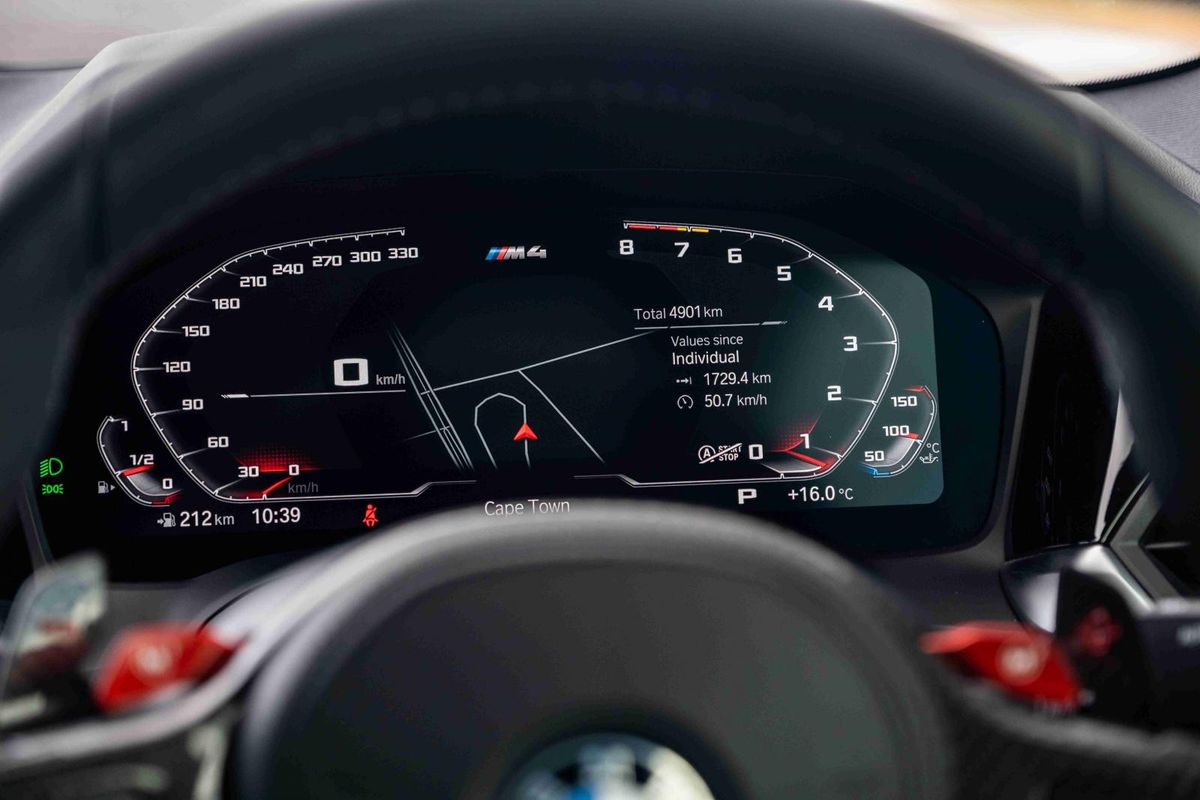
The display of the 12.3-inch digital instrument cluster can be configured to suit your preference and when sportier settings are engaged, the cluster and head-up display adopt layouts that suit the drive mode you’ve selected. The 10.25-inch infotainment system is familiar (from the 4 Series and other contemporary BMW models) and easy to navigate either via touch inputs or by using the iDrive Controller. It comes equipped with ConnectedDrive services, integrated navigation, Bluetooth, voice control, Apple CarPlay and Android Auto compatibility, plus a wireless charging pad is fitted for your convenience.
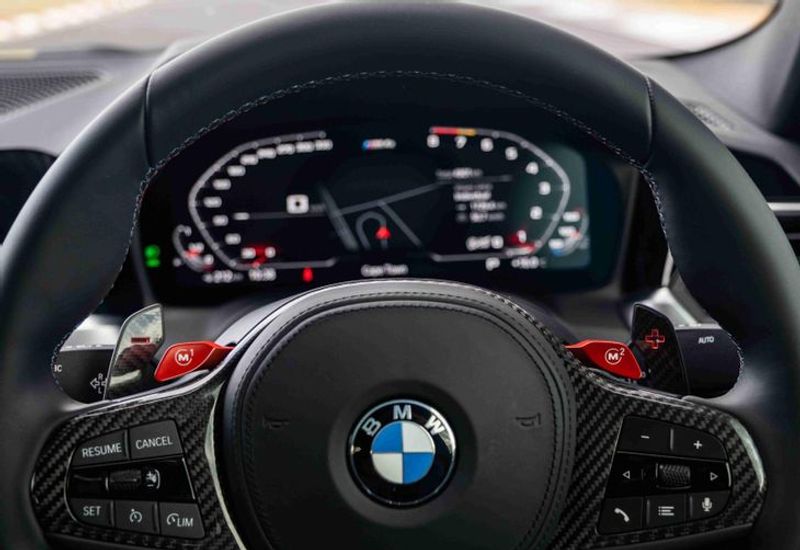
You can set your favourite drive settings for the M1 and M2 buttons which can be easily accessed.
Lastly, take note of the exhaust button in the centre console – you can use it to wake up your neighbours and their pets first thing in the morning, which is a very handy feature… if you’re evil incarnate.
Overall, we think the M4 Competition’s interior looks the part and imparts a sense that you are about to experience something special as soon as you press that red Engine Start button. Let’s press it, then!
What’s the M4 Competition like to drive?
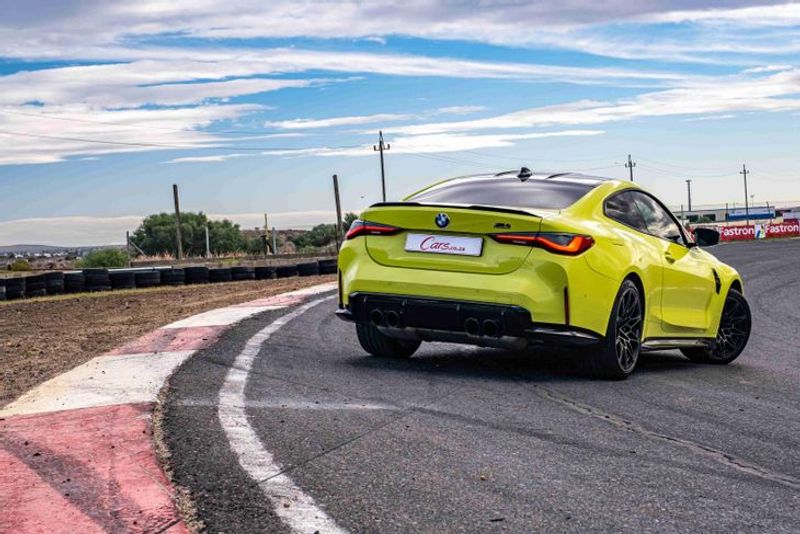
If it’s driving thrills you’re after, the M4 Competition delivers…
It is, in a word, marvellous!
Of course, before I took the M4 Competition for a drive for the first time, my colleagues repeatedly warned me that the Bimmer’s rear-end liked to step out often and with little effort. Alrighty then…
At start up, the powerful 375 kW/650 Nm twin-turbocharged 3.0-litre inline 6-cylinder engine comes alive with a distinct bark, which is followed by an urgent gurgle that emanates from the Bavarian speed merchant’s quad tailpipes. For a moment, I was convinced that I had arrived in heaven…
Not wanting to prod and poke the beast just yet, I decided to ease into the drive with the Bimmer’s settings dialled in for optimal comfort and efficiency. I was soon struck by how usable the M4 Competition is on our notoriously poor road surfaces. The new M3 and M4’s underpinnings are said to have been specifically engineered to be significantly stiffer (or taut) than those of the outgoing models, which laid the foundation for BMW’s engineers to scale up the performance of the newcomers’ brakes and suspension, resulting in sharper-, but also a more balanced, driving experiences. That was the idea, anyway…
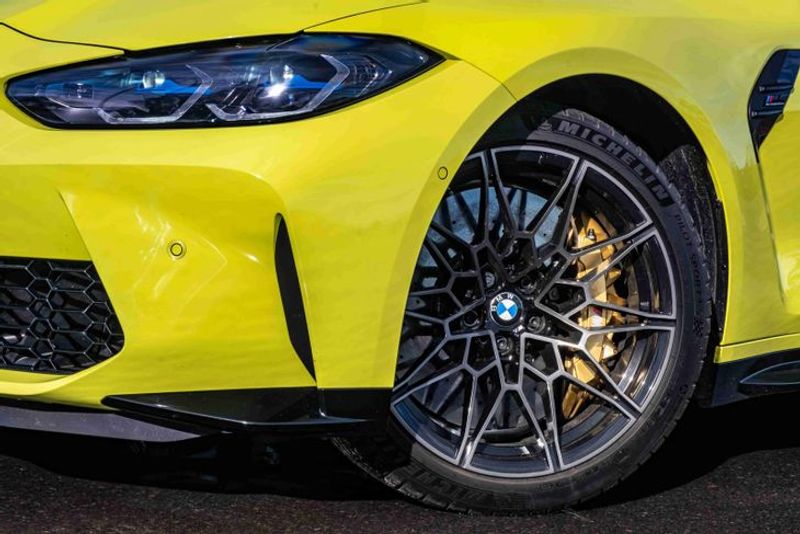
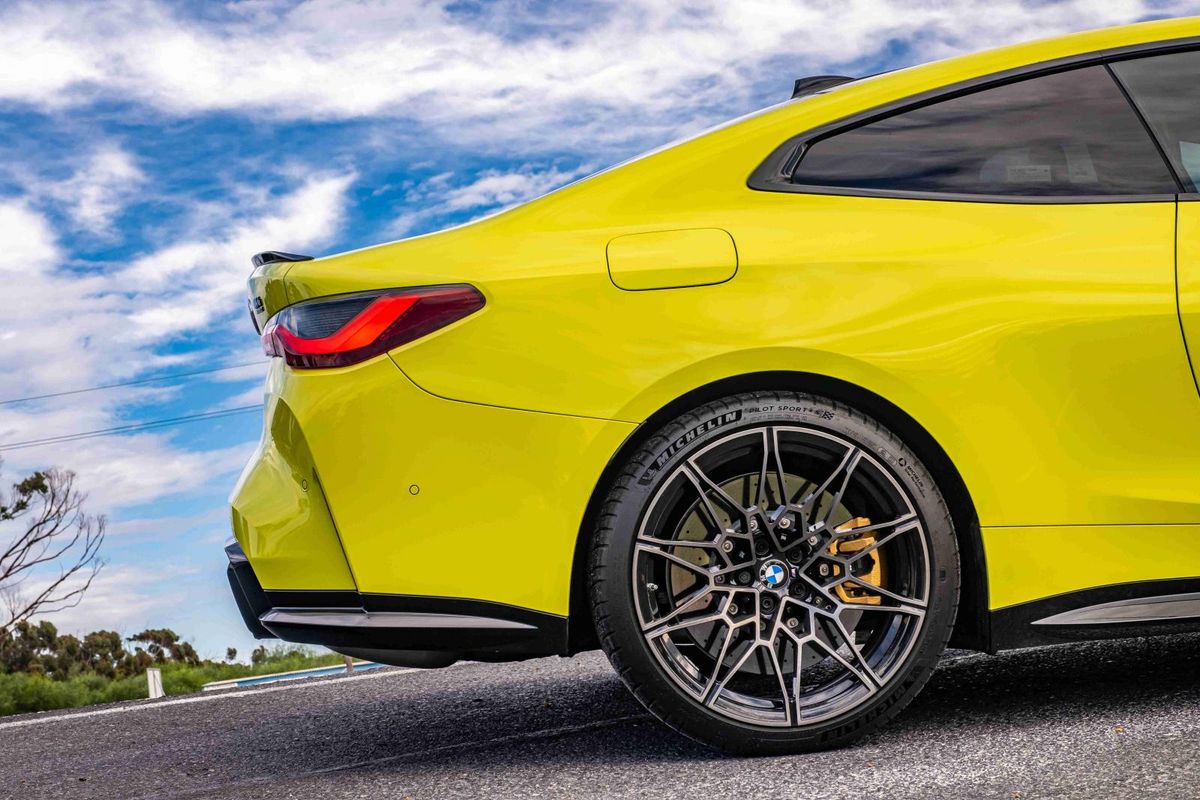
M Carbon Ceramic brakes are optional and you can choose between either Normal or Sport braking performance via the Setup menu.
Sure, the Adaptive M Suspension is firmly sprung – as it ought to be on a car of this calibre, but it wasn’t overly rigid or crashy over poor surfaces. I later discovered that the M4 Competition’s ride quality is surprisingly forgiving, even with its sportier settings engaged. Apart from the stellar performance that this car offers, its sheer adaptability makes it notably more suited to everyday use than its predecessor.
As my driving confidence increased, I started playing with the M4 Competition’s drive modes and settings and, on occasion, opened the 6-cylinder’s taps and unleashed the full might of this brilliant engine.
There’s no fluffing of feathers here. Full-bore acceleration in the M4 Competition is a thrilling and engaging experience and you better have your wits about you when you fully depress the accelerator pedal, because even when the stability systems are not switched off, the coupe’s rear-end has a propensity to shimmy and briefly fishtail as the rear wheels claw the tar for traction. Oh, and don’t be surprised if this behaviour continues as you flick the paddles to select 2nd and even 3rd gears… Before you know it, you will be rocketing towards the horizon at serious speeds. The M4 Competition means business!
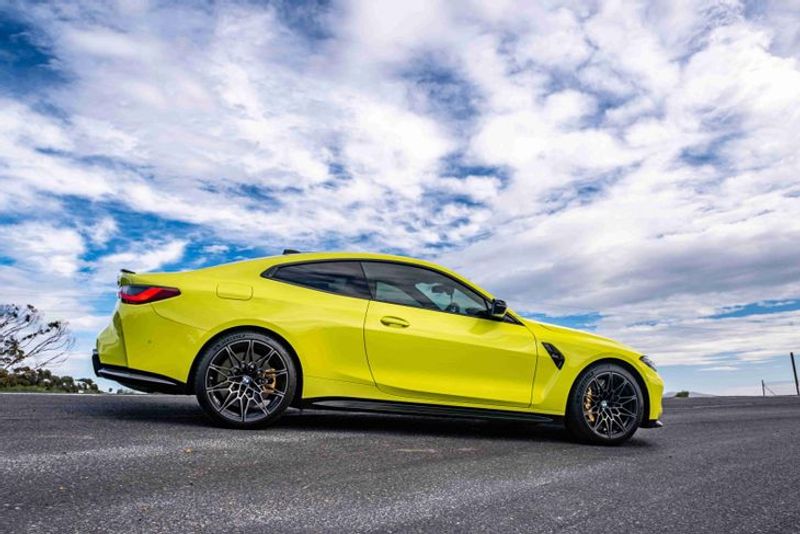
The new 8-speed automatic transmission in the new M4 Competition is more refined than the outgoing dual-clutch unit.
BMW claims a 0-to-100 kph sprint time of 3.9 sec, but the M4 Competition feels more like a 3.5-second car. It’s fast, very, very fast… It’s worth mentioning that this test unit was also equipped with BMW’s optional M Carbon Ceramic brakes; they provide sharp and responsive stopping power, but they are a R141 000 option. Then again, if you’re willing to spend R2-million on a performance car…
Some BMW fans might be upset that the highly praised M-DCT dual-clutch transmission from the previous M4 has been substituted by a conventional 8-speed torque-convertor automatic (made by ZF), but they really shouldn’t be… This new transmission is, in our opinion, noticeably smoother-shifting than the M-DCT and the ‘shifts still feel appreciably quick! It’s better suited to the new, more grown-up, M4.
Fuel efficiency should not be of tremendous importance to the M4 Competition’s target market, but for the record, while BMW claims a figure of 10.2 L/100 km, we never saw figures under 13 L/100 km.
How good is the new M4’s handling?
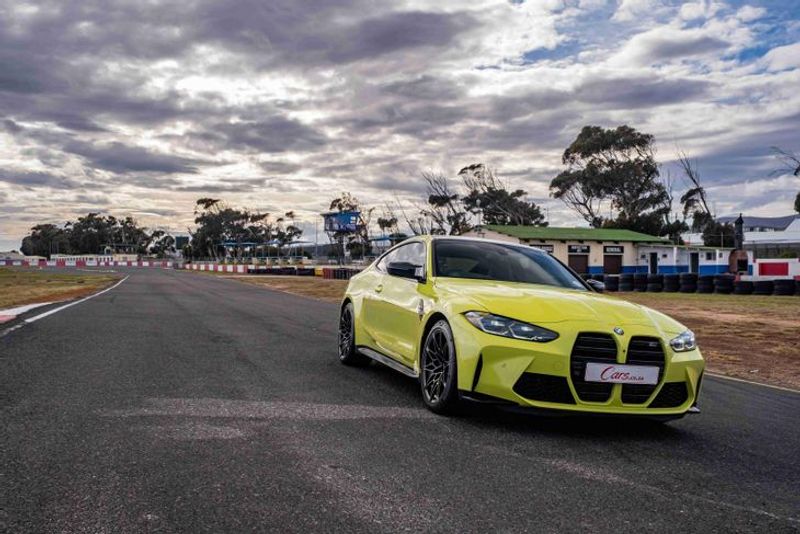
The M4 Competition delivers sharp and accurate dynamic handling ability.
The new M4 Competition is 122-mm longer, 17-mm wider and 5-mm taller than the previous-generation M4; its wheelbase has also grown (by some 45 mm). It’s also important to note that the new M4 Competition weighs roughly 185 kg more than before (it has a kerb weight of around 1 800 kg, so it’s not light).
Even if the new M4 Competition is heavier in its current iteration, that extra heft that it needs to lug around is not necessarily noticeable when the coupe’s cornering at heady velocities… Perhaps the more powerful engine and increased track widths (which aid stability/road holding) do a fair job of nullifying the weight gain or, at the very least, the perception thereof. In fact, the new M4 Competition feels quite nimble and agile on its rubber – plus, because the rear (20-inch) tyres are an inch larger than the front (19-inch) ones, the Bimmer’s nose is said to bite into corners with significantly more urgency. In fact, there’s so much more control and precision at the driver’s disposal that more power can be laid down so much earlier when exiting corners. This really is an impressive high-performance machine!
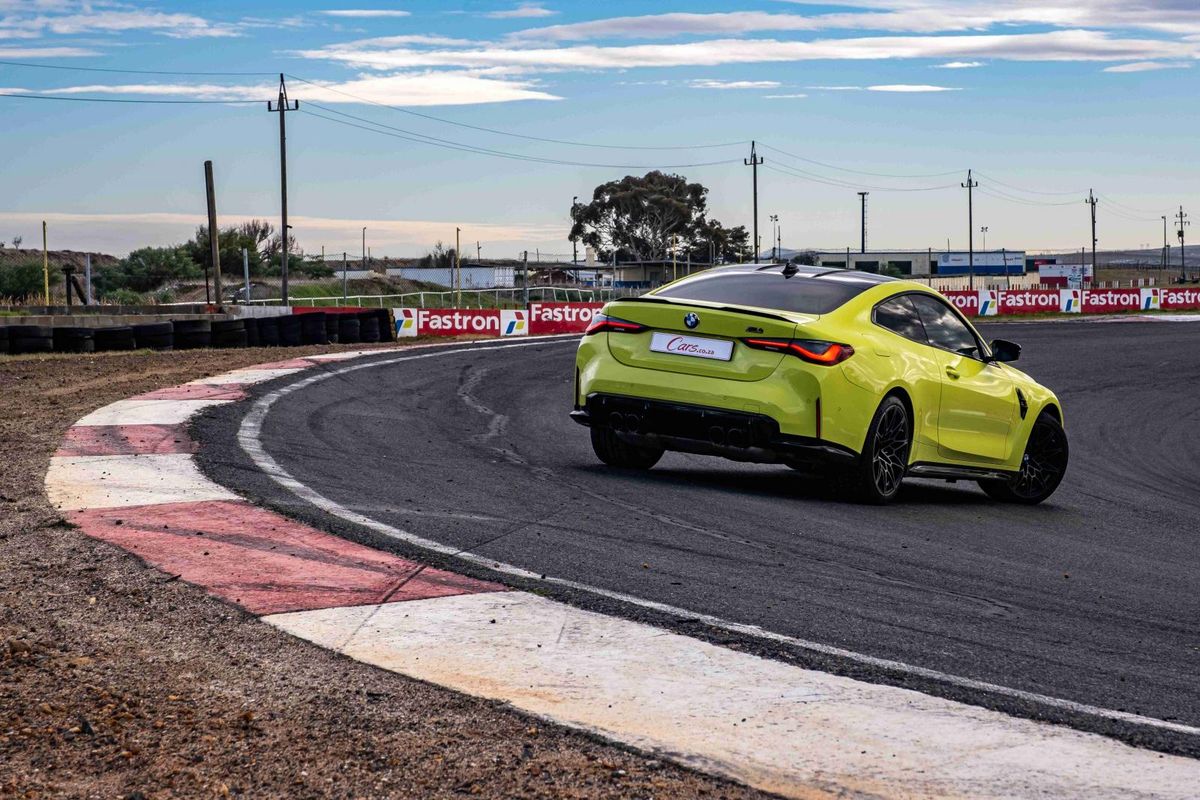
The M4 Competition’s M Servotronic steering is impressively responsive to inputs (and even delivers a notable measure of feedback to the driver, which marks an improvement over the previous model). The driver can set the steering to favour Comfort or Sport, depending on their preference. Even though I didn’t get a chance to explore the full breadth of the newcomer’s dynamic handling ability (I drove it on public roads only), our in-house race-ace, Ashley Oldfield, was much braver behind the Bimmer’s tiller when he drove it on an undisclosed circuit in the Winelands…
He had the following to say about the new M4 Competition’s dynamic handling ability: “The best thing you can do before engaging M Mode is to check the tyre temperatures; at anything below 40C there just isn’t enough heat to facilitate sufficient traction for performance driving. The car’s a slippery snake when you power out of corners, but the long-wheelbase makes the rear-end quite ‘catchable’ when it steps out of line. You still need a good ‘bum gyro’ to feel the car underneath you, but despite the BMW being quite quick to break traction – it’s not snappy, which inspires the confidence to make bigger power applications on corner exits, until you finally scare yourself too much and rein it in. There’s always DSC Sport for those who want added protection before attempting to switch traction control off entirely.”
Much of the M4 Competition’s improved predictability near or at the limit can be attributed to the conventional automatic transmission, which transitions between its gears in a much smoother motion. While in its sportiest setting, the previous M4’s dual-clutch ‘box actually felt jarringly brutal when you’d actuate ‘shifts; it kind of felt like someone inside the ‘box was using a bludgeon to swop cogs.
Should you wait for the xDrive version or go ahead and try your hand at the rear-wheel-driven model currently on sale? Have a serious conversation with the person in the mirror first and check your ego at the door when you do. The aft-propelled M4 Competition is the default choice for the so-called purist or experienced driver, which many believe they are until they end up starring in a Youtube crash video.
Is the BMW M4 Competition practical?
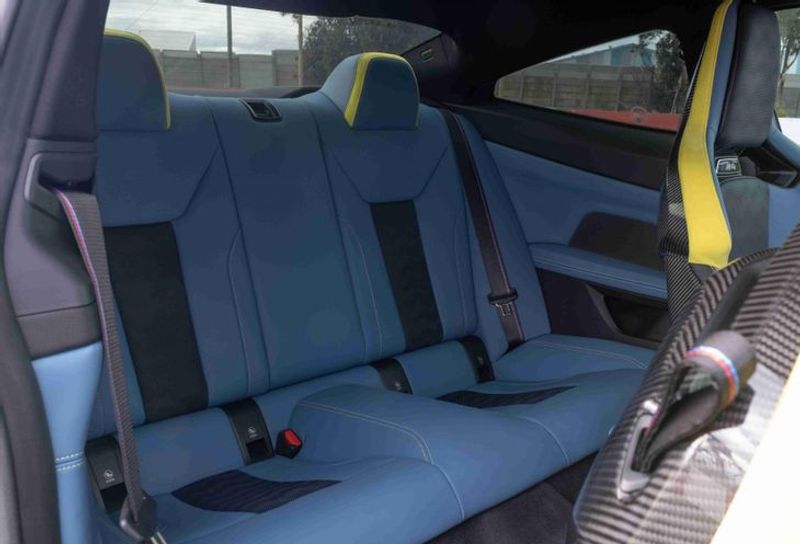
Rear head- and legroom will be on the tight side for taller passengers.
By virtue of having 2 fewer doors than its M3 Competition, the M4 Competition has an obvious disadvantage to its sedan sibling in terms of practicality and its sveltely sloping roofline doesn’t help rear headroom either. However, we still found the newcomer to be surprisingly capable of transporting not only more than a pair of occupants, but a variety of goods too.
Due to its longer wheelbase (compared with the previous-generation 4 Series/M4), the quality of rear accommodation has improved marginally in the M4 Competition. By pulling a lever on one of the front seats, passengers can access the rear bench; those of average size will be able to sit relatively comfortably, but taller passengers must expect both head- and legroom to be at a premium.
In terms of load-carrying ability, BMW claims a 440-litre capacity for the M4 Competition’s boot and, with the rear seats folded down, we were able to load no fewer than two 6-foot surfboards in through the rear cabin (along with additional luggage). We were also surprised to discover that you can fit a bicycle (with one wheel removed) into the BMW’s hold, which was rather impressive!
How much does the BMW M4 Cost in South Africa?
The BMW M4 Competition Coupe is priced from R2 238 002, before options. Pricing includes a 2-year/unlimited km warranty and a 5-year/100 000 km maintenance plan.
See full specification details for the BMW M4 Competition
Buy a used BMW M4 on Cars.co.za
Verdict
The M4 Competition is a marked improvement over its predecessor…
The M4 Competition positively exudes kerb appeal. Everywhere we drove in this car, people would stop, stare and record images and videos on their smartphones. In effect, that gaping grille, for better or for worse, has put all eyes on the M3/M4 Competition. Regardless of the haters, that’s good marketing and something that’s more than likely to result in increased interest and, ultimately, more sales.
Looks aside, the dynamic ability and sheer performance of the M4 Competition is nothing short of phenomenal – it has, in our opinion, raised the bar in the performance-coupe segment (the Alfa Romeo Giulia Quadrifoglio will have to take on the M3 for ultimate honours). For driving purists, this rear-wheel-drive M4 M Competition will be a near-irresistible proposition, even at its near R2-million asking price.
Yes, it’s eye-wateringly expensive, but if you consider the Mercedes-AMG C63 S Coupe, which is similarly priced, is due to be replaced soon (and its successor will have a 2.0-litre turbocharged hybrid power unit instead of a twin-turbo 4.0-litre V8), this throaty 6-cylinder Bimmer starts to look an incredibly attractive proposition for performance-car aficionados. Yes, you can of course opt for the facelifted Audi RS5 Coupe for much less money (priced from R1 394 500), or even consider the Porsche 911 Carrera S Coupe for a touch over R2 million. The latter might be an especially tempting alternative…
Tough choices, but if you can afford it and are prepared to live with that grille, we can’t think of a good reason not to put the M4 Competition right at the top of your performance-coupe shortlist.
Frequently Asked Questions
What are the different models of the 2025 BMW M4 available in South Africa?
The 2025 BMW M4 range in South Africa includes the M4 Competition Coupe, the M4 Competition Convertible, and a limited edition M4 CS model.
What are the engine specifications of the new BMW M4?
The standard M4 Competition models are powered by a 3.0-liter turbocharged 6-cylinder petrol engine that produces 390 kW and 650 Nm of torque. The M4 CS version has an increased output of 405 kW.
What are the 0-100 kph acceleration times for the new M4?
The M4 Competition Coupe with all-wheel drive accelerates from 0 to 100 kph in 3.5 seconds. The convertible version does it in 3.7 seconds, and the M4 CS achieves it in 3.4 seconds.
What is the price of the 2025 BMW M4 in South Africa?
As of May 2025, the M4 Competition Coupe AWD is priced at R2,238,002, and the M4 Competition Convertible AWD is priced at R2,338,842.
What are the warranty and service plan details for the M4?
The BMW M4 comes standard with a 5-year/100,000 km service plan and a 2-year/unlimited km warranty.
Related Content:
Reviews
BMW M4 Competition (2021) Review
BMW M4 GTS (2016) Review
BMW M4 M-DCT with M Performance Parts (2016) Review
Buyer’s Guide
Gero Lilleike

Gero Lilleike is a published writer and photographer with most of his work appearing in the fields of travel and motoring. Gero has worked as a motoring journalist for Cars.co.za for the past 8 years and takes every opportunity to go on an adventure whether it be offroad or in the ocean. For Gero, a car's worth is measured by how many surfboards it's able to carry.