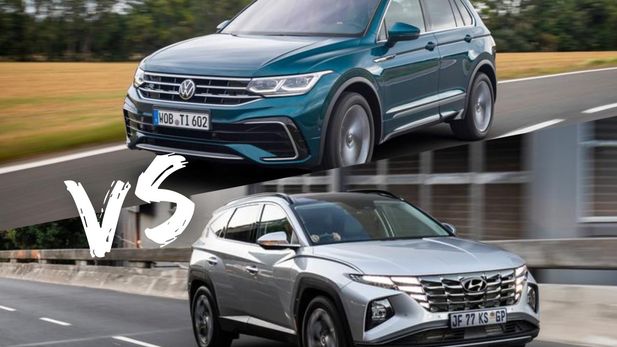
The Volkswagen Tiguan is one of the most popular family cars on sale in South Africa but with the arrival of the new Hyundai Tucson, buyers will have some thinking to do…
Family cars are versatile vehicles that are typically required to be competent in a number of areas including performance, practicality, in-car technology and value.
The Volkswagen Tiguan is arguably the benchmark product in this segment and the popular model received an update in 2021 which introduced some styling tweaks, interior enhancements and equipment upgrades, all of which intend to boost the Tiguan’s share in this segment.
Hyundai, however, has the same intentions for its all-new fourth-generation Tucson which arrived locally in March 2022 to take the fight to its German rival. The new Tucson is larger than its predecessor which bodes well for its practicality as a family vehicle but which one of these family SUVs is best suited to your needs and budget?
The main aim of this article is to help you, the consumer, make an informed buying decision. To help you do this, we will provide you with the need-to-know information and insight based on available vehicle information and our experience with the cars in question.
This article will cover key aspects including Engine Performance, Efficiency & Handling, Interior Features & Safety, Dimensions & Practicality and Pricing and Warranty details.
Please note that because design and styling are subjective, we will not pass judgment and you can decide for yourself what car you think looks better.
If at the end of this article you are still undecided as to ‘What To Buy’, you are more than welcome to reach out to us for additional information or advice via Twitter, Facebook or Instagram and our experienced test team will gladly assist you.
What To Buy – Volkswagen Tiguan or Hyundai Tucson?
Engine Performace, Efficiency and Ride Quality
| VW Tiguan 1.4TSI | VW Tiguan 2.0TSI | Hyundai Tucson 2.0 | Hyundai Tucson 2.0D | |
| Engine | 1.4-litre turbopetrol | 2.0-litre turbopetrol | 2.0-litre petrol (NA) | 2.0-litre turbodiesel |
| Power Output | 110 kW | 162 kW | 115 kW | 137 kW |
| Torque Output | 250 Nm | 350 Nm | 192 Nm | 416 Nm |
| Transmission | 6-speed DSG | 7-speed DSG | 6-speed automatic | 8-speed automatic |
| Fuel Consumption (claimed) | 7.7 L/100km | 8.3 L/100km | 8.9 L/100km | 7.4 L/100km |
Volkswagen Tiguan
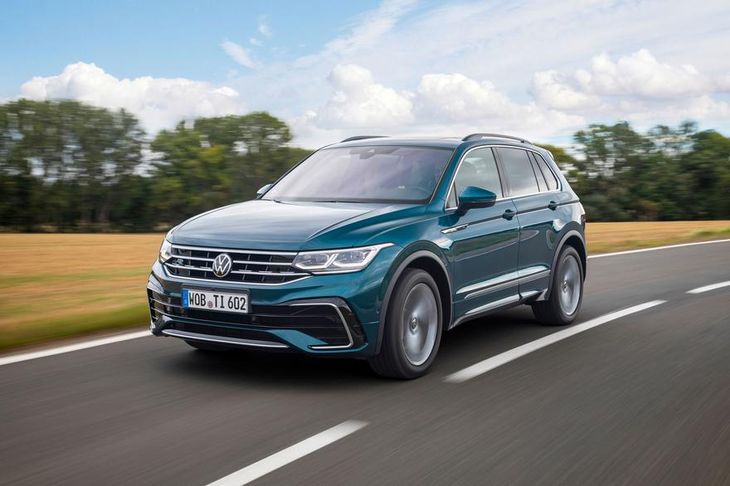
With 2 turbopetrol engines currently available for the Tiguan and a turbodiesel engine expected to join the range this year, buyers are spoilt for choice. The 1.4-litre turbopetrol engine will suit the needs of most family car buyers by offering an attractive combination of performance and efficiency. However, for buyers seeking more punch, the range-topping 2.0-litre turbopetrol engine with 4Motion all-wheel-drive delivers livelier performance but buyers will have to accept that the fuel efficiency is not as good as the smaller-engined Tiguan.
As far as ride quality is concerned, the Tiguan excels, particularly when fitted with 17- or 18-inch wheels which results in a comfortable and refined ride on various surfaces. Ride quality on the larger 19-inch rims as fitted as standard on the Tiguan 1.4 R-Line and Tiguan 2.0 R-Line display a firmer disposition at the expense of a degree of overall ride comfort. The Tiguan, however, exhibits excellent road manners and delivers responsive, surefooted handling that contributes positively to the Tiguan’s overall driving experience.
Also see: Volkswagen Tiguan: What it’s like to live with
Hyundai Tucson
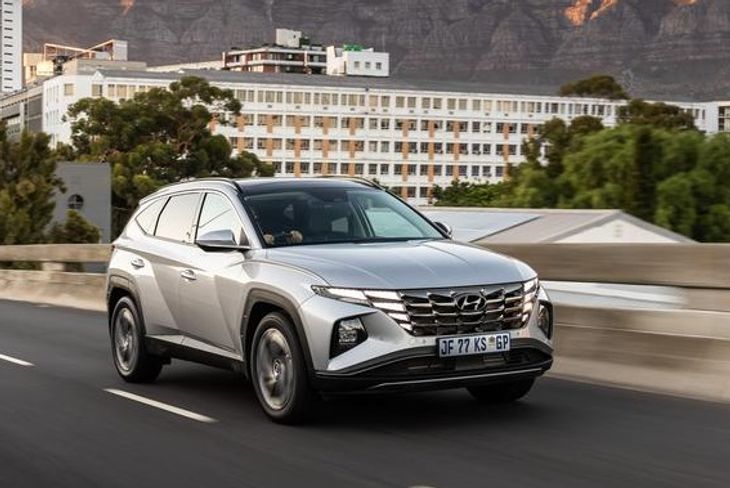
The new Hyundai Tucson has come to market with the choice of either a petrol or diesel engine. The naturally-aspirated 2.0-litre petrol engine offers average performance with middling outputs and ultimately lacks the punch offered by its turbocharged rivals, including the Tiguan. It is, however, still adequately capable to fulfill its daily duties as a family car. Fuel consumption for this engine is fairly high too with Hyundai claiming 8.9 L/100km.
For better performance and efficiency, buyers will have to opt for the range-topping diesel-powered Tucson 2.0D Elite derivative which carries a claimed fuel consumption figure of 7.4 L/100km.
The Tucson’s ride quality is now more refined than before and while its suspension is firmer than its predecessor, it copes well on various surfaces, including gravel. More so, the Tucson’s steering feel is also more direct and responsive which has enhanced the driving experience.
It’s worth noting that the Tucson range doesn’t have an all-wheel-drive option yet, which the Tiguan does. If you intend on venturing off-road further than a gravel road, that’s something you might want to take into account.
Read our Hyundai Tucson (2022) Launch Review
Interior Features and Safety
For this section, we will compare key specifications of the equivalent top-spec derivatives from each model range.
You can, however, use our handy Cars.co.za Compare Tool to compare any vehicle derivative you like.
| Volkswagen Tiguan 2.0TSI R-Line | Hyundai Tucson 2.0D Elite | |
| Infotainment system | 8.0-inch MIB3 Composition Media Radio with app connect | 8.0-inch AudioVisual Navigation (AVN) touchscreen with app connect |
| Digital Instrument cluster | 12.3-inch Active Info Display | 10.25-inch digital display |
| Android Auto and Apple CarPlay, Bluetooth, voice control, USB, wireless charging | Yes, wireless app connect is optional. Front and rear USB ports, Bluetooth, voice control. Wireless charging is optional. | Yes, wireless app connect is standard. Front and rear USB ports. Wireless charging is standard. |
| Rear View Camera | No, optional | Yes, standard |
| Cruise Control | Yes | Yes, Adaptive |
| Air Conditioning | Climate Control | Climate Control |
| Panoramic sunroof | No, optional | Yes, standard |
| Front and rear park distance control | Yes, front and rear | Yes, front and rear |
| Upholstery / electric seats | Leather, electronic driver seat adjustment, heated seats, front lumbar support | Artificial leather, manual adjustment, heated seats, driver lumbar support |
| Safety features | 6 airbags, ABS with EBD, electronic stability control, traction control, brake assist, hill descent control, tyre pressure monitoring. IQ Drive safety features are optional. | 6 airbags, ABS with EBD, electronic stability control, hill descent control, tyre pressure monitoring, blind spot assist, lane-keeping assist, lane follow assist, forward collision-avoidance assist, rear cross-traffic alert, fatigue detection |
Feature Summary
The above table clearly illustrates that the range-topping Hyundai Tucson pips the equivalent Volkswagen Tiguan in terms of standard feature value. The Tucson is also equipped with useful driver assistance systems as standard while these features are optionally offered for the Tiguan
With the latest update for the Tiguan, Volkswagen has infused more technology into the interior with the addition of a new steering wheel with touch controls and digitised air conditioning controls. The Tiguan retains its clean, modern and tech-forward interior design approach and the cabin now features fewer physical buttons as most functions operate via touch control. It’s worth noting that some of the touch controls are finicky to operate.
The new Tucson boasts excellent perceived interior build quality with quality soft-touch surfaces dominating the cabin. As indicated in the table above, standard feature specification is generous. Buttons inside the new Tucson have also been reduced thanks to the new infotainment system which houses all the key functions including ventilation and air conditioning. The digital instrument cluster further elevates the ‘tech-feel’ inside the cabin.
Dimensions and Practicality
| Volkswagen Tiguan 2.0TSI R-Line | Hyundai Tucson 2.0D Elite | |
| Length | 4 509 mm | 4 630 mm |
| Width | 1 839 mm | 1 865 mm |
| Height | 1 635 mm | 1 665 mm |
| Wheelbase | 2 678 mm | 2 755 mm |
| Ground Clearance | 191 mm | 181 mm |
| Rear Seating Configuration | 60:40 split | 60:40 split |
| Load Capacity | 520 – 1 655 L | 539 – 1 860 L |
Practicality Summary
In terms of practicality, the Volkswagen Tiguan excels with one of the largest load bays in the segment at 520-litres and with the 60:40 seats folded down you have access to 1 655 litres. More so, rear passengers are also well catered for with ample leg-, head- and shoulder room.
However, the new Hyundai Tucson trumps its German rival in the practicality stakes. With a larger footprint, the new Tucson’s practicality credentials have improved significantly with a load bay capacity now claimed at 539 litres, some 51 litres more than its predecessor and with its 60:40 split seats folded down, space increases to a useful 1 860 litres. Its wheelbase has also increased by 85 mm which has resulted in more space for rear passengers, particularly in terms of legroom.
Pricing and Warranty
*Pricing is accurate as of March 2022
| Volkswagen Tiguan | Price | Hyundai Tucson | Price | |
| Base | Tiguan 1.4TSI 110 kW | R541 800 | Tucson 2.0 Premium | R519 900 |
| Mid | Tiguan 1.4TSI 110 kW Life | R610 600 | Tucson 2.0 Executive | R569 900 |
| Top | Tiguan 1.4TSI 110 kW R-Line | R670 200 | Tucson 2.0 Elite | R634 900 |
| Tiguan 2.0TSI 162 kW 4Motion R-Line | R738 400 | Tucson 2.0D Elite | R699 900 | |
| Warranty | 3-year / 120 000 km | 5-year / 150 000 km 7-year / 200 000 km Drivetrain | ||
| Service Plan | 5-year / 90 000 km | 6-year/90 000 km |
As shown above, the Hyundai Tucson is aggressively priced against the Volkswagen Tiguan and the Korean family car does offer a hard-to-ignore warranty and service plan when compared against the Tiguan.
It’s also worthwhile stating that Volkswagen offers a range of optional features (which will ultimately increase the overall cost) while Hyundai adopts more of an all-in approach when it comes to standard specification. Hyundai does, however, offer a selection of practical and styling accessories for the Tucson should you want to beef up the look.
What to Buy?
Family cars are required to wear many hats (and wear them all well) and both the Tiguan and the Tucson are excellent product offerings in their own right.
The Tiguan, in our opinion, does offer better performance (both engines) and overall it’s a great all-rounder when it comes to technology and practicality. However, it’s impossible to ignore the Tiguan’s steep pricing structure which is exacerbated when you start ticking off those optional extras. With that said, a fully-loaded, range-topping Tiguan will easily cost over R800k! The Tiguan is a pricey proposition and unless you can afford it, you will have to look elsewhere…
And that’s where Hyundai comes in. Yes, the naturally-aspirated Tucson might lack some punch but it makes up for it by offering good standard specification and a palatable pricing structure as well as offering significant peace of mind with a comprehensive warranty and service plan. If you have your heart set on the Tucson, we suggest that you consider the range-topping diesel-powered Elite derivative.
Your buying decision will ultimately depend on what’s more important to you. If you value performance above all else, then go for the Tiguan. If outright practicality and value-for-money are of greater importance to you, then we think the Tucson is a winner.
If buying a new car is out of your financial reach then it’s definitely worthwhile shopping for a used Volkswagen Tiguan or a used Hyundai Tucson.
Related Content
Toyota Urban Cruiser vs Chery Tiggo 4 Pro – Which should you buy?
Toyota Corolla Cross vs Haval Jolion – Which should you buy?