Car shopping usually starts with dreams of power, features and sleek lines. But ultimately, it comes down to one critical factor: affordability. Use the Cars.co.za finance and affordability calculators to run your numbers before you commit.
Whether you’re buying a new car from a dealer or browsing Cars.co.za’s used stock from the comfort of your sofa, at some point you’ll have to crunch the numbers on a calculator.
What’s worth knowing upfront is that an advertised monthly instalment depends on assumptions about the interest rate, deposit, repayment term and any balloon payment. It may also exclude fees and insurance costs.
Read more: Subscribe, loan or lease? How to choose your next car’s finance plan

Don’t be overwhelmed. By factoring in all the relevant costs and using the finance and affordability calculators, you can get a clearer picture of your likely monthly commitment before you sign on the dotted line. Treat the results as estimates, not a guarantee of affordability or credit approval.
What determines your monthly car instalment?
If you’re buying your car through an instalment sale, the following factors determine your monthly repayment and the overall cost of finance:
- The amount financed is the amount you borrow after deducting your deposit and any available trade-in equity, plus any extras or fees included in the loan. For a financed trade-in, only the amount left after settling its existing finance can contribute towards the new purchase.
- The interest rate determines what the bank charges for lending you the money. It may be fixed for the agreed term or variable (linked to the prime lending rate), and interest is charged on the outstanding balance.
- The loan term determines how long you’ll take to repay the debt. At the same interest rate and amount financed, a shorter term means higher monthly instalments but less interest paid over the life of the loan. Stretching repayments over a longer period reduces the monthly commitment but increases the total interest paid.
- A balloon payment may also be built into the finance agreement to reduce monthly instalments. It leaves a lump sum payable at the end of the term and increases the total interest paid compared with an otherwise identical loan without a balloon.
Read more: Refinancing your balloon payment: The processes, costs & potential traps
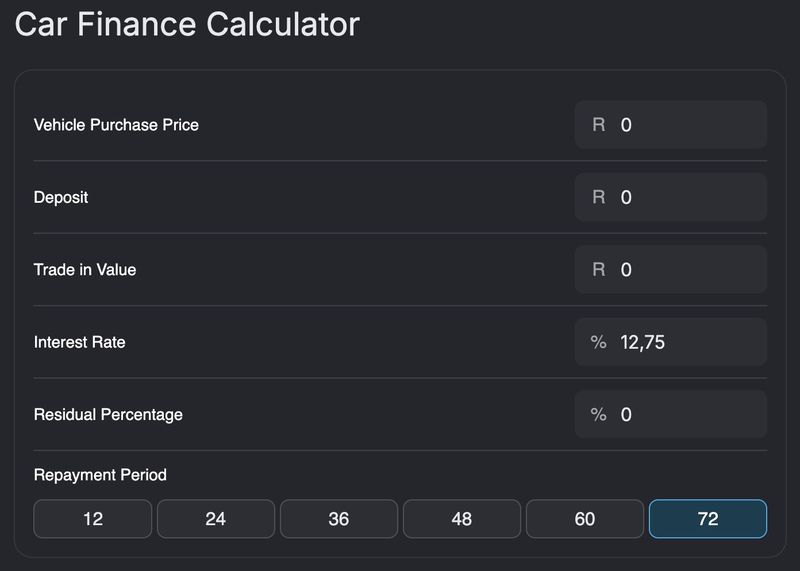
Use Cars.co.za’s finance calculator to test different deposits, repayment terms, interest rates and balloon payments, and its affordability calculator to estimate a purchase budget. The calculators exclude certain fees, so confirm the full cost with your finance provider.
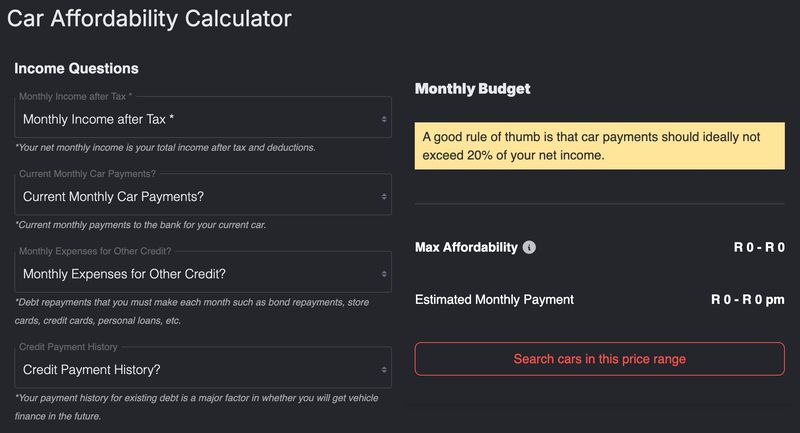
Time to bring out the calculator: How much car can your budget comfortably cover?
Affording a monthly instalment means more than having enough left in your bank account to make the payment. Your budget also needs to cover the car’s running costs.
Cars.co.za’s affordability calculator suggests keeping car payments within 20% of your net income as a general guideline. That is not a guarantee of affordability: your existing commitments, household expenses and the car’s running costs will determine what you can comfortably afford.
Read more: The real monthly cost of owning a car

Start with your take-home income, then subtract your regular living expenses and existing debt repayments. What’s left gives you a clearer indication of how much room you have for a vehicle. Include fuel, maintenance, insurance, licence costs and monthly finance service fees, not just the instalment, and leave a buffer for unexpected expenses or increases in costs.
Deposits & balloon payments: Lower instalments, different trade-offs
Two factors that can significantly affect the amount of the instalment are the size of the deposit and balloon payment.
The illustrative calculations below use a R400 000 vehicle financed over 60 months at an assumed annual interest rate of 11.75%, held constant throughout. They assume equal month-end repayments, with interest calculated monthly, and exclude fees, insurance and running costs. Each 20% balloon is based on the vehicle’s purchase price, not the amount financed. Figures are rounded to the nearest rand; total interest is calculated from unrounded instalments. The rate is an example, not a current market quote.
| Finance structure | Deposit paid | Amount financed | Balloon (20%) | Estimated monthly instalment | Total interest paid | Final lump sum due |
| No deposit, no balloon | R0 | R400 000 | R0 | R8 847 | R130 840 | R0 |
| 10% deposit, no balloon | R40 000 | R360 000 | R0 | R7 963 | R117 756 | R0 |
| 20% deposit, no balloon | R80 000 | R320 000 | R0 | R7 078 | R104 672 | R0 |
| No deposit + 20% balloon | R0 | R400 000 | R80 000 | R7 861 | R151 672 | R80 000 |
| 10% deposit + 20% balloon | R40 000 | R360 000 | R80 000 | R6 976 | R138 588 | R80 000 |
The figures show the trade-offs. Doubling the deposit from 10% to 20%, with no balloon payment, reduces the monthly instalment by around R885 and saves approximately R13 084 in interest over five years, but requires an extra R40 000 upfront.
Read more: Financing a car in SA: The true cost of 60-month balloons vs 84-month loans
Compared with the no-deposit, no-balloon option, adding a 20% balloon payment (R80 000) reduces the monthly instalment by around R986 but increases the total interest paid by approximately R20 832 over five years. You still owe R80 000 at the end of the term, so plan how you’ll settle it.
Fixed or variable interest: certainty or flexibility?
Choosing a fixed or variable interest rate comes down to the quotes you receive, your budget and how much uncertainty you’re prepared to live with.
A fixed interest rate gives you predictable finance repayments throughout the agreed term, making budgeting easier and protecting you against interest-rate increases. That certainty may come at a price, as the fixed rate offered can be higher than the variable rate. Compare both quotes before deciding whether the extra certainty is worth the cost.

A variable interest rate is linked to the prime lending rate. When prime falls, your rate and monthly instalment fall too; when it rises, so do your repayments. A variable rate may appeal if you expect rates to fall, but forecasts are never guarantees. Consider whether your budget can absorb an increase. If you plan to settle the finance early, ask the lender for a settlement quote rather than relying on the outstanding balance alone.
Read more about variable vs fixed interest rates
| Finance factor | Impact on monthly instalment | Impact on total interest paid | Best used for |
| Larger deposit (10-20%) | Lowers monthly payment | Reduces total interest | Buyers wanting lower monthly repayments and less interest over the loan term |
| Longer loan term (72 months or more) | Lowers monthly payment | Increases total interest | Buyers needing lower instalments who can accommodate higher total interest |
| Balloon/residual payment | Significantly lowers monthly payment | Increases total interest | Buyers who understand the final payment and can realistically settle it |
| Fixed interest rate | Keeps finance repayments predictable throughout the term | Depends on the quoted rate; protects against rate rises but gives no benefit from rate cuts | Risk-averse buyers wanting fixed monthly budgeting |
| Variable interest rate | Fluctuates with prime lending rate | Can increase or decrease over time | Buyers whose budgets can absorb repayment increases |
Smart car shopping starts with calculating what you can afford, not chasing instant gratification.

Taking the time to explore different finance scenarios using the Cars.co.za finance calculator lets you see how deposits, repayment terms and balloon payments affect your estimated instalment and total finance cost. Use the Cars.co.za affordability calculator alongside your full household budget to gauge what you can comfortably afford before you start negotiating.
Once you’ve settled on an instalment and running costs your budget can accommodate, you can browse with a clearer head. The dream car might still be out there; the difference is that you now have a better idea of what you can afford.
Our alternative to traditional finance: A guide to DrivePass – The benefits and what to consider
Cars.co.za

Providing you with the latest motoring news, new car releases and the simplest way to buy and sell cars.