Most of the checks that can protect you from a costly used-car mistake are free. And the one worth paying for costs less than R150. Here’s how to make sure you’re not buying someone else’s problem.
The latest South African Police Service (SAPS) crime statistics, released on 20 November 2026, brought some encouraging news: carjackings fell by 16.8% year on year between July and September 2026. But fewer hijackings don’t mean fewer reasons to be careful when buying a used car. During those three months, police recorded 3 977 carjackings and 7 046 cases of motor vehicle and motorcycle theft. That’s more than 11 000 reported incidents, or approximately 120 a day.
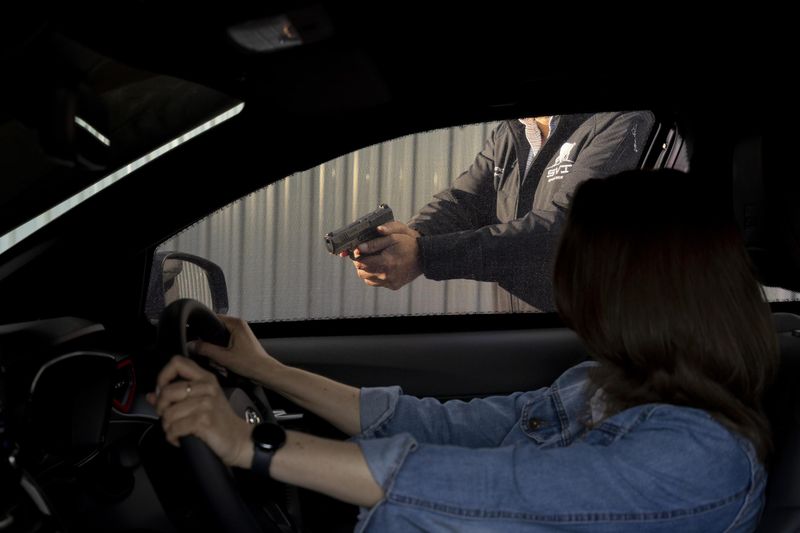
Add previously written-off vehicles being passed off as accident-free, cars with outstanding finance and increasingly sophisticated scams, and the year-end used-car market can become a minefield.
Fortunately, there are several straightforward ways to protect yourself, many of which won’t cost you a cent.
How do you check a used car’s history in South Africa?
Before handing over any money, you need to establish three things: whether the vehicle has been reported stolen, whether it has previously been written off or seriously damaged, and whether there’s still money owing to a finance house.
No single check provides all the answers, but combining the following steps will significantly reduce your risk.
Six essential used-car checks
| Check | What it reveals | Cost |
|---|---|---|
| VIN and engine number | Whether the vehicle’s identifying numbers match its documents | Free |
| Registration certificate | Registered owner, title holder and vehicle details | Free |
| Police verification | Whether the vehicle is flagged as stolen or wanted | Enquire with SAPS |
| SAIA VIN-Lookup | Recorded Code 3, Code 3A or Code 4 salvage status | Free |
| Bank settlement letter | Outstanding finance and settlement requirements | Usually free |
| Vehicle-history report | Recorded damage, police interest, finance and other information | R79 or R149 |
1. Check that the VIN and engine numbers match
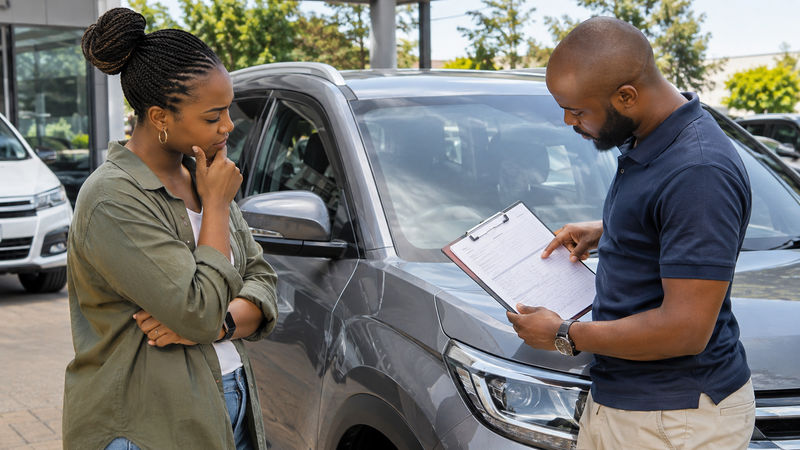
Every modern passenger car has a unique 17-character Vehicle Identification Number (VIN), which acts much like its identity number.
You’ll usually find it at the base of the windscreen, on a door pillar or on a manufacturer identification plate. Its exact location varies between models.
Compare the VIN with the number on the vehicle’s registration certificate (NaTIS document). The engine number should also match the registration details.
Look carefully for signs of tampering, including scratched or ground-down surfaces, uneven stamping, damaged identification plates or suspiciously fresh paint around the numbers.
Criminals sometimes use a legitimate vehicle’s identity to disguise a stolen one, a practice known as vehicle cloning.
That’s why checking the physical numbers is just as important as checking a database.
Our advice: If any identifying number doesn’t match the paperwork, don’t proceed until the discrepancy has been properly investigated and resolved.
For more practical advice, see our guide to buying a second-hand car in South Africa.
2. Ask to see the original registration certificate
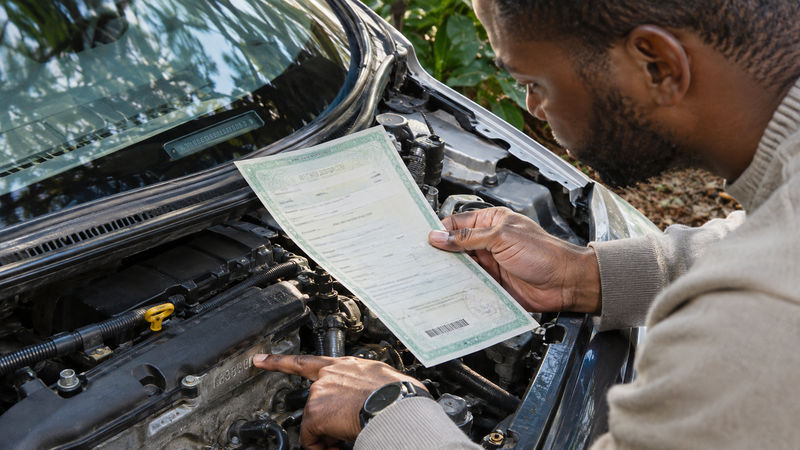
The vehicle’s registration certificate is one of the most important documents in any used-car transaction.
It identifies the registered owner and title holder, who may be different parties.
If the car is financed, the bank or finance house will generally be listed as the title holder, while the person paying the instalments is recorded as the owner.
This distinction matters because the finance house retains legal title until the outstanding debt has been settled.
Ask the seller to produce the original registration certificate and check that the details correspond with the vehicle and the seller’s identification.
If the bank is still the title holder, the seller may not have the original certificate. In that case, request supporting documentation from the finance house and follow the correct settlement procedure.
A missing original certificate isn’t necessarily evidence of fraud, but it does require further investigation.
Our advice: Never rely solely on a photocopy, photograph or the seller’s assurances. Make sure there’s a legitimate, verifiable route to obtaining the original registration certificate before committing to the purchase.
3. Check whether the vehicle has been reported stolen
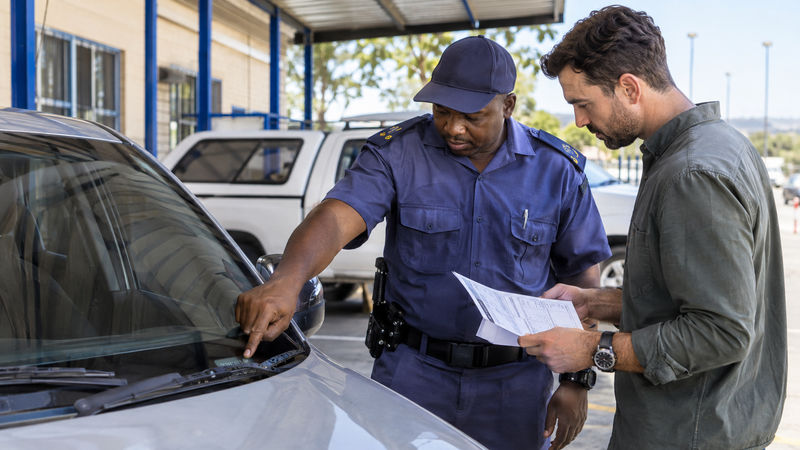
A vehicle can look perfectly legitimate, have convincing paperwork and still be flagged as stolen.
A police-interest check is therefore an important part of the buying process.
You can approach SAPS to enquire about verifying a vehicle’s status, although the availability of informal checks may differ between police stations. Don’t assume that every station will provide an immediate database search or written confirmation.
For additional reassurance, consider a reputable paid vehicle-history service that includes a police-interest check.
Where formal police clearance is required, the process is more involved. It generally requires an application through a vehicle registration authority and a physical inspection at an authorised SAPS vehicle clearance unit.
Police clearance should not be confused with a simple stolen-vehicle database enquiry.
Our advice: If the vehicle’s identity or documentation raises concerns, insist that these are resolved through the appropriate authorities before paying anything.
You should also familiarise yourself with the warning signs covered in our guide to avoiding used-car scams in South Africa.
4. Find out whether the car was previously written off
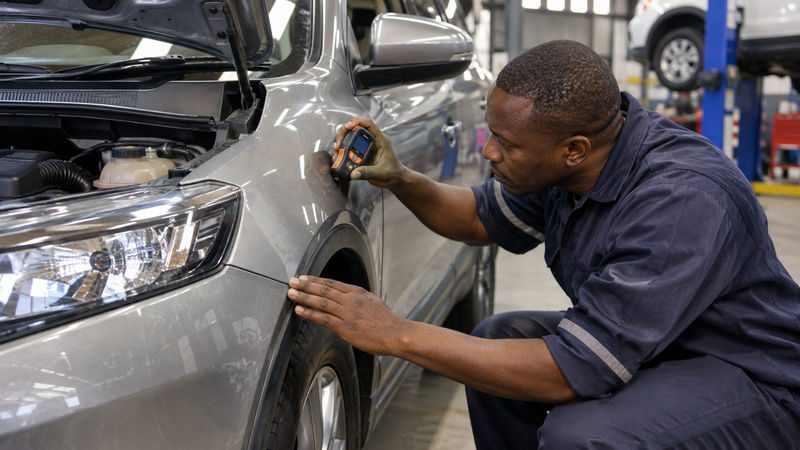
One of the most useful free tools available to South African used-car buyers is the South African Insurance Association’s (SAIA) VIN-Lookup service.
Launched in September 2023, the platform allows consumers to search participating insurers’ salvage records using a vehicle’s VIN.
Visit vinlookupsa.co.za to perform a check.
The database covers 3 important vehicle classifications:
| Classification | Meaning |
|---|---|
| Code 3 | A vehicle classified as rebuilt or built-up |
| Code 3A | A vehicle designated for spare parts only |
| Code 4 | A vehicle classified as permanently demolished or scrapped |
A Code 3 vehicle may have been extensively damaged and subsequently rebuilt. Although such vehicles can potentially be returned to the road following the required procedures, their history can affect their value, insurability and finance eligibility.
As we explain in our Code 2 vs Code 3 comparison, Code 3 vehicles typically command substantially lower prices than equivalent Code 2 examples. Financing and comprehensive insurance can also be difficult to obtain.
However, there’s an important catch.
A clean VIN-Lookup result doesn’t necessarily mean a car has never been written off or seriously damaged.
SAIA’s database doesn’t include all vehicles or all insurance-related write-offs. Code 2 salvage records are excluded, while vehicles repaired privately may never appear on the system.
In other words, a car could have sustained substantial accident damage, been repaired and still be registered as Code 2.
Our advice: Use VIN-Lookup as a starting point, not a guarantee. If you’re serious about buying a particular vehicle, have it independently inspected for previous accident damage.South African Insurance Association+2
5. If the car is financed, settle the bank first
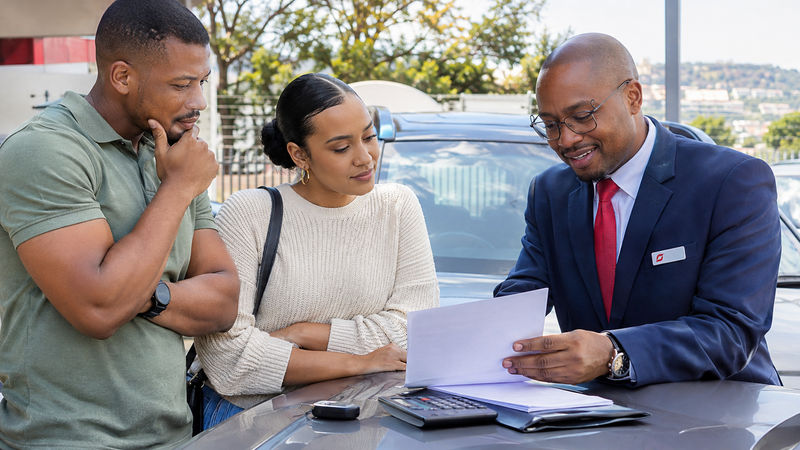
Buying a vehicle that’s still under finance isn’t necessarily a problem, provided the transaction is handled correctly.
The first step is to ask the seller for a current settlement letter from their finance house.
This document confirms how much is needed to settle the outstanding debt and the period for which the settlement figure remains valid.
Check that the vehicle and account details are correct, and independently verify the payment instructions with the bank. Don’t simply trust banking details forwarded by the seller.
Where the agreed purchase price exceeds the outstanding finance, the settlement amount can be paid directly to the finance house, with the remaining balance paid to the seller under an agreed arrangement.
If the outstanding finance exceeds the selling price, the seller must arrange to cover the shortfall before the bank can release its title.
Once the account is settled, the finance house can release the necessary ownership documentation so that the transfer can proceed.
Our advice: Never pay the full purchase price directly to a private seller on the promise that they’ll settle the bank afterwards. Arrange the transaction with the finance house and make sure the documentation and payment process are agreed upon in advance.
For a more detailed explanation, read our guide on how to sell a financed car privately in South Africa.
6. Spend R149 on a comprehensive vehicle-history report
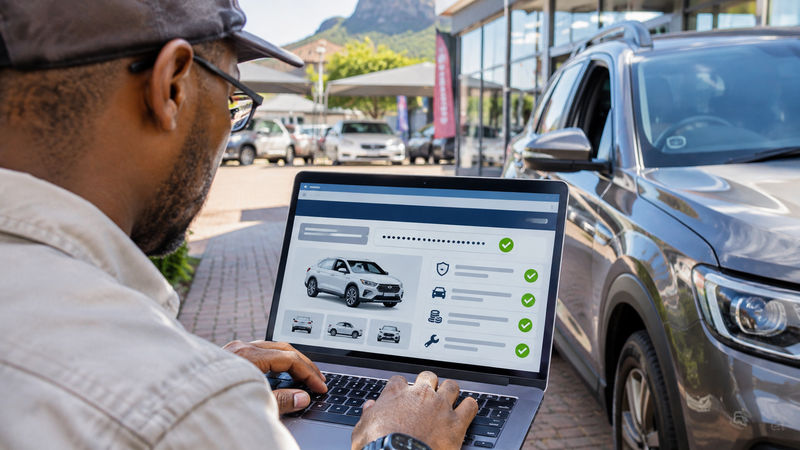
While several checks are free, spending a relatively small amount on a vehicle-history report could save you thousands of rands.
FirstCheck, for example, currently advertises 2 vehicle-history packages:
| Feature | Essential Check | Complete Confidence Check |
|---|---|---|
| Price | R79 | R149 |
| VIN verification | Yes | Yes |
| Vehicle specifications and valuation | Yes | Yes |
| Recorded repair or damage history | Yes | Yes |
| Police-interest check | No | Yes |
| Outstanding-finance check | No | Yes |
| Microdot information | No | Yes |
The R149 Complete Confidence Check is the more comprehensive option, particularly when buying from a private seller.
It combines several important checks in one report, including police-interest and outstanding-finance information.
You can obtain a report through FirstCheck.
Bear in mind that even a comprehensive vehicle-history report is only as reliable as the information available to the provider. It cannot guarantee that every accident, repair or ownership issue has been recorded.
Our advice: For a private purchase, the additional R70 for the more comprehensive report is money well spent. But don’t use it as a substitute for checking the vehicle’s documents or arranging an independent mechanical inspection.
Don’t forget the paperwork after buying
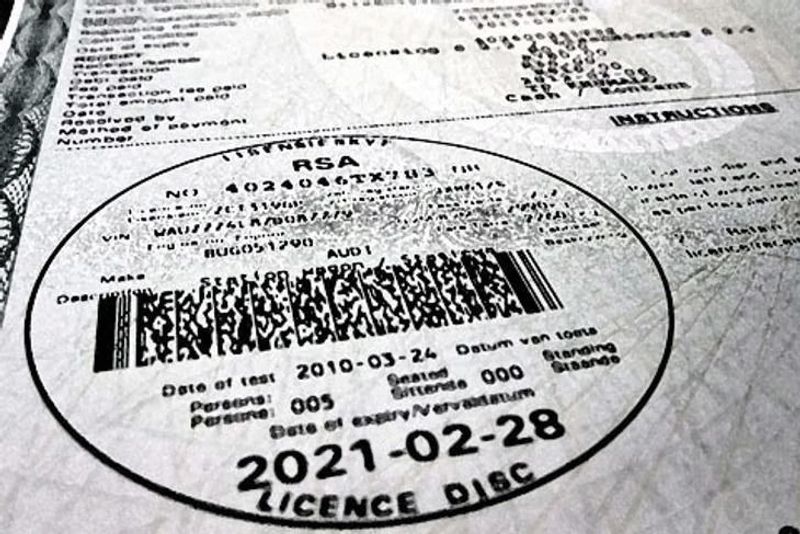
Once you’ve verified the vehicle and agreed on a purchase, there are still a few administrative requirements to complete.
The seller must notify the relevant registering authority of the sale by submitting a Notification of Change of Ownership (NCO).
The buyer must then register and license the vehicle in their name within 21 days of the change of ownership.
You’ll generally need the relevant registration documents, proof of purchase, identification, an application for registration and licensing, and a valid roadworthy certificate where required.
According to the South African government’s official guidance, failing to register the vehicle within the prescribed period can result in arrears and penalties.
Make sure the seller completes their part of the process and that you receive all the documents needed to transfer ownership.
Verdict: A few checks now could save you thousands later
Buying a used car privately can be an excellent way to save money, but the responsibility for verifying its history largely rests with you.
Checking the VIN, confirming the ownership documents, investigating previous accident damage and establishing whether finance is outstanding should all happen before any money changes hands.
For just R149, a comprehensive vehicle-history report can add another valuable layer of protection.
And don’t overlook the car’s mechanical condition. Even a vehicle with legitimate paperwork and no recorded accident damage could be hiding expensive problems.
Our rule is simple: no verifiable paperwork, no matching numbers and no clear ownership or finance arrangements mean no deal.
If a seller becomes evasive, refuses reasonable checks or pressures you into making an immediate payment, it’s probably time to look elsewhere.
Buying from a reputable dealer can offer additional consumer protections, but you should still inspect the vehicle and verify its history.
Ready to start looking? Browse the latest used cars for sale on Cars.co.za and familiarise yourself with our tips for buying a used car from a private seller before committing.
Cars.co.za

Providing you with the latest motoring news, new car releases and the simplest way to buy and sell cars.