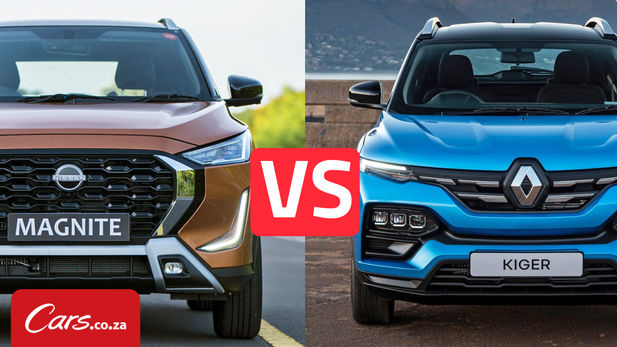
The Nissan Magnite and Renault Kiger are closely related, though there are a few key differences. Let’s look at the main differences between these 2 budget crossovers…
The Nissan Magnite and Renault Kiger are effectively automotive cousins. Despite being offered by Japanese and French brands respectively, these budget crossovers are closely related. They even ride on the same CMF-A+ platform!
While they both roll off the production line at Renault’s manufacturing plant near Chennai in India, the Magnite and Kiger are primarily differentiated by their interior and exterior designs. However, there are a few more key distinctions, in addition to minor specification variances. Let’s take a closer look at the differences!
Nissan Magnite vs Renault Kiger: What’s the difference?
1. Engine Outputs and Fuel Economy
In South Africa, the Magnite and Kiger are both available with 1.0-litre, 3-cylinder petrol engines, either in naturally aspirated or turbocharged guise. The atmospheric motor in the Magnite makes 53 kW at 6 250 rpm. The Kiger version offers slightly less power (52 kW), though this peak arrives earlier in the rev range (6 000 rpm). Peak torque is 96 Nm in either case.
See specification details for the Nissan Magnite
See specification details for the Renault Kiger
Compare specifications using our handy Car Compare Tool
The free-breathing mill has a listed fuel consumption of 5.9 L/100 km in the Magnite in both 5-speed manual and automated manual transmission (AMT) guise. However, the corresponding claims for the Kiger are interestingly 5.3- and 5.2 L/100 km, respectively.
Meanwhile, the turbocharged engine makes 74 kW and 160 Nm in manual-equipped versions of both the Magnite and Kiger. We must note that the Kiger’s claimed economy is slightly more appealing (5.0- vs 5.3 L/100 km).
Paired with a Continuously Variable Transmission (CVT), the Magnite 1.0 Turbo loses 8 Nm, reducing its peak torque to 152 Nm. In addition, the CVT-equipped Magnite’s claimed fuel consumption figure of 6.0 L/100 km is higher than the Kiger’s 5.4 L/100 km.
2. Dimensions and Practicality
While they share the same 2 500 mm wheelbase, the Magnite measures 3 995 mm long, while the Kiger stands 3 991 mm long. However, the Renault version stands 33 mm taller at 1 605 mm, though the Nissan is a touch wider.
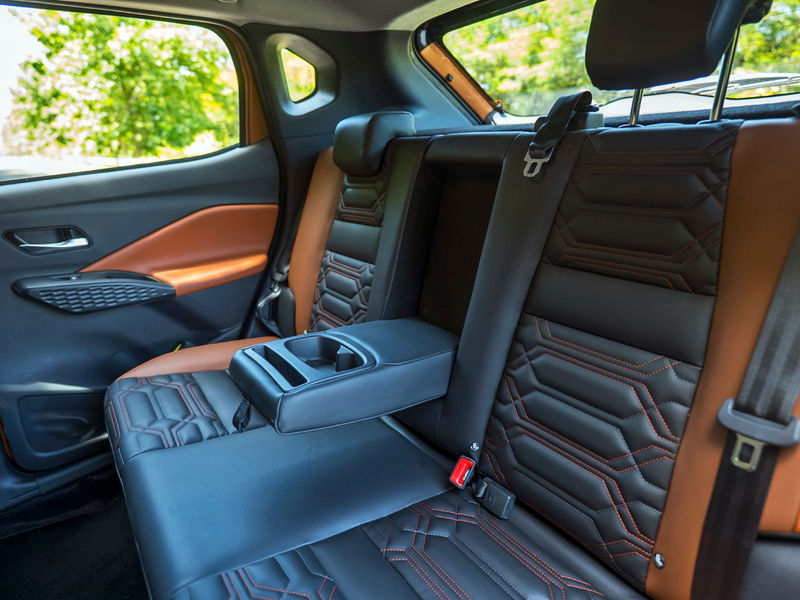
Luggage space is perhaps more important than a few millimetres of bodywork and the Kiger has a claimed boot space of 405 litres. The Magnite’s capacity comes in at 336 litres, though it features a lower loading lip. However, Nissan’s contender boasts more cabin space, including rear legroom, along with arguably more comfortable seats.
Also see: What To Buy: Hyundai Exter vs Chery Tiggo 4 vs Nissan Magnite
3. Standard Safety Features
While the Kiger ships with either 2 or 4 airbags (depending on the derivative), all versions of the Magnite were upgraded to 6 airbags for this model’s facelift late in 2024. The Nissan furthermore features ABS, rear parking sensors, electronic stability control and tyre-pressure monitoring across the range. Only certain derivatives in the Kiger line-up, meanwhile, come with the latter 2 items.
4. Nissan Magnite vs Renault Kiger: Price and Warranty in South Africa
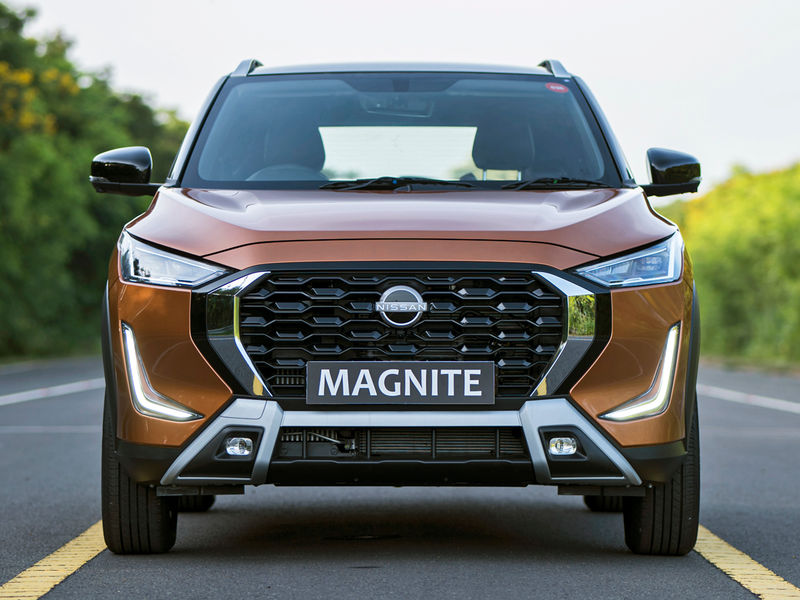
In South Africa, the facelifted Nissan Magnite range comprises 10 derivatives, including the Move-badged panel-van derivative. The still-to-be-refreshed Kiger line-up, meanwhile, is made up of 7 variants (likewise including a panel-van iteration called the “Express”).
At the time of writing (June 2025), Nissan SA’s pricing for the Magnite ran from R229 900 to R410 700, with all derivatives covered by a 6-year/150 000 km warranty.
Buy a new Nissan Magnite on Cars.co.za
Buy a used Nissan Magnite on Cars.co.za
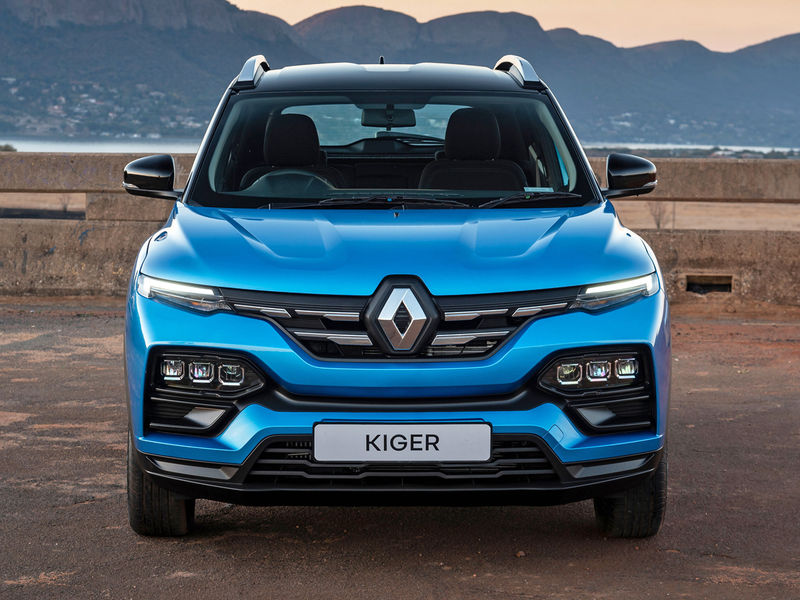
Renault SA, meanwhile, listed pricing bookends of R249 999 and R359 999 for the Kiger, along with a marginally shorter 5-year/150 000 km warranty.
Buy a new Renault Kiger on Cars.co.za
Buy a used Renault Kiger on Cars.co.za
Nissan includes a 3-year/30 000 km service plan (with 10 000 km intervals) in the purchase price of all Magnite derivatives bar the panel van. Renault offers a more modest 2-year/30 000 km service plan, though its service intervals are stretched to 15 000 km.
Summary
Based on the above, we can see that the Nissan Magnite range – which offers more choice than that of its Gallic cousin – boasts slightly more interior space, along with a more extensive list of standard safety kit. It also features a lower starting price and a longer warranty, while its service plan stretches to 3 years!
Both models offer similar performance characteristics but the Renault Kiger hits back with better claimed fuel economy and a larger luggage compartment. Furthermore, the Kiger’s service plan covers just 2 years but the recommended service intervals (in mileage terms, anyway) are higher at 15 000 km.
Ultimately, your decision will hinge on your personal needs. Which one of these budget crossovers gets your thumbs up?
Related content
Automatic Compact SUVs in SA Under R300k
Most Fuel-Efficient Compact SUVs Under R350k
Nissan Magnite (2024) Price & Specs
What to Buy: Suzuki Fronx vs Chery Tiggo 4 Pro vs Nissan Magnite
Cars.co.za

Providing you with the latest motoring news, new car releases and the simplest way to buy and sell cars.