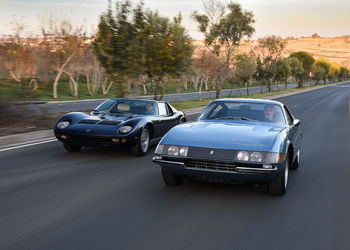
Owning a Lamborghini Miura in South Africa is a rare privilege. But how about owning 2 at the same time? For many years, Peter Bailey was the caring custodian of the 2 incredibly special cars you see here.
The Lamborghini Miura is unquestionably one of the prettiest supercars ever made. Apart from that, it’s widely regarded as the model that laid the foundation of what would become the supercar genre.
That is, if you define a supercar as a high-performance, 2-door sportscar that is also mid-engined. In the Miura’s case, this means a 3.9-litre, V12 engine that is fitted transversely, with the gearbox on the side of the engine… it is truly an engineering marvel.
IMAGES: Justin Pinto
Lamborghini Miuras are as scarce as hen’s teeth in South Africa. Around 5 years ago, a rather special Miura left our shores, which had been in the country for several decades.
Specifications:
- Model: 1970 Lamborghini Miura P400S
- Production years: 1968–71
- Units produced: 338 (of the P400 S)
- Engine: 3.9-litre, V12
- Power: 276 kW at 7 500 rpm
- Torque: 388 Nm at 5 500 rpm
- Gearbox: five-speed, manual, RWD
- 0-100 kph: 5.5 sec (claimed)
- Top speed: 282 kph (claimed)
Shortly after filming this video, the orange car sadly also left South Africa, leaving the blue Miura as likely the last of its breed. That said, rumours persist that there is another 1 somewhere in the Republic…
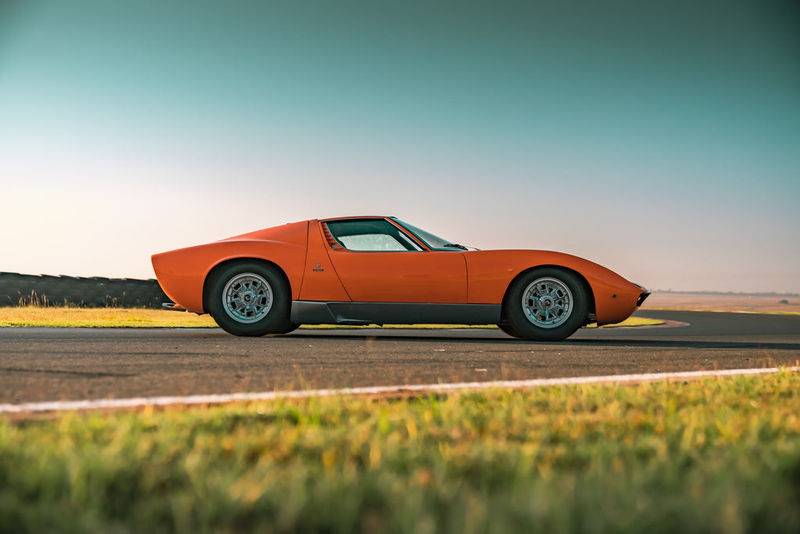
On the day of filming, the owner, Peter Bailey, allowed us to shoot his neatly restored Arancio Orange example, a car he found in pieces many years ago and then took several years more to restore perfectly.

However, when the gearbox started to give some trouble 2 hours into our filming schedule, I had to ask him the difficult question: “Peter, can we please go and fetch your other Miura?”… Now THAT was a question I never thought I’d ask anyone!
A gearbox issue brings the blue Miura into play
Being a true enthusiast, Peter said “sure”, and we headed back to Johannesburg, and pulled the soft car cover off his Azzurro Mexico Blue Miura.
I lowered myself into the passenger seat and during the next few kilometres enjoyed the sights and sounds as Peter took his time to slowly warm up all the Miura’s fluids.
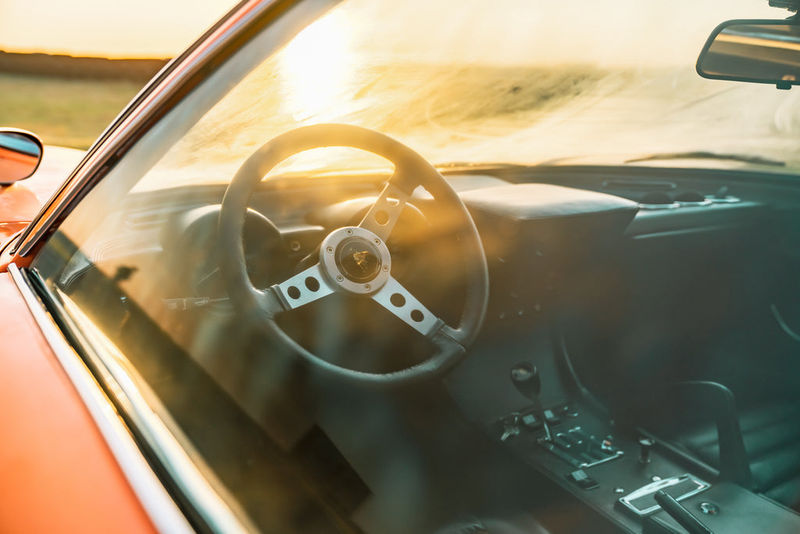
Then we hit the highway, and centimetres behind my head, the V12 engine sang away as the sounds permeated the cabin, and the Miura hit its stride. The performance must have been quite intoxicating when the Miura was launched in 1966.
The story of Ferruccio Lamborghini‘s decision to start manufacturing cars has been well documented, but the Miura is the car that truly placed the raging bull manufacturer from Sant’Agata on the map.
Lamborghini turned to Bertone, where the late automotive design legend Marcello Gandini, then aged 26, put pencil to paper. The Miura made its global debut at the Geneva Motor Show in 1966.
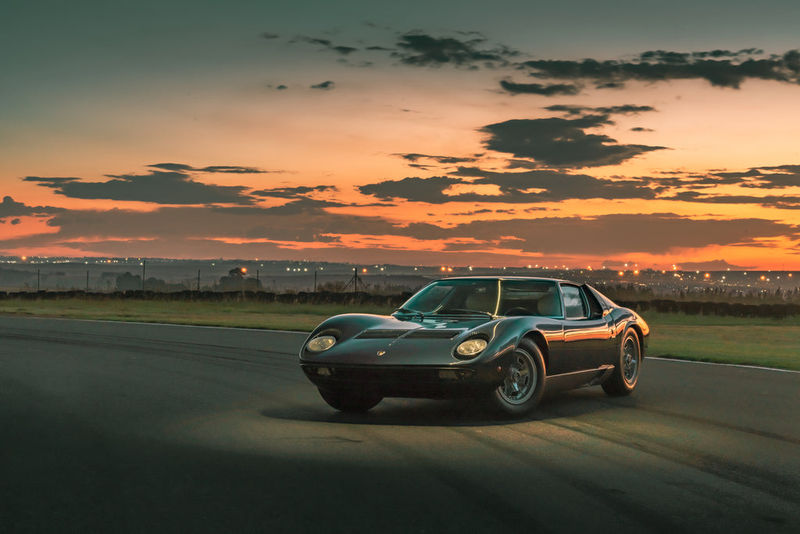
Before the show, the car was referred to as project P400, but then at the show, it was decided to name the car after Don Eduardo Miura, at the time a respected breeder of fighting bulls. The first production car was delivered to its owner in March 1967.
Orange Miura took 17 years to restore
“It truly is a piece of art. About 20 years ago, I found the blue one. It was at the local Lamborghini dealership when I saw it, and 5 months later it was still there,” said Bailey. “The dealer said we should come to an arrangement, and I bought it. About a year later, I came across the orange one; it was in pieces, but I thought it would be a good idea to buy it, which I did, and 17 years later, it was on the road.
“They are both identical cars, supposedly, made within a year of each other, but they are unique. The blue Miura is unrestored, the engine has been redone, and it starts and runs. It has that lovely thing that the English call ‘patina’. The orange one is fully restored; the result is that they are both different.”

Although most drives with these cars have been all too brief, the dark car has been driven to Durban and back as part of an epic 3-day road trip.
Overall, the design of the Miura is a near-perfect blend of sportiness, elegance and style. The pop-up headlights are flush with the body and surrounded by small grilles that aid air flow to the front brakes. Soon after its introduction, these grilles started being referred to as the Miura’s “eyelashes”.
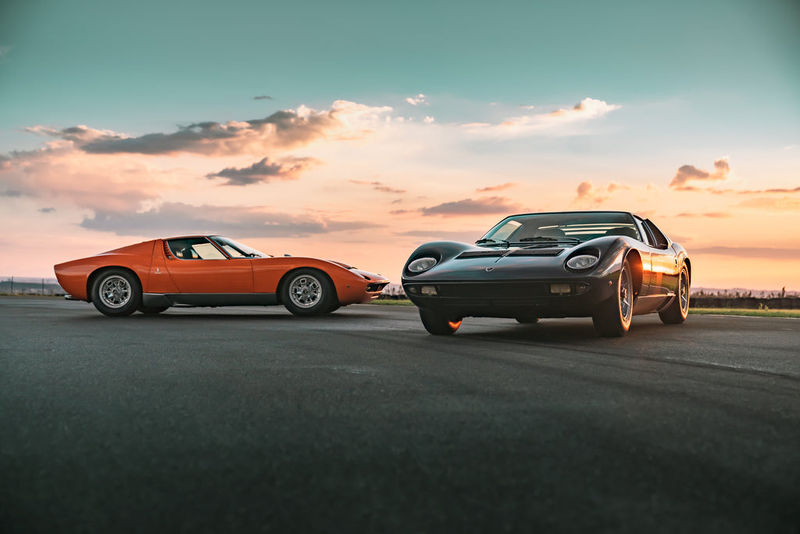
Lamborghini continued the evolution of the Miura by unveiling the “P400S” at the 1968 Turin Motor Show – it went into production in January 1969. With power increased to 276 kW, the car also featured wider-section tyres and “thicker body panels compared to the thinner metal of the first models”, Bailey says.
“Being in South Africa, I couldn’t have finished the orange car without the blue car. It would have been very difficult,” he adds. But he most certainly did, and we have both on video!
New Lamborghini Specs & Prices in South Africa
Find a new/used Lamborghini model on Cars.co.za
Related content:
Ferrari 365 GTB/4 Daytona vs Lamborghini Miura P400S: Classic Comparison
Stunning Lamborghini Miura SV restored – with SA heritage
Ferrari 400 vs 456M GT vs 612 Scaglietti: Classic Comparison