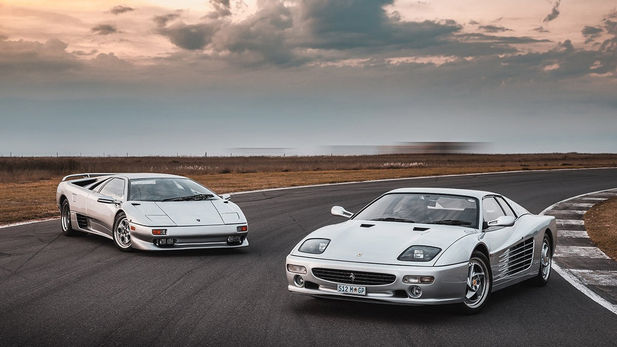
Both these evocative ’90s supercars offer mid-engined 12-cylinder thrills, but as we discovered, the Lamborghini Diablo and Ferrari F512 M are very different animals…
I’m filled with nostalgia as my gaze sets upon the Lamborghini Diablo, which is parked in an industrial area – thoughts of all those mad supercars of the 80s and 90s (yes, including the Ferrari F512 M) and the TV shows and movies in which they starred, overwhelm me and send shivers down my spine.
The owner bought his Diablo more than 10 years ago with 70 000 km on the odo and has since added more than 22 000 km. He uses this supercar (very) often – for his daily commute and longer, more enjoyable runs. Based in Johannesburg, he is clearly not afraid of sitting in traffic with the Diablo.
I walk around the car on my way to the passenger side, thinking that the owner can drive his, um, fiendish machine through the traffic before I get my turn behind its ‘wheel at the track, only to find him already warming the seat. Having met him a few times before, I fully expect the chirp he slings my way.
His “don’t you know how to use a clutch?” sends me back to the Diablo’s driver’s seat. Okay, so my first taste of a Diablo VT is going to be driving through peak afternoon traffic in South Africa’s largest city…
See also: Ciro drives a Lamborghini Diablo at Zwartkops
Specifications:
- Model: 1995 Lamborghini Diablo VT
- Engine: 5.7-litre, V12
- Power: 362 kW at 7 000 rpm
- Torque: 580 Nm at 5 200 rpm
- Transmission: 5-speed manual, RWD
- Weight: 1 625 kg
- 0-100 kph: 4.5 sec (claimed)
- Top speed: 325 kph (claimed)

I slide into the Lamborghini‘s driver’s seat, and suddenly I’m not concerned about the traffic anymore. This car grabs your attention from every little angle. The seat is mounted low in the chassis, while your view from the driver’s seat is vastly different to that of any other “modern classic” that I’ve driven.
When I pull the scissor door shut (still an attention-grabber, 3 decades on), I notice how the side window dips down towards the front wheel to give you a clear view of the road – ideal for clipping apexes?
You have the angled dashboard in front of you, while the steeply raked windscreen gives the cabin an airy aura. Once seated, it becomes very clear that you are positioned towards the nose of the car, with the business end, which houses that thrusting Sant’Agata-built 5.7-litre V12, sitting right behind you.
It is initially overwhelming to drive the Diablo through traffic, as I don’t want to ride the clutch in any way, but after a few kilometres, I realise that this ’90s supercar is easier to drive sedately than I anticipated.
Sure, the clutch pedal is rather heavy and gear changes should not be rushed, but overall it is certainly not as challenging as I had imagined. While I try to navigate through traffic, the owner deals with all the remarks from fellow road users – he is clearly quite used to it.
We are making our way to Red Star Raceway, which is approximately an hour’s drive outside Joburg. There, we meet up with a pristine example of the F512 M, in the custody of a good friend of its owner.
Design & History
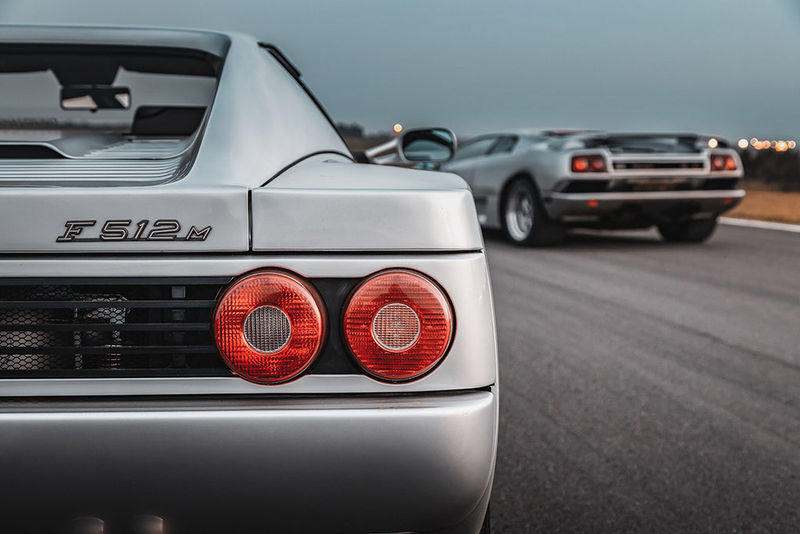
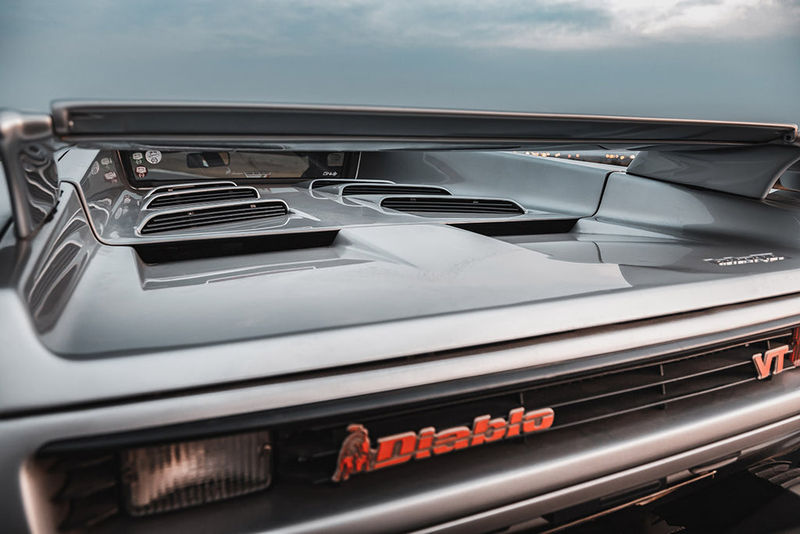
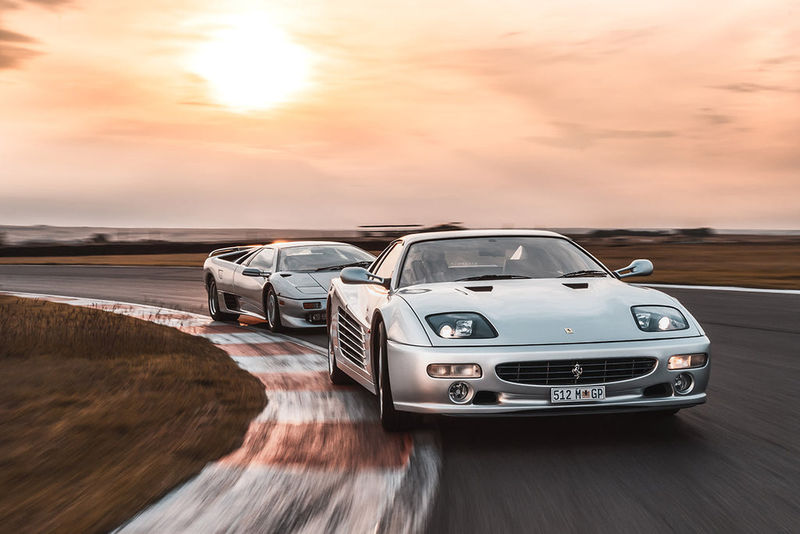
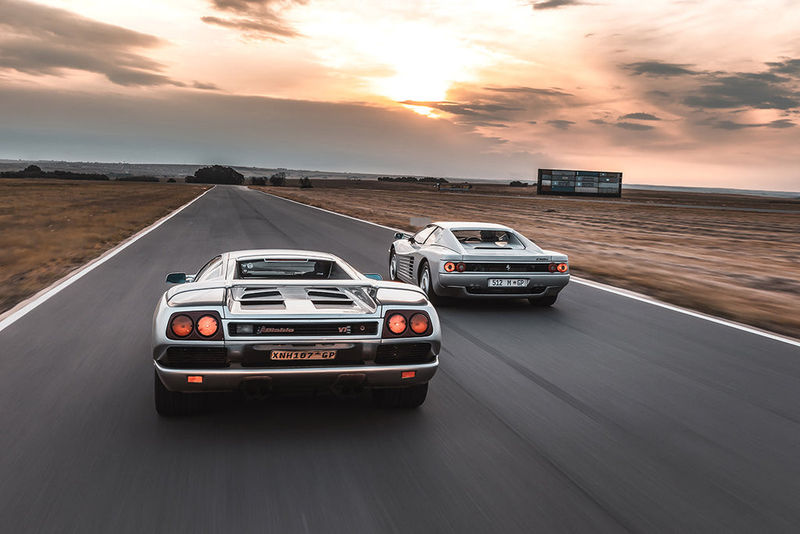
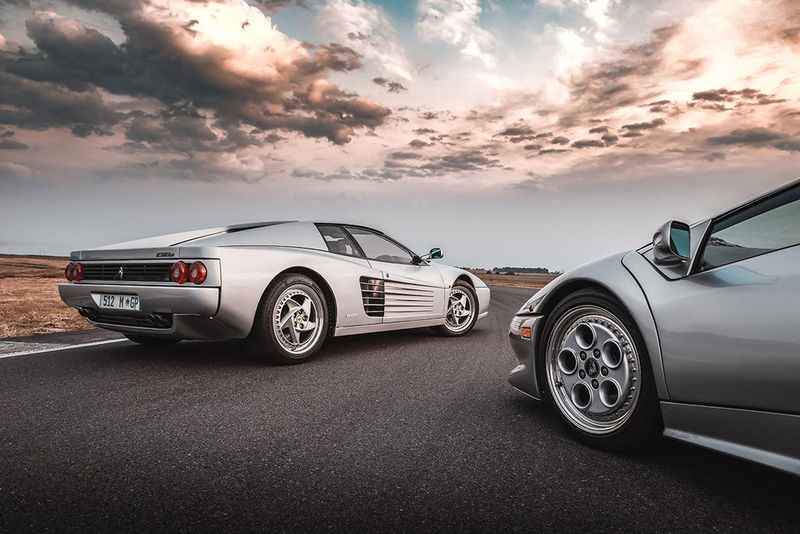
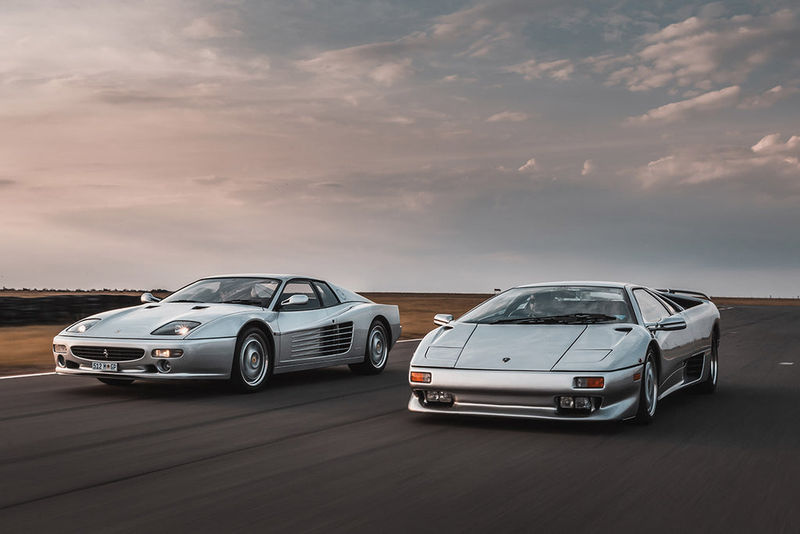
As the Ferrari F512 M arrives, it immediately offers a stark, yet welcoming contrast with the outlandish Lamborghini Diablo. Whereas the Diablo has that notable rear wing, angular front wedge shape, pop-up lights and side and top air intakes, the Ferrari visually classifies itself as the gentleman’s super-GT.
Although both cars have NACA ducts above their headlights (not seen on the Testarossa or the TR), the front design of the F512 M is more fluid, followed by the flowing curve above the slatted side intakes and lower and wingless rear end. The Diablo’s rear also offers larger and more obvious engine air outlets and even more outlets below the rear deck.
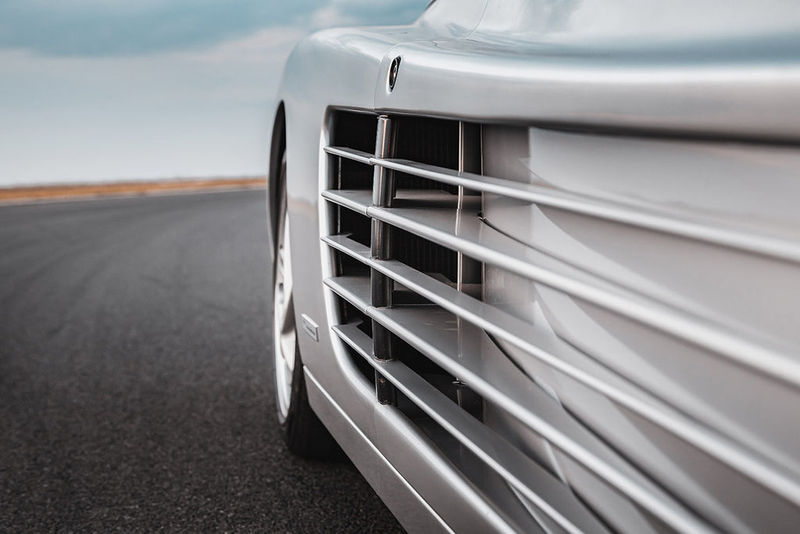
As with the Diablo, the F512 M clearly stands out from the crowd today (imagine what it must have been like in the ’90s!), but its presence is undoubtedly less shouty than the bull from Sant’Agata.
The F512 M was the 3rd and final iteration of a lineage started by the Ferrari Testarossa (and the 365 GT4 BB before that), its direct predecessor being the 512 TR. Unveiled at the 1994 Paris Motor Show, the F512 M incorporated several new Pininfarina styling elements and improvements.
Gone were the pop-up headlights; it got a revised front-end treatment (including a new grille, with cues of the then-upcoming F355) and new wheels to name 3 of the main changes. At the rear, the grille was reduced in size, while a pair of circular taillamps was fitted on either end of the fascia.
The engine cover was now body coloured. To my eyes, it’s a more modern and resolved design than its predecessors and, as one would expect, presents much less of the 1980s Leonardo Fioravanti influence.
Whereas the Maranello-built flat-12 produced 287 kW in the Testarossa and 317 kW in the 512 TR, it developed 328 kW at 6 750 rpm and 500 Nm at 5 500 rpm in the F512 M (which had a claimed kerb weight of 1 455 kg). Its claimed top speed was an impressive 315 kph (not far off the F40‘s 324 kph).
The 512 M is also a relatively rare beast, with only 501 units manufactured (more than 2 500 Diablos were produced over the model’s 11-year production cycle, of which around 400 units were VTs).
Specifications:
- Model: 1995 Ferrari F512 M
- Engine: 4.9-litre flat-12, naturally aspirated
- Power: 328 kW at 6 750 rpm
- Torque: 500 Nm at 5 500 rpm
- Transmission: 5-speed manual, RWD
- Weight: 1 455 kg
- 0-100 kph: 4.7 sec (claimed)
- Top speed: 315 kph (claimed)
The F512 M has lived a vastly different life from the Diablo. It has covered less than 26 000 km, and this is obvious not only in the car’s interior and exterior condition, not to mention the driving experience.
On track
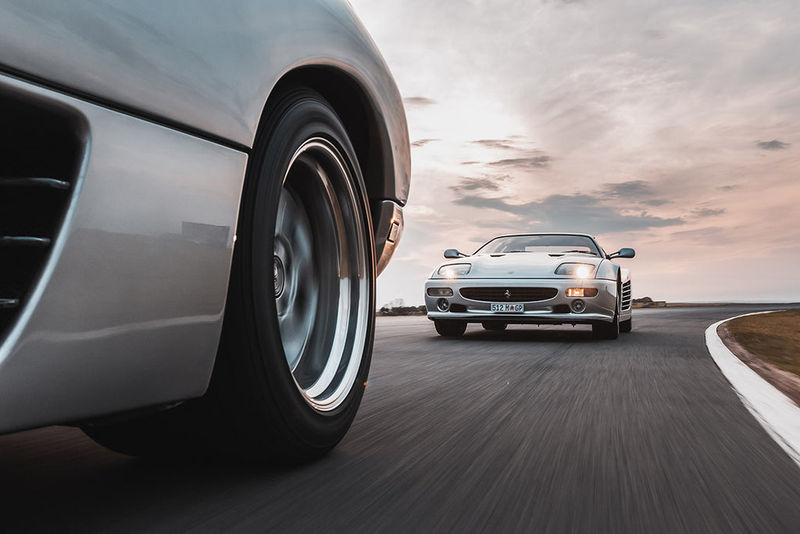
With photography done, the track is a safe place to explore what these supercars offer, 3 decades after their debuts. I step into the luxurious cabin of the F512 M and immediately I experience it as a different kind of supercar, perhaps it leans more towards a super-GT that just happens to be mid-engined.
The combination of the Nero and Blu Scuro (black and dark blue) leather together with the plush carpets lends the cabin a cosy feel, which is not the case with the Lamborghini. However, the seriousness of the performance on offer is immediately felt by the presence of that quintessential metal gearknob and exposed gate, as well as the drilled metal pedals, which are slightly offset to the left.
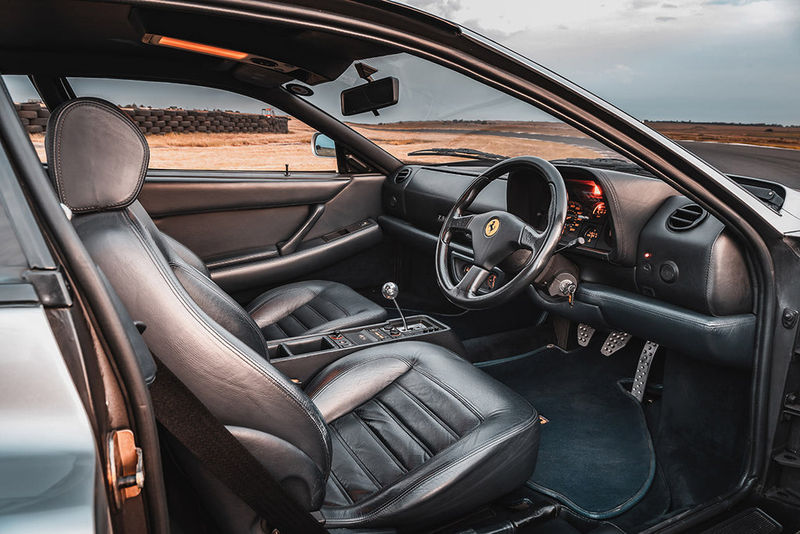
The seating position is good (and comfortable), although I would have liked the ‘wheel closer to me. My hair only just brushes the roof lining, so I’m constantly kept aware that I’m driving a low-slung sportscar!
The layout of the Ferrari F512 M’s cabin is more conservative than the almost playboy-like interior of the Lamborghini Diablo, which is also perfectly in keeping with the divergent approaches of these supercars.
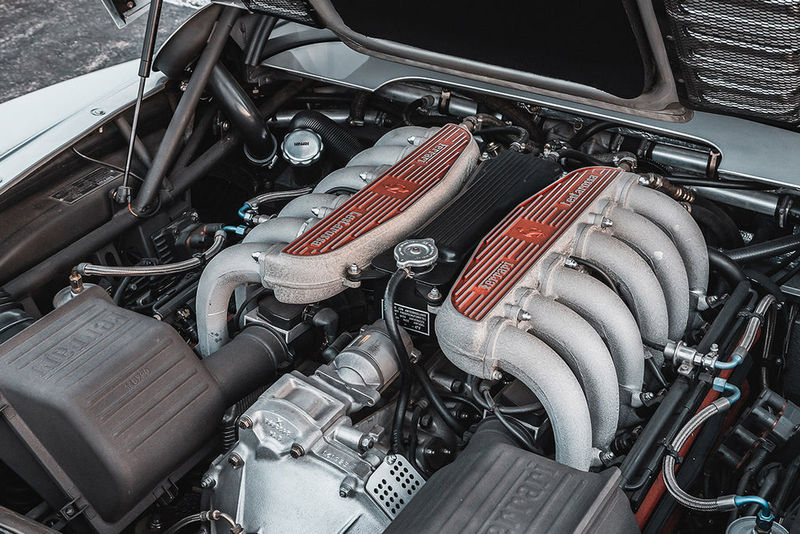
I twist the ignition key to the right of the ‘wheel, and the Prancing Horse’s engine growls into life. As the gear lever slips into 1st gear’s slot with a subtle “clack”, I can’t help but smile. If you don’t own an open-gate Ferrari, do whatever you can to drive one at least once; it’s one of the great motoring experiences.
It only takes a few slow corners to realise this car is in tip-top condition. There are barely any rattles, and the Ferrari almost doesn’t feel its age. Considering the heft of the flat-12 behind me, the turn-in is good.
But as I get into a rhythm with the car I start trusting those wide rear tyres (which are 295/35 ZR18s, but the Lamborghini has even wider 335/35 ZR17 “gumballs”) and realise that, once the F512 M has settled into a corner, a measured flex of that medal throttle pedal shows just how much grip is actually on offer.
Make no mistake, the engine is eager to rev and it does so linearly and efficiently, which is typical of a large, naturally-aspirated powerplant. There are no surprises, just an honest howl running through the rev range all the way past 6 000 rpm – the red line is just after 7 000 rpm.
Flat-12 pulls eagerly from low revs
If you can (somehow) contain the urge to rev to the redline, the 4.9-litre flat-12 pulls eagerly enough from low in its rev range, which of course is an ideal characteristic of a super-GT. What’s more, although I didn’t lean on them very heavily, the Ferrari‘s brakes feel strong, even by modern standards.
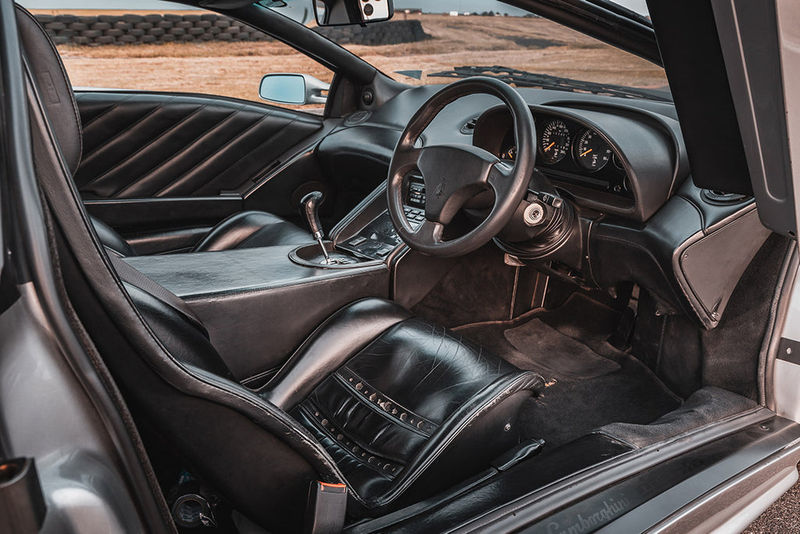
As I return to the Lamborghini Diablo‘s cockpit, it feels like you sit closer to the ground than in the Ferrari F512 M, plus the wide transmission tunnel creates further distance between you and your passenger.
As is the case with the Ferrari, the Lamborghini’s open-gate gearlever (which is fitted with a slightly less appealing, almost generic leather gearknob) reminds one of a time when driving these cars was not for the faint of heart, demanding from you a focus and determination not required by contemporary exotics.
If Lamborghini fitted the Diablo VT with a relatively small steering wheel to make the car feel nimbler, its plan certainly succeeded. Diablos are not lightweight cars, but the turn-in is surprisingly crisp (if you take the machine’s size and heft into consideration), while every shift of the transmission takes some planning – such a welcome exercise compared to today’s sophisticated, if slightly boring, dual-clutch systems.
You can easily place the Diablo‘s front wheels exactly where you want them to go, while the throaty and intense sound from the quad exhaust pipes underlines the difference in personality between the beastly Diablo and the more debonaire F512 M. However, the previous owner of the Diablo couldn’t help but fit a Tubi aftermarket system on the supercar – another reason it is considerably louder than the Ferrari.
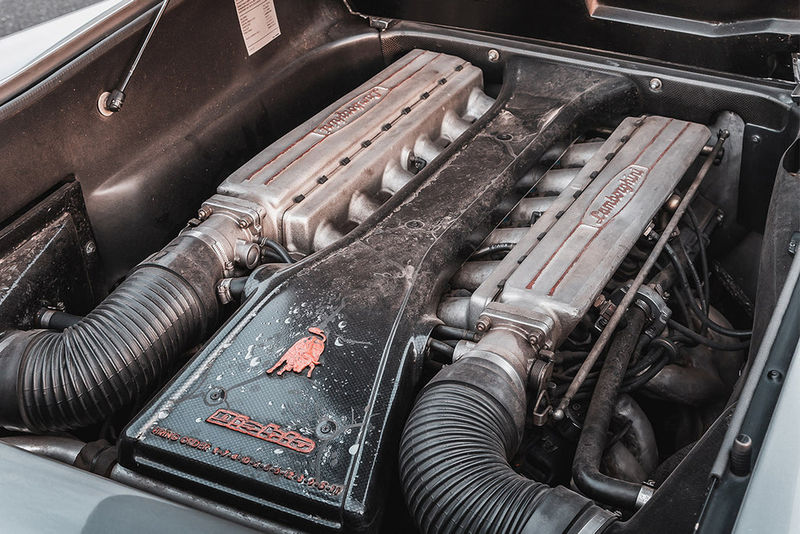
The engine’s power delivery is brutal (its peak outputs are 362 kW and 580 Nm), and although you can use the available torque by shifting through the gearbox early, when you do leave it in gear and pass 3 000 and then 4 000 rpm that rawness of the performance makes itself heard until well past 6 000 rpm.
Lambo’s V12 is brutal
The Diablo‘s brake pedal is firm and requires a good stomp to scrub off speed. Driving this car is a huge thrill and something you want to do over and over again. To offer a purer driving experience, the owner removed the front drive shafts, which transformed this VT from an all- to a rear-wheel-drive supercar.
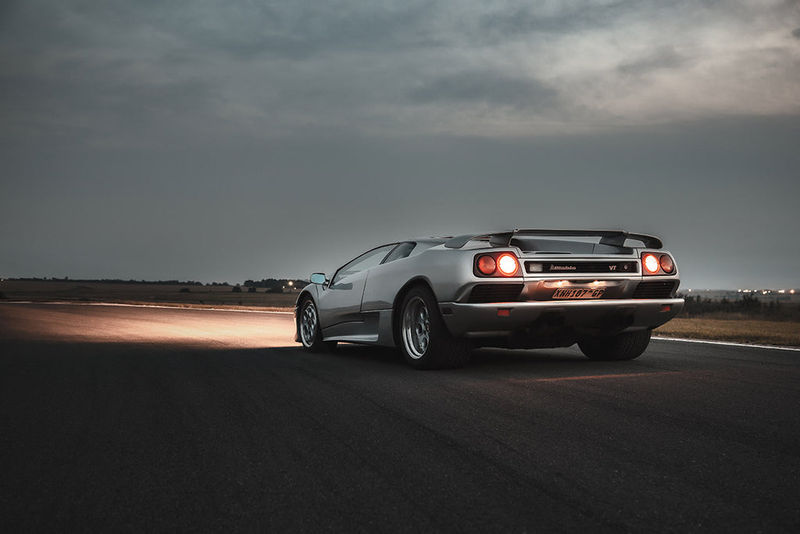
Later, when the Diablo’s owner takes his car for a final lap with the sun already set behind the horizon, the Marcello Gandini-penned shape looks utterly stunning and focused – a sight I’ll never forget.
I asked him about how the Diablo crossed his path: “It’s funny you should ask that. Earlier today, I re-watched the opening scene of Cannonball Run. It’s that movie, which featured a black Countach and some beautiful women, that got me into Lamborghinis in the first place.
“I’ve always wanted a Countach; years ago, I did bid on one in an auction (even though I couldn’t really afford the car at the time), so I bought a Ferrari 308 instead. But later, things fell into place, and in 2012, I was able to purchase this example after I put in a cheeky offer.”
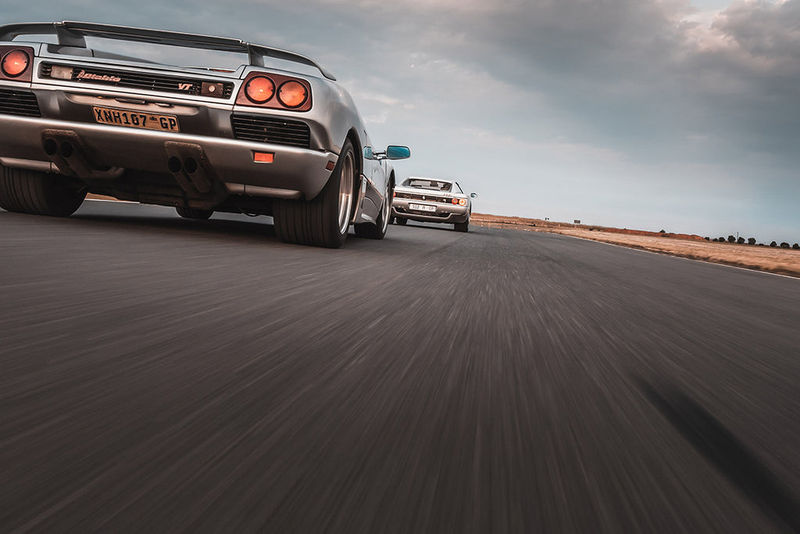
Needless to say, the Diablo’s owner has no intention of selling his car, perhaps ever. “Every single car I have purchased, I bought to drive and experience. I never buy a car just to park it,” he adds.
F512 M owner ‘a stickler for originality’
The owner of the F512 M has a long history of restoring a variety of cars and is utterly pedantic about keeping his cars in original condition. He explains: “In 2014, a Ferrari specialist approached me and told me that he had a car that I might be interested in. There are only 2 of these F512 Ms in South Africa, and I’ve always appreciated them. In the ’60s and ’70s, flat-12s were the apex road- and race car engines.
“I’ve owned a TR for a couple of years, but the F512 M is the gold standard and last-of-the-line Ferrari flat-12. The fact that this car was completely original and meticulously maintained appealed to me.”
Verdict
Both these cars were easier to drive than I anticipated. Both also looked as enticing in real life as I had hoped. They represent the pinnacle of performance of their time, but whereas the Lamborghini Diablo is the winner in terms of being a Goliath that stands its ground, the Ferrari F512 M does its job in a more sophisticated and perhaps more stylish way.
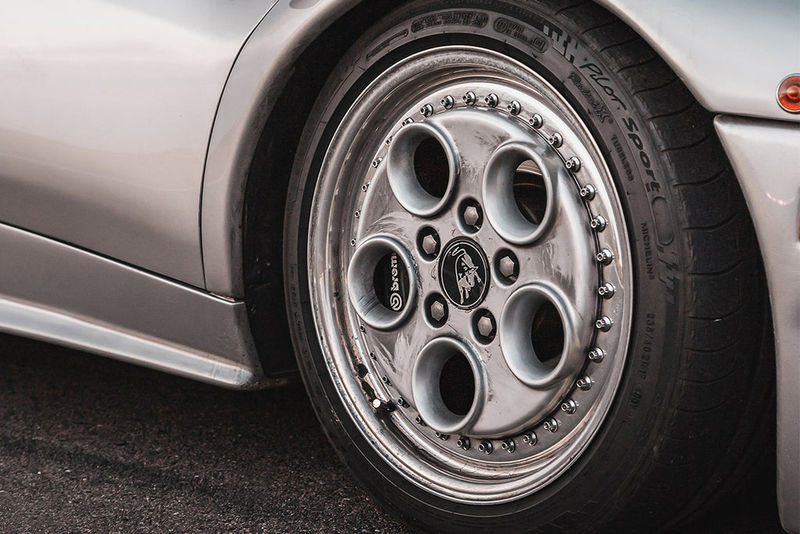
The Lamborghini Diablo draws attention away from the Ferrari F512 M, even when they’re standing still. But style is subjective – they’re impressive, poster-worthy designs, awash with fine details such as split-rim wheels and the subtle aerodynamic addenda. As for divine 12-cylinder engine notes, take your pick.
Watch Ciro De Siena drive the Lamborghini Diablo at Zwartkops:
But, when you want to cover long distances and “operate slightly more under the radar”, the Ferrari F512 M will be one to have. As a Road & Track article mentioned: “Its styling is dramatic, its highway manners nearly flawless, and that big 12-cylinder engine makes a soul-stirring sound you will hear nowhere else. It’s a combination of desirable attributes difficult to improve upon, even for Ferrari”.
Find a new/used Lamborghini listed for sale on Cars.co.za
Find a new/used Ferrari listed for sale on Cars.co.za
Related content:
Ciro drives a Lamborghini Diablo at Zwartkops
Poster Child Ferrari Testarossa: SentiMETAL Ep7
Ferrari 365 GTB/4 Daytona vs Lamborghini Miura P400S: Classic Comparison
Lamborghini Miura: Meet the SA man who owned 2 of them!
Ferrari F40: Enzo’s Greatest – SentiMETAL Ep13
Ferrari 400 vs 456M GT vs 612 Scaglietti: Classic Comparison
Wilhelm Lutjeharms

A passionate car enthusiast from an early age, Wilhelm has been a motoring writer since 2006, having worked for more than 10 years at CAR magazine before turning to a full-time freelance career. He is also a contributing writer for UK, USA and European-based motoring titles.