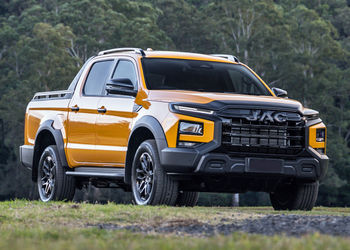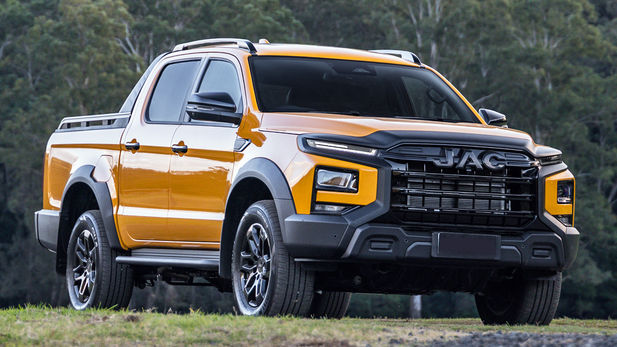
The JAC T9 PHEV promises better performance than a Ford Ranger Raptor. But is 360 kW in a double-cab perhaps too much of a good thing?
There was a time when 200 kW seemed like an impossible power threshold for a double-cab bakkie. But the final version of the first-generation Amarok 3.0 V6 turbodiesel changed that assumption in late 2020. VW brought a true double-cab bakkie with 200 kW and usable payload to market and proved it could be done.
Six years later, South African double-cab bakkie buyers now have a choice of extraordinarily powerful models, nearly all of them Chinese. And none of them turbodiesel. It’s telling how much the Chinese brands are influencing the local bakkie market.
BYD’s Shark 6, launched in 2025, shattered expectations of how much acceleration and highway overtaking power a South African buyer could have in a double-cab. With a peak power output of 350 kW, the Shark 6 offers performance unimaginable to bakkie buyers only a few years ago.
However, the Shark 6 is no longer South Africa’s brawniest bakkie. Enter the JAC T9 PHEV… Its stats are startling: 360 kW and 674 Nm of torque.
Let’s look at what those numbers mean in a real-world application and how they compare to rivals’ outputs.
Where the T9 fits into the range
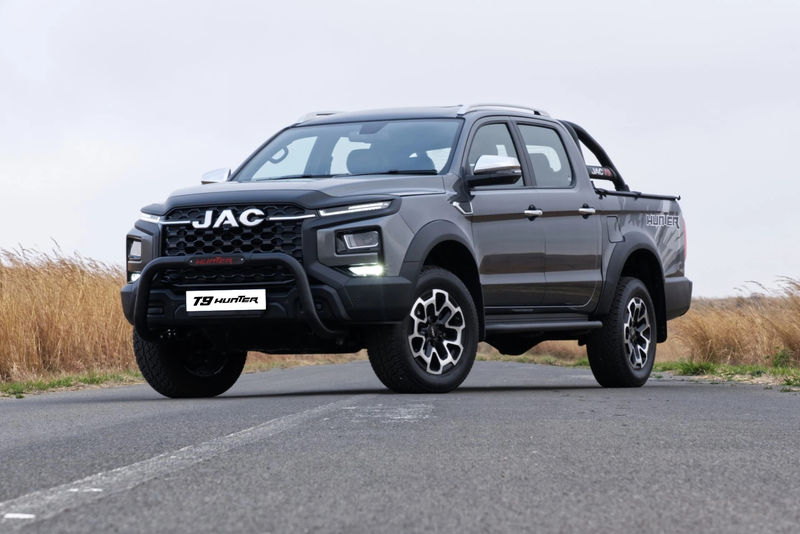
JAC’s bakkies aren’t necessarily well known as leisure double cabs. The brand has mostly served fleet and utility buyers rather than competing with adventure-grade Hilux and Ranger derivatives. But JAC’s T9 series looks set to change that. It features JAC’s most luxurious cabin as well as multi-link rear suspension, prioritising unladen ride comfort and enhanced stability on corrugated dirt roads.
Like most Chinese vehicles, the JAC T9 PHEV has a selection of standard features that are a lot more generous than you’d find in legacy rivals. The PHEV, meanwhile, also offers some much-needed ergonomic upgrades over diesel-powered T9 versions.
Setting a comfortable driving position in a bakkie can be challenging due to the shallow floor. This is compounded by a number of bakkies not offering depth adjustment on the steering column. One such bakkie is the T9 range, except on the PHEV, which tilts and telescopes. That’s a welcome upgrade.
Search for a JAC T9 on Cars.co.za
It’s heavy but it still has a decent payload rating
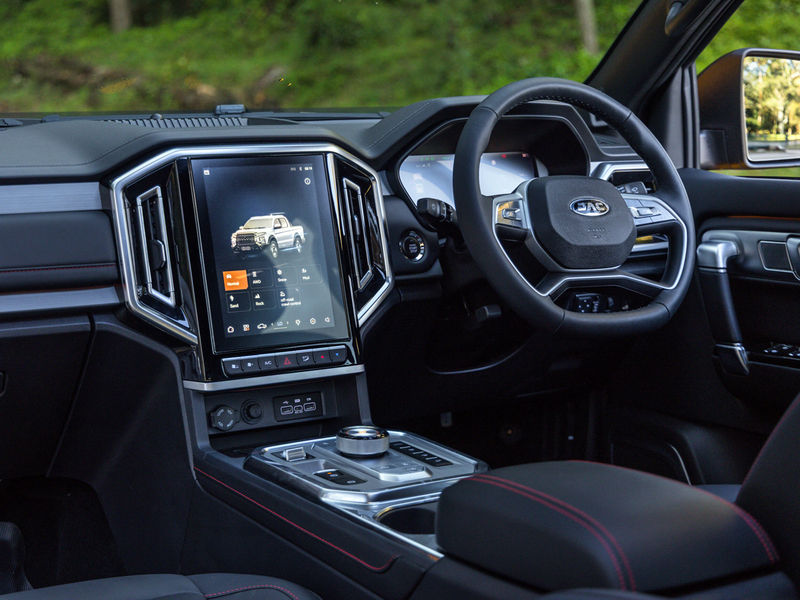
Like the BYD Shark 6, the JAC T9 PHEV is heavy. At 2 512 kg, the performance potential of 360 kW will always feel a little blunted, but not by much. Do the power-to-weight math and it works out to 143 kW/tonne. That’s impressive, especially compared to a Ford Ranger Raptor, which delivers 120 kW/tonne.
Thankfully, unlike many Chinese PHEVs, the JAC T9 PHEV doesn’t have a remarkably low payload. Despite the weight of its large battery pack, it does retain an entirely usable carrying capacity of 915 kg. In fact, it can take a heavier load than the Ford Ranger Raptor (by some 187 kg).
What’s interesting about the JAC T9 PHEV’s payload rating is that it’s possible despite the multi-link rear suspension instead of a leaf-sprung live axle. Some clever linkage engineering must have been applied to the bakkie’s rear to allow it to balance ride comfort and carrying capacity.
Towing is impressive, too, with a braked capacity of 3 500 kg. That’s on par with the best standard-driving-licence Ford and Toyota bakkies on sale in South Africa.
But what about the JAC T9 PHEV’s battery setup?
The T9 PHEV has a 31.2 kWh lithium-iron phosphate battery pack. That should be good for 100 km of real-world driving range, or enough for most urban-dwelling bakkie owners.
Lithium-iron phosphate is also best for durability, especially compared to nickel-based lithium-ion powertrain batteries. It sacrifices outright recharging speed for battery cell integrity. That means there’s little apparent risk of the JAC’s battery pack suffering long-term degradation.
It has more gears than BYD’s bakkie
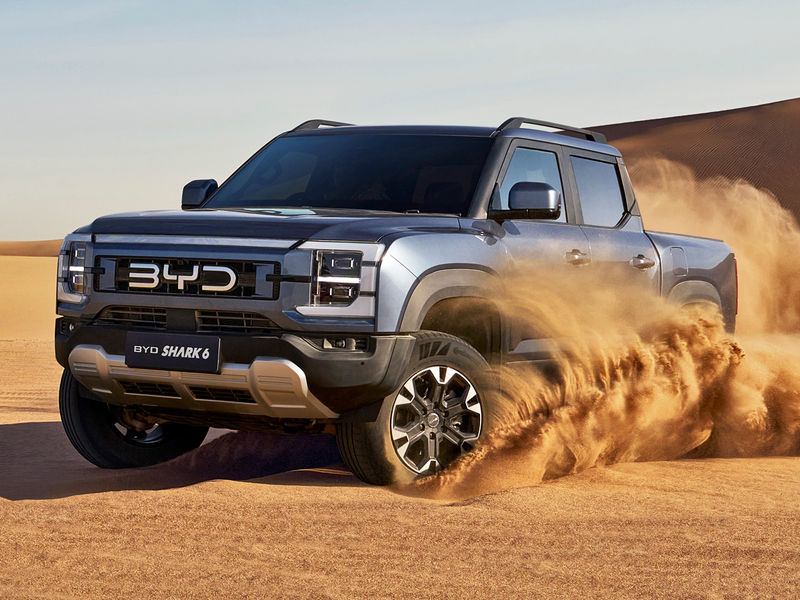
The JAC T9 diesels feature an eight-speed automatic transmission from renowned German supplier ZF. The PHEV has a different setup, however. Drive from the 2.0-litre turbopetrol engine and the two electric motors are managed by a 4-speed hybrid automatic transmission. That’s half the gears of the T9 turbodiesel, but a lot more than the single-gear setup you get in the BYD Shark 6.
It should mean much better off-road ability, too. One of the BYD Shark 6’s evident weaknesses is the single-gear drivetrain. This setup is geared for highway driving but can’t provide the ratio needed for high-torque, slow-wheel-rotation exercises. And that is what technical off-road driving is all about.
Search for a JAC T9 on Cars.co.za
When is a lot too much?
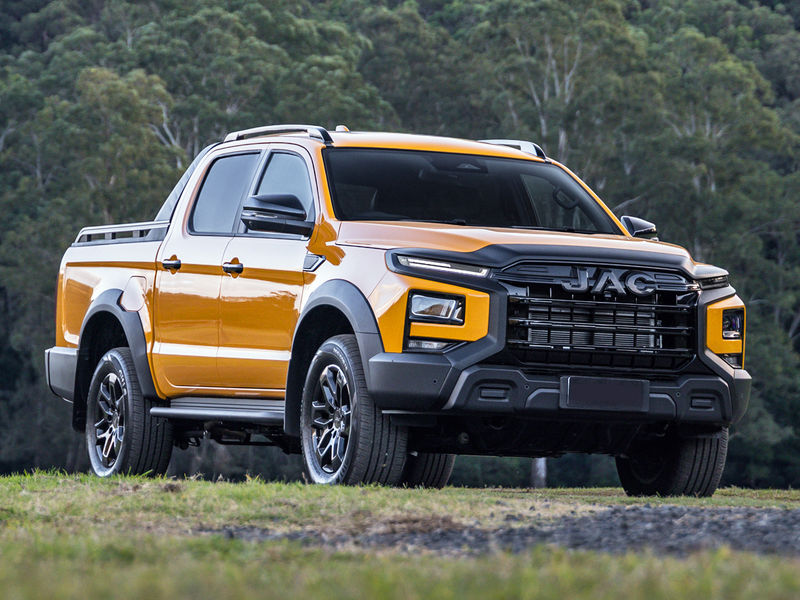
If AMG has been selling heavy, extremely powerful large SUVs for many years, why can’t a body-on-frame bakkie have more than 300 kW?
If there are questions about a 360 kW body-on-frame family vehicle, what about Toyota’s Land Cruiser 300 HEV? Or the Mercedes-AMG G63? These legacy-brand SUVs are also heavy, built on a ladder-frame chassis and very powerful. Both platforms have been proven and refined over several generations, and their suspension setups are as sophisticated as it gets.
When VW brought the 200 kW Amarok 3.0 V6 turbodiesel to market, questions were raised about the platform handling so much power. VW responded by upgrading the rear drums to disc brakes. And besides, the platform had already proven itself.
That said, bakkie buyers should consider the limitations of a body-on-frame layout, especially when there’s 360 kW on tap. Ultimately, the T9 PHEV has a high centre of gravity, relatively slow steering responses and tyres specified for a bakkie.
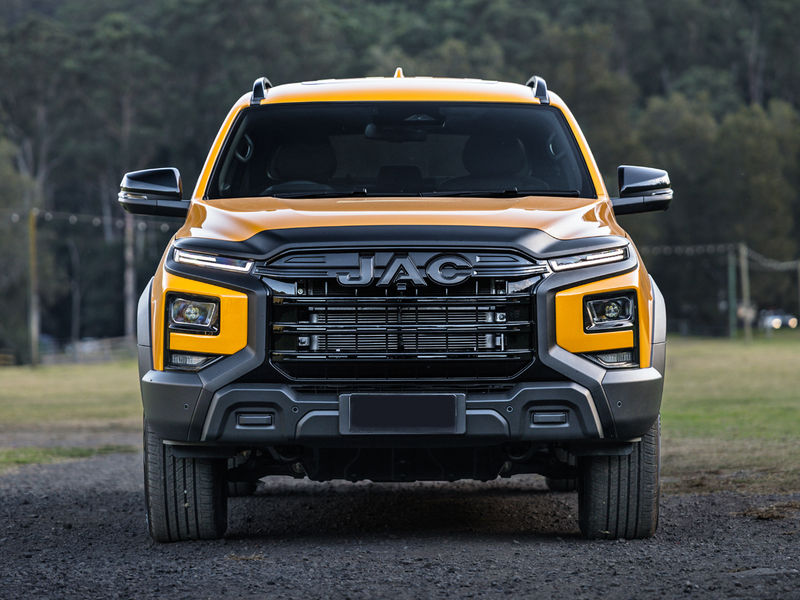
The 360 kW peak power output has its benefits, however. It creates a margin of safety when overtaking, because you spend fewer seconds at risk in the oncoming traffic lane. But is the rest of the bakkie upgraded to be in dynamic balance with all that power?
Ford’s Ranger Raptor is a high-performance bakkie with a significantly upgraded structure, suspension and brakes compared to the standard Ranger, which already has one of the most over-engineered bakkie platforms. The BYD Shark 6 also features a beefed-up structure; it has some of the most oversized frame rails on a production bakkie.
What about the T9 PHEV, seeing as it has 3 times the power output of the most powerful T9 turbodiesel. How much more advanced are its braking and suspension components, and actual frame structure? We cannot wait to get our hands on one to answer all these questions.