In the market for a first-generation Toyota Fortuner? Here’s everything you need to know, from strengths and weaknesses to what you should look out for when shopping for a used version of this popular Hilux-based SUV…
This Toyota Fortuner Buyer’s Guide will help you make the best buying decision if you’re in the market for a used Fortuner!
Late in 2004, Toyota brought to fruition the idea of building a 7-seater SUV based on the popular Hilux bakkie (incidentally, its second attempt, after the Hilux Surf was unveiled in the mid-1980s). The thinking – as part of the company’s International Multi-purpose Vehicles (IMV) project – was to build a series of closely related models for emerging markets in emerging markets, rather than in the brand’s domestic space of Japan.
South Africa, of course, was one of those production sites, alongside Thailand, Indonesia and Argentina. Thus, the Toyota Fortuner family SUV was born, inheriting the rugged underpinnings of the seventh-generation Hilux but gaining plenty more in the comfort department, too (in part thanks to its coil-sprung rear end). With hindsight, the move may have seemed like an absolute no-brainer – particularly considering Isuzu’s earlier success with the KB-based Frontier – but even the Japanese firm’s local division was initially surprised by just how favourably local buyers received the Fortuner.
Shrewdly positioned just above the RAV4 but below the Land Cruiser Prado, the 3-row Fortuner quickly became South Africa’s best-selling SUV, appealing to frequenters of both bush and boulevard. The formula is one that continues to pay dividends to this day, with the second-generation Fortuner still selling up a storm in South Africa.
Toyota Fortuner model line-up
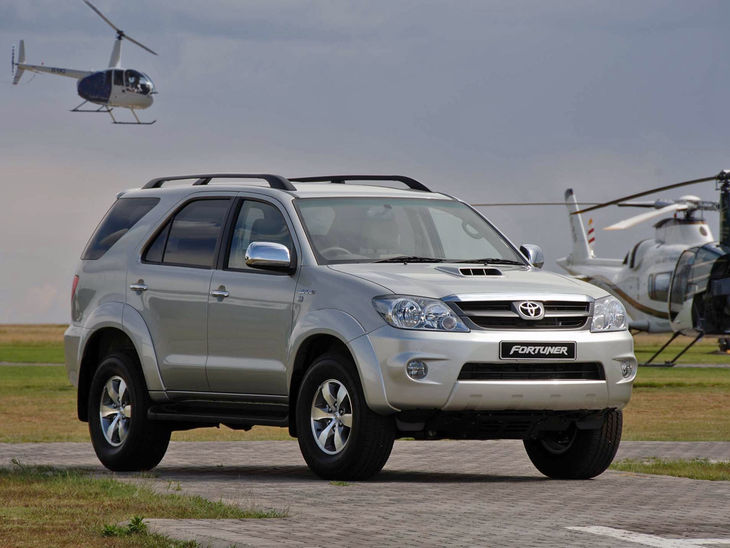
Local production of the original Fortuner kicked off in KZN in early 2006.
Effectively succeeding the Condor and known as the SW4 in some markets, the original Toyota Fortuner was revealed in December 2004 in Thailand. Production officially commenced at Toyota’s Prospecton facility in KwaZulu-Natal in February 2006, with local sales kicking off the following month.
Interestingly, the range did without frivolities such as trim levels, with each derivative in the initial line-up instead differentiated by its combination of engine (3.0 D-4D or 4.0 V6 petrol), transmission (5-speed manual or 5-speed automatic) and driven wheels (4×2 or 4×4). At launch, 5 variants were available:
- 3.0 D-4D 4×2 (120 kW/343 Nm) 5-speed manual
- 3.0 D-4D 4×4 (120 kW/343 Nm) 5-speed manual
- 4.0 V6 4×2 (175 kW/343 Nm) 5-speed manual
- 4.0 V6 4×4 (175 kW/343 Nm) 5-speed manual
- 4.0 V6 4×4 AT (175 kW/376 Nm) 5-speed automatic
Over the next decade, the AN50/AN60-generation Fortuner benefited from a handful of updates. Such was its popularity, however, that Toyota was never forced to make sweeping changes, instead being content to occasionally tweak the body-on-frame SUV to keep it in line with local tastes and expectations.
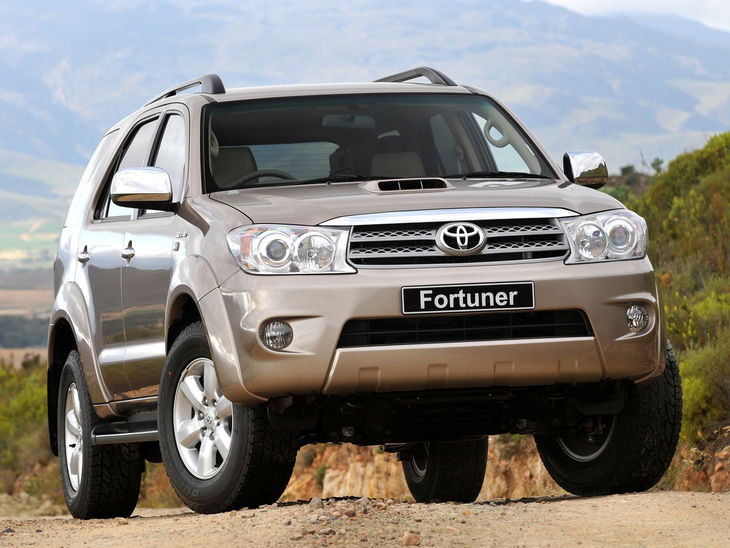
Note the new grille and headlights that arrived with the Fortuner’s 2009 update.
In 2009, for instance, the Fortuner’s cabin gained ergonomic updates such as new air-conditioning controls (linked to roof-mounted vents for the two rearmost rows of seats), while the exterior scored redesigned lights, fore and aft, as well as a new grille and larger wheels (growing in diameter from 16 to 17 inches). Though the engines were unchanged, the rear-driven 3.0 D-4D variant gained the option of a 4-speed automatic cog-swapper. Electronic stability control was also introduced at this point, while the fuel-tank size increased from 65 to a more useful 80 litres. “Epic” special-edition versions of the V6 model were also offered.
Two years later, in 2011, a few more running changes were implemented, including the fitment of a new chrome-heavy grille, redesigned bumpers (front and rear) and somewhat chunkier fenders. Heritage Edition models then briefly appeared in the range. Perhaps more significant, though, was the local introduction of a fresh base engine in the form of the 2.5 D-4D unit, which offered peak outputs of 106 kW and 343 Nm (yes, twisting force matched that of the 3.0 D-4D). Though this powerplant was initially available only with a manual gearbox, Toyota added a 4-speed automatic option late in 2012.
Early in the second half of 2013, the aptly named LTD Edition hit the local market, with production running from July until September of that year. The package was available on all 3.0-litre D-4D turbodiesel and 4.0-litre V6 petrol derivatives, and comprised items such as a branded stainless-steel nudge bar, stainless-steel side steps, chrome side-mirror caps, a rear sill protector, grey 17-inch alloys, a matte-black tow bar, a branded carpet set and the requisite rear badging.
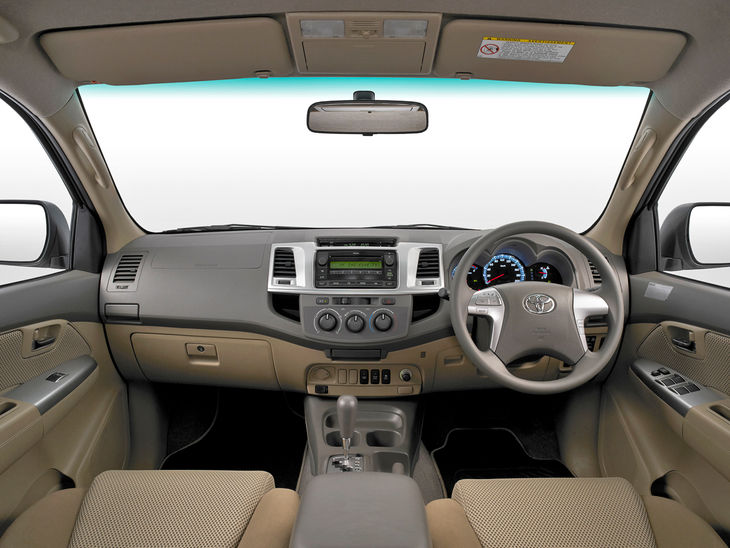
This is what the Fortuner’s cabin looked like (in 2.5 D-4D AT guise) in 2012. Not the most pleasing combination of hues.
Despite local buyers bemoaning the Fortuner’s standard interior colour – which over much of its life ranged from a stain-prone light beige hue to something a few shades closer to brownish-grey – it was only deep in 2013 that Toyota finally switched to a black dashboard and upholstery (fabric in the case of the 2.5 D-4D derivatives and leather for the 3.0 D-4D and 4.0 V6 variants). At the same time, the larger-engined models scored an all-new multimedia system, complete with a bigger display, while 2.5 D-4D models were also upgraded to a revised infotainment system (replete with Bluetooth).
Towards the end of 2014, the bakkie-based SUV received yet more tweaks, including new head- and taillights (now with black detailing), teardrop-shaped front foglamp bezels and chrome side-mirror caps. Half of all 3.0 D-4D and 4.0 V6 Fortuner units produced for two months were again handed the “Epic” treatment, this time comprising a branded chrome nudge bar, dark-grey 17-inch alloy wheels, a rear sill protector, a towbar and “Epic” badging. Another Limited Edition version of the 3.0 D-4D made a brief appearance in 2015, around the time of the all-new model’s reveal on the global stage.
Local production of the original Fortuner ended early in 2016, with the second-generation model officially hitting the market at the close of the first quarter of that year.
Product strengths
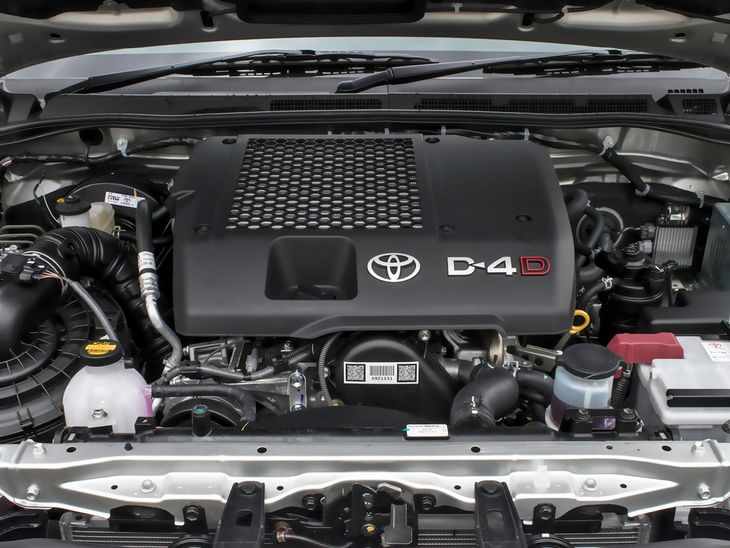
The Fortuner’s renowned D-4D engines were shared with the Hilux.
Rugged and reliable: Thanks to its utilitarian underpinnings and heavy-duty suspension system, the original Toyota Fortuner was as rugged a family SUV as you could buy. Owing to the widespread use of robust materials in the cabin, the sturdy interior proved impressively durable as well.
The tried-and-tested powertrains, too, meant the Fortuner quickly built a strong reputation for reliability. The 1KD-FTV 3.0 D-4D engine was especially highly regarded, with many examples racking up huge mileage with very few problems at all (while being properly maintained, of course). This powerplant also handled 500 ppm sulphur content diesel somewhat better than Toyota’s more modern GD-6 engines that succeeded it.
Space and practicality: In many ways, the first-generation Fortuner was quite simply the right vehicle for thousands of South African families (at the right price), offering the robustness of the Hilux but with added comfort in the capacious cabin. It was versatile, too, with the sliding second row offering the option of maximising legroom in either of the two rearmost banks.

The Fortuner’s spacious cabin gained black upholstery (leather or cloth, depending on the model) in 2014.
There was one black mark in the Fortuner’s practicality ledger, though: the configuration of that final row of seats. Hinged to the luggage compartment’s side-walls, they ate into carrying capacity even when stowed, had a tendency to rattle about and couldn’t be easily removed, either.
Breadth of abilities: A Toyota SA Motors executive once described the Fortuner as “the consummate all-rounder”. There’s plenty of truth in that statement, as the bakkie-based SUV was as capable tackling the school run in relative comfort as it was negotiating rocky passes or clawing its way up Namibian sand dunes. As you might expect, the 4×4 derivatives were particularly impressive off the beaten path, shipping standard with full-time 4WD, with low range and a locking (centrally sited) Torsen limited-slip differential. Rear-driven variants, meanwhile, came equipped with a rear differential lock.
Product weaknesses
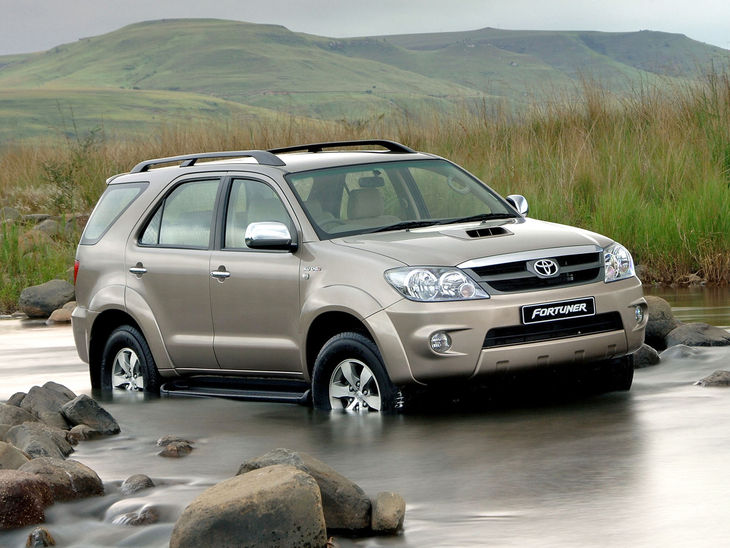
Owners of early Fortuners complained of unstable handling.
Handling stability woes: Early in the Fortuner’s life, there were a number of reports of the SUV exhibiting unstable handling (and sometimes even rolling) on gravel. After a couple of years, a local online forum was awash with irate Fortuner owners, who even collectively threatened to take Toyota to court. Eventually, in 2009, the Japanese firm’s local division acknowledged the existence of a “perceived problem” and opted to fit stability control to all new Fortuners, along with a larger tyre configuration (replacing the original Continental General Grabber 265/70 R16 items). Some owners, though, also opted to upgrade the suspension with aftermarket components.
Faulty fuel gauges: A number of Fortuner (and Hilux) owners reported instances of the fuel gauge “sticking” at around a quarter of tank. The cluster would furthermore show an inaccurate distance-to-empty reading and ultimately leave the unsuspecting driver to run out of fuel (the fuel light would also fail to illuminate). This prompted Toyota SA Motors to release a technical bulletin to its dealer network detailing how to repair potentially faulty IMV combination meters. Though it’s not clear whether this fault was limited to a particular production period, it’s worth noting most of the complaints we’ve seen related to 2012 models.
Injector failures (1KD-FTV): Though the 3.0 D-4D engine was a largely reliable motor, there were a few known issues specifically relating to the 1KD-FTV’s injectors. The copper injector seats used by early models, for instance, were prone to failure (look out for white smoke and listen for a distinctive rattling noise when the engine is still cold), while the injectors themselves were likewise sometimes troublesome. Left unchecked, such issues could lead to clogged oil pick-ups and even cracked pistons.
Other potential foibles to look out for include blocked exhaust gas recirculate valves (resulting in dulled performance) and leaking water pumps, while it’s also worth noting certain versions of the Fortuner were the subject of a 2014 recall in South Africa for a potentially faulty spiral cable (indicated by a dashboard warning light) that could prevent the driver’s airbag from deploying in a crash. Finally, keep in mind the 1KD-FTV and 2KD-FTV turbodiesel engines both use a timing belt that requires replacement every 150 000 km.
What to pay?
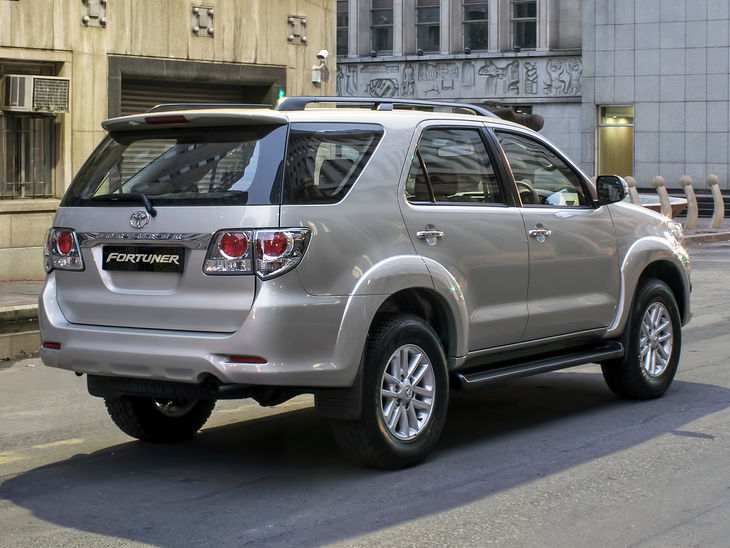
There’s plenty of Fortuner stock on the used market.
As always, it’s worth asking the seller of any Fortuner you’re interested in to provide proof of the vehicle’s service history. Since this bakkie-based SUV shipped standard with a 3-year/100 000 km warranty and a 5-year/90 000 km service plan, even the final few units from this generation would no longer enjoy cover (though the original buyer had the option to extend the service plan to 7 years or 200 000 km). Also, note the turbodiesel models had a service interval of 10 000 km, while the petrol V6’s mark was 15 000 km.
Of the used first-generation Fortuner stock on Cars.co.za at the time of writing, diesel was easily the most popular fuel type, accounting for 88% of all listings (73% in the form of the 3.0 D-4D and 15% in 2.5 D-4D guise). Interestingly, the ratio between manual and automatic transmissions was a near-equal 49:51, while 4×2 configurations made up 69% of all stock. A considerable 49% of vehicles listed had more than 200 000 km on the clock, while we found five examples that had done in excess of 400 000 km.
- Below R200 000: Predictably, the overwhelming majority of vehicles listed below R200 000 were early model-year examples, many sporting lofty numbers on their odometers. There were also a couple of special-edition units (Heritage and Epic) at this price point.
- From R200 000 to R300 000: This was the most densely populated pricing bracket at the time of writing, containing 60% of all listings. We found a number of 2014 and 2015 vehicles that were showing under 100 000 km, most of them in Raised Body (that is, 4×2) guise and combining the 3.0 D-4D powerplant with a self-shifting transmission. It’s here most buyers today would be shopping.
- From R300 000 to R350 000: Despite this higher (not to mention narrower) price band, the 4×2 configuration still dominated, as did the later model years and 1KD-FTV engine. There were also a number of very low mileage examples on offer. If you’re considering paying a premium for the latter, be sure to closely inspect the vehicle to determine whether the general level of wear-and-tear matches the claimed mileage. If it seems too good to be true, it probably is.
- R350 000 and up: Illustrating that 3.0 D-4D models tend to hold their value far better than their V6 petrol counterparts (despite the 6-cylinder derivatives having served as higher-priced flagships when new), this final pricing segment contained only examples with the oil-burning engine. Here we also noticed a few lightly modified Fortuners, bearing items such as snorkels and aftermarket alloys. Unless you’re a seasoned overlander able to identify the quality of such components, we’d suggest avoiding models that are no longer stock standard.
Pick of the range?
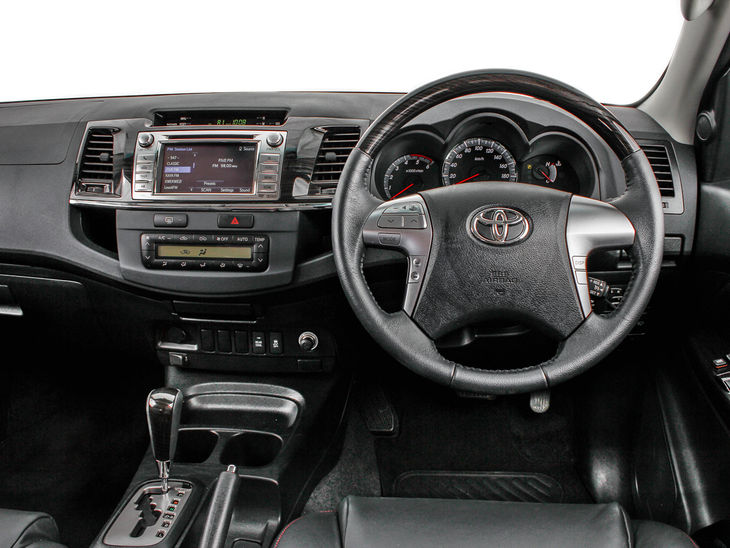
Later models come with more sophisticated infotainment and a more pleasing black interior colour scheme.
So, which model should you consider? Well, as always, the buyer’s budget and intended usage play a large role in answering such a question. If you have intentions of heading far off the beaten track, for instance, you’d obviously be better served shelling out for a 4×4 model.
That said, of the three available engine options, we’d argue the 3.0 D-4D – which is handily also the most common powerplant – offers the best mix of performance and economy (with the 4-speed automatic likely to suit more buyers than the 5-speed manual gearbox). The market seems to agree, as 3.0 D-4D models are generally priced a little higher than their siblings. Stick to the later models (November 2013 and up) and you’ll score a more modern infotainment system as well as the far more practical and visually pleasing black interior.
Though the 2.5-litre D-4D (2KD-FTV) boasts the same peak torque figure as the larger unit, it’s worth noting models equipped with this motor had a little less standard equipment (doing without leather, for example) and safety kit (forgoing the additional airbags fitted to the larger-engined models). The 4.0-litre V6 has all the kit but is likely too thirsty for most modern tastes. Braked towing capacities, meanwhile, vary between derivatives, depending on the combination of engine, transmission and driven wheels, with the highest being 2 020 kg courtesy of the 3.0 D-4D 4×4 powertrain.
Verdict
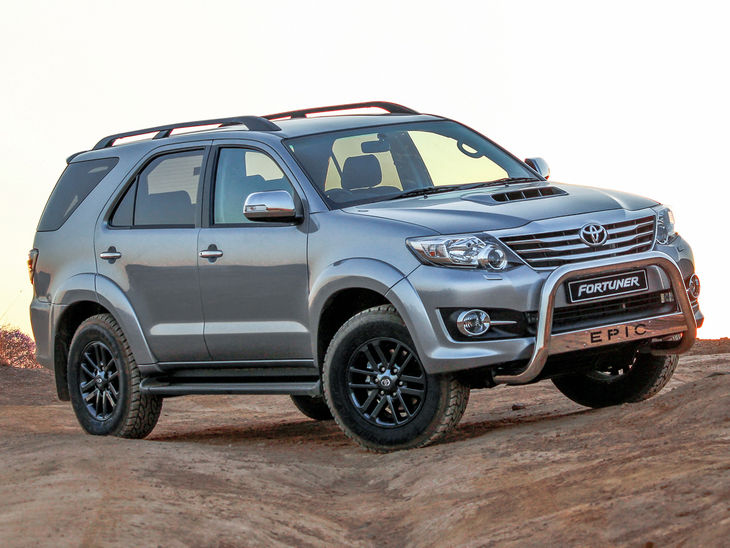
The second Epic introduced a few compelling changes to the range. Stick with later-model vehicles if budget allows.
The original Fortuner was a resounding success for Toyota, outselling its rivals by a massive margin, month after month for 10 years. That means there are still loads of options on the used-car market, despite the fact production ended as long ago as early 2016. Of course, there’s also still quite some demand, with the 3.0 D-4D models showing particularly strong residual values.
As always, there are a few compelling alternatives to consider in this space, such as the second-generation Mitsubishi Pajero Sport and the third-generation Nissan Pathfinder. The Chevrolet Trailblazer is worth a look, too, while it’d also be tempting to stretch to its platform sibling in the form of a later-model Isuzu MU-X (the nameplate arrived in SA only in 2018), if you can find one.
We’d suggest steering clear of the original Ford Everest, as the U268-gen model lagged behind the Fortuner in most departments (though an early model-year second-gen Everest might be worth a shout). Still, as mentioned above, none of these likewise bakkie-based alternatives sold in numbers anywhere near those of the Fortuner, which means they’re far more difficult to come by today.
Though its utilitarian roots and comparatively noisy diesel engines mean the first-generation model isn’t terribly refined in the context of modern SUVs, it still offers a convincing mix of practicality, durability and go-anywhere ability. Back in 2006 and indeed over the decade that followed, the Fortuner resonated with South African buyers like no SUV before it. And that appeal endures today.
Looking for a Toyota Fortuner to buy?
Buy a used Toyota Fortuner on Cars.co.za today!
Looking to sell your car? You can sell it for free to our dealer network here.
Frequently Asked Questions
How many seats does the Toyota Fortuner have?
The Fortuner is a 7-seater SUV with three rows of seats, designed to accommodate a driver and up to six passengers.
What is the ground clearance of the Toyota Fortuner?
The Toyota Fortuner has a ground clearance of approximately 225 mm to 279 mm, depending on the model year and specific variant. This high clearance makes it well-suited for off-road driving and navigating rough terrain.
What are the engine and transmission options for the Toyota Fortuner?
The Toyota Fortuner is available with two diesel engines, with some derivatives featuring 48V mild-hybrid technology to improve efficiency. Engines include a 2.4-litre and 2.8-litre turbocharged diesel engine. Transmission choices typically include both a 6-speed manual and a 6-speed automatic gearbox, with some variants offering a 4×4 drivetrain.
What are some key features of the Toyota Fortuner?
Key features of the Toyota Fortuner include a high-strength body-on-frame chassis for durability, an 8-inch touchscreen infotainment system with Apple CarPlay and Android Auto, leather seats, automatic climate control, and a suite of safety features such as multiple airbags, ABS with EBD, and traction control. Higher trims may also offer a premium JBL sound system and a powered tailgate.
What is the fuel tank capacity of the Toyota Fortuner?
The Toyota Fortuner has a fuel tank capacity of 80 litres.
Related Content
Toyota Fortuner (2025) Price & Specs in South Africa
Reviews
Toyota Fortuner GR-S review: More Power, Worth the Price?
Toyota Fortuner (2023) In-Depth Review
Extended Test: Toyota Fortuner 2.8 GD-6 4×4 Automatic [with Video]
Toyota Fortuner 2.4GD-6 (2016) Review
Comparisons
Ford Everest vs Toyota Fortuner: What to buy?
Comparative Review: Ford Everest 3.2 4×4 XLT vs Toyota Fortuner 2.8 GD-6 4×4 6At
Buyer’s Guide