

If you are under the impression that the MPV segment is dead, think again! Luxury minibuses are doing very well on the sales charts – and Opel wants a slice of the pie with its Zafira Life.
We like: Spaciousness, practicality, good performance/efficiency balance
We don’t like: Huge dimensions, but 7 seats only. Lags in terms of cabin tech.
FAST FACTS
- Model: Opel Zafira Life 2.0TD Elegance
- Price: R902 900 (October 2022)
- Engine: 2.0-Litre, 4-cylinder, turbopetrol
- Power/Torque: 110 kW/370 Nm
- Transmission: 8-speed automatic
- Fuel consumption: 6.3 L/100 km (claimed)
- Boot/Utility space: 1 060 litres
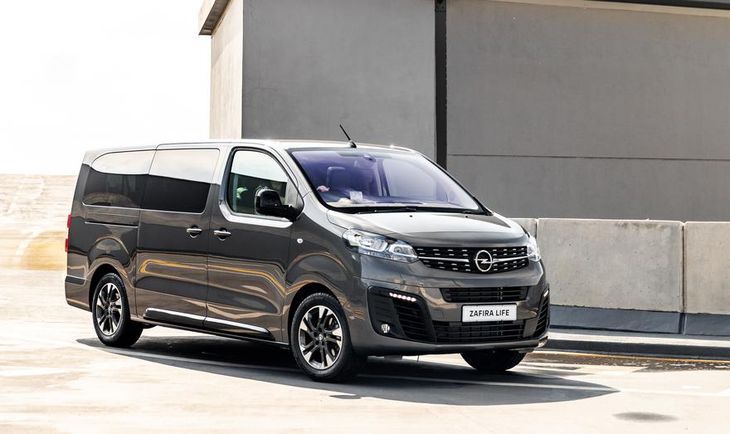
The Opel Zafira has transformed from an underappreciated compact MPV to a spacious people carrier.
Where does the 2022 Opel Zafira Life fit in?
The Zafira nameplate is, of course, not new to South Africa, but it’s applied here to a markedly different vehicle. While previous Zafiras sold in South Africa were 7-seat MPVs that rivalled the likes of the (discontinued) Volkswagen Touran and Renault Scenic, the new Zafira Life is a much bigger vehicle that shares its underpinnings with the Toyota ProAce Verso, Fiat Ulysses, Peugeot Traveller and Citroen Spacetourer. None of those buses is offered in the Republic, but there is nevertheless plenty of competition in the local market, particularly in the shape of the Hyundai Staria, which is available in various configurations.
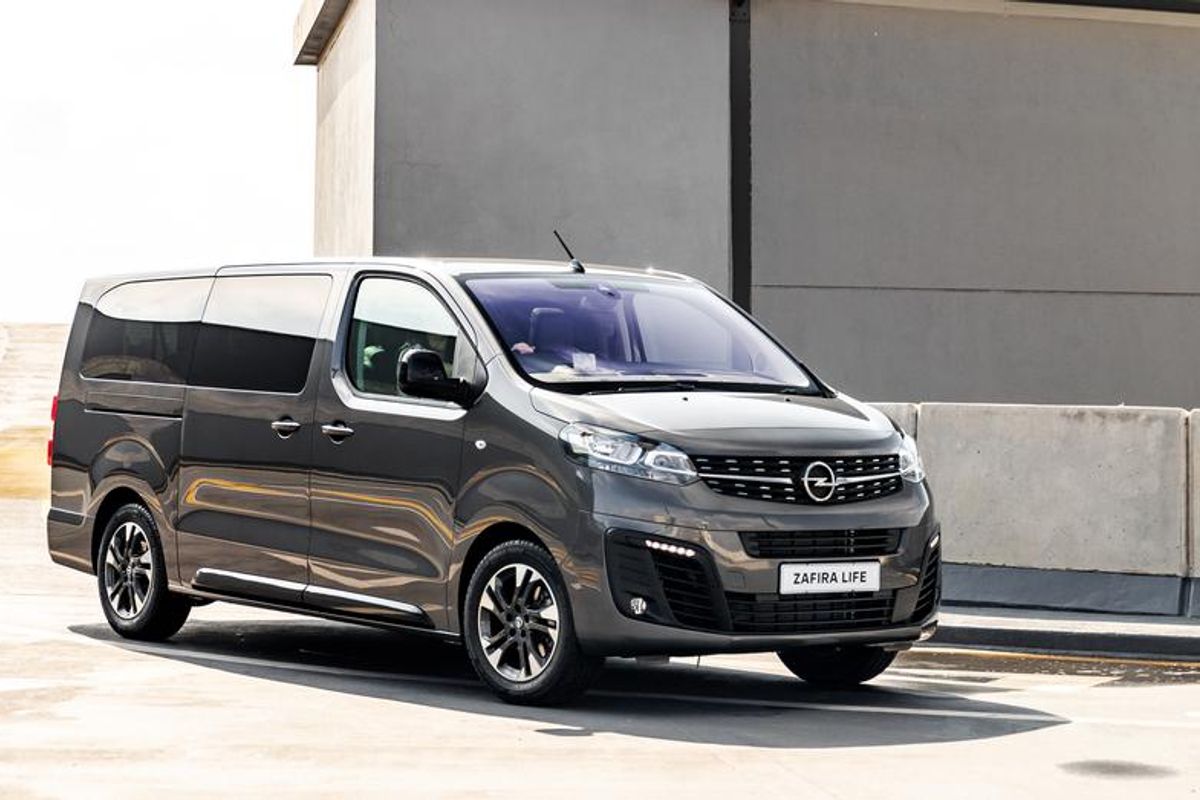
The subject of this review is the flagship 2.0TD Elegance, which, despite its enormous proportions (it’s just over 5.3-metres long) is a 7-seater only. The focus here is on a combination of luxury (for all passengers) and useful packing space, even when all seats are taken. If you want more seats in your Zafira Life, you’ll have to opt for the more affordable “Edition” specification, which adds one more chair, but at the cost of several luxury features.
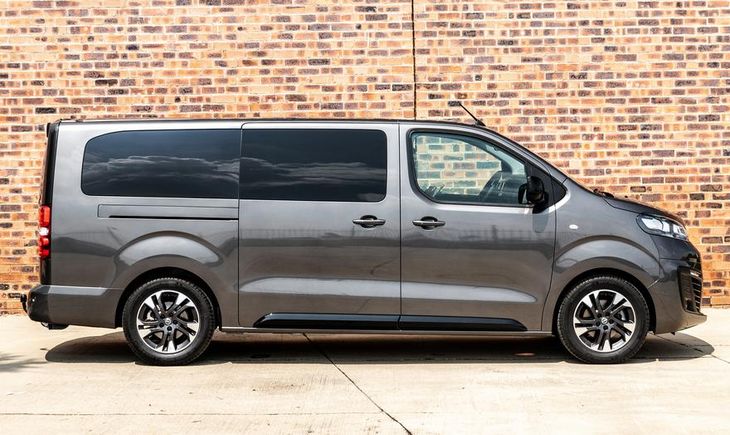
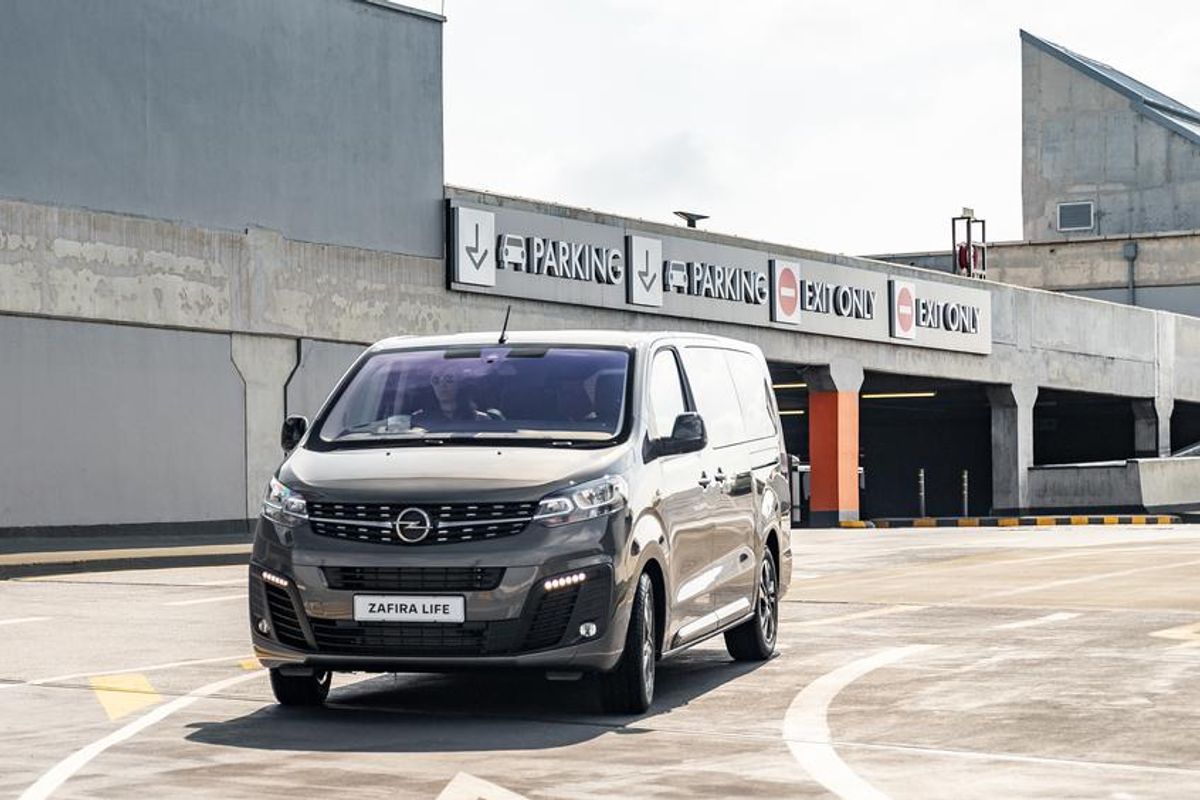
The Zafira Life is a sizeable vehicle; make sure you have a parking spot that’s big enough to accommodate it.
How the 2022 Opel Zafira Life 2.0TD Elegance fares in terms of…
Design and Packaging
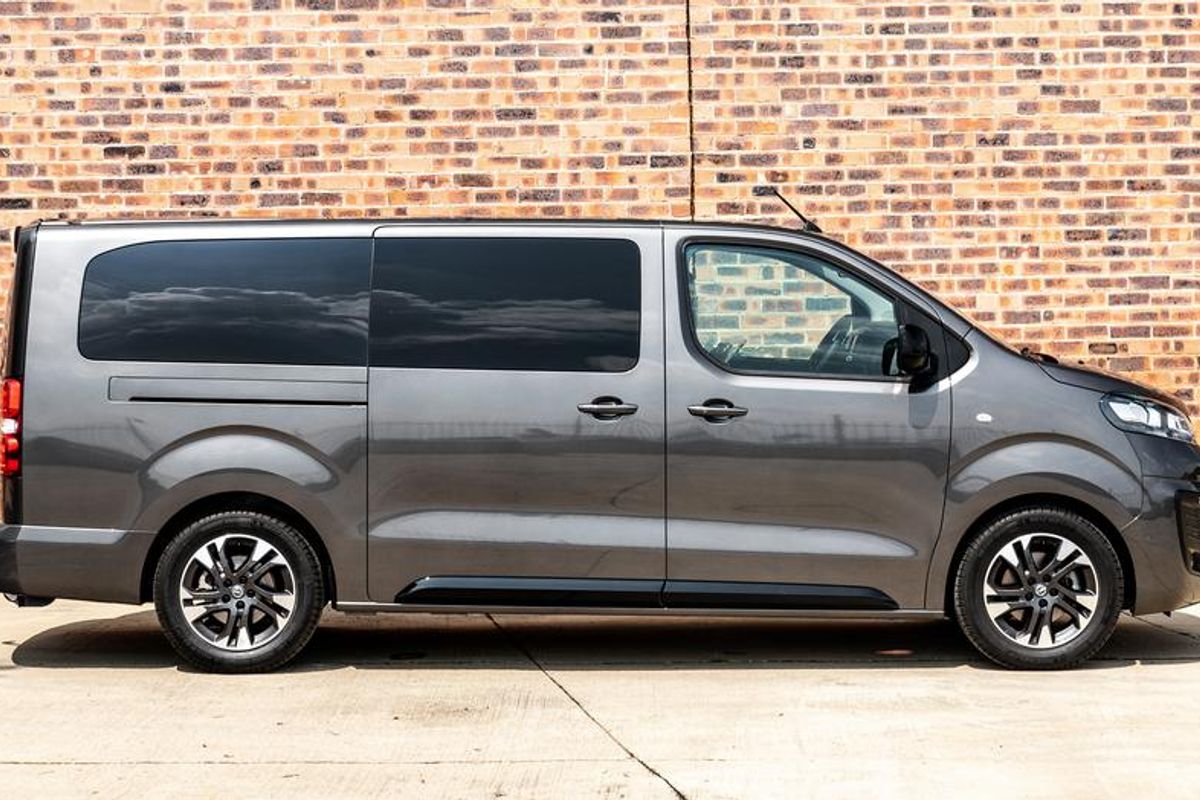
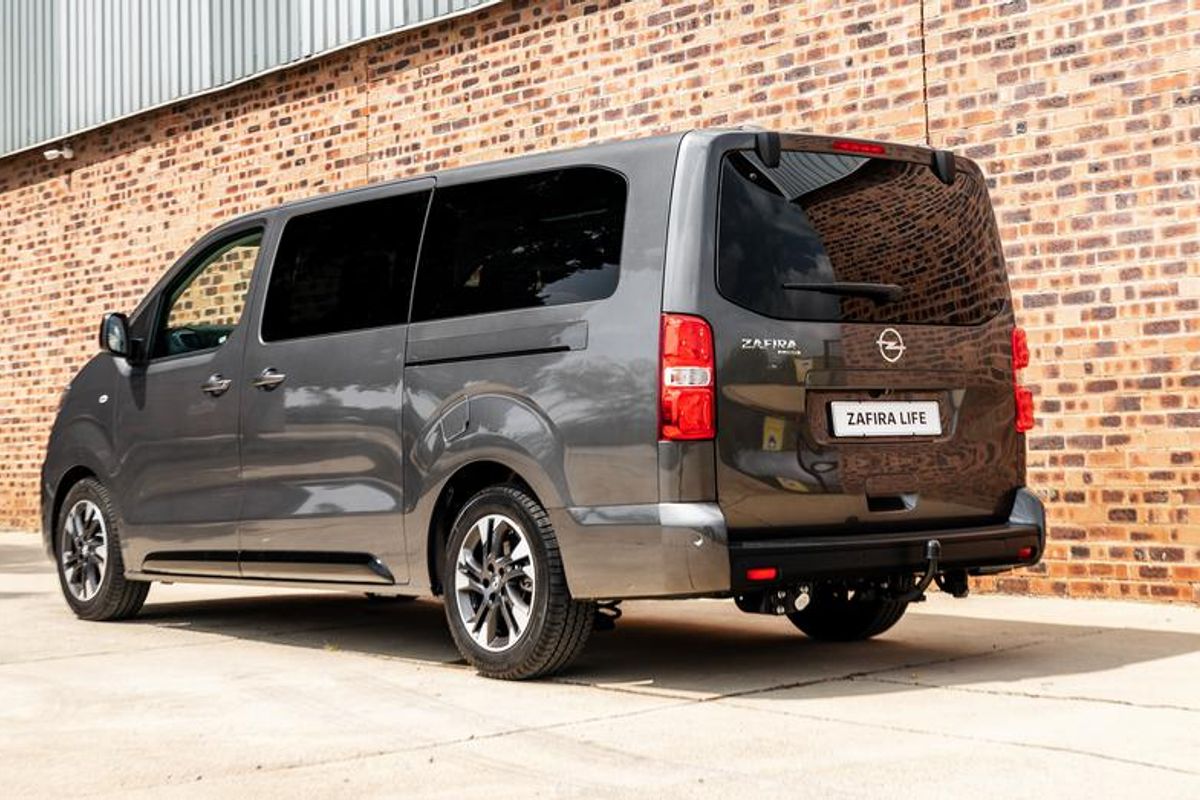
Opel has done well to hide the Zafira Life’s commercial roots, and this 2.0TD Elegance flagship boasts such stylish features as dual-tone 17-inch alloy wheels, privacy glass, LED light strips at the front, and an interesting dual sunroof setup. It might not have the space-age looks of the Staria, or the badge appeal of a Mercedes-Benz V-Class, but by minibus standards, it’s quite a handsome vehicle.
It is also very large. Measuring in at just over 5.3 metres in length and standing 2.2 metres wide and nearly 2 metres tall, you will have to make sure it will fit in your garage before signing on the dotted line. The wheelbase measures 3 275 mm, which is among the longest in the segment. With its box-like cabin, you would rightfully expect it to be very spacious inside, and that it certainly is.
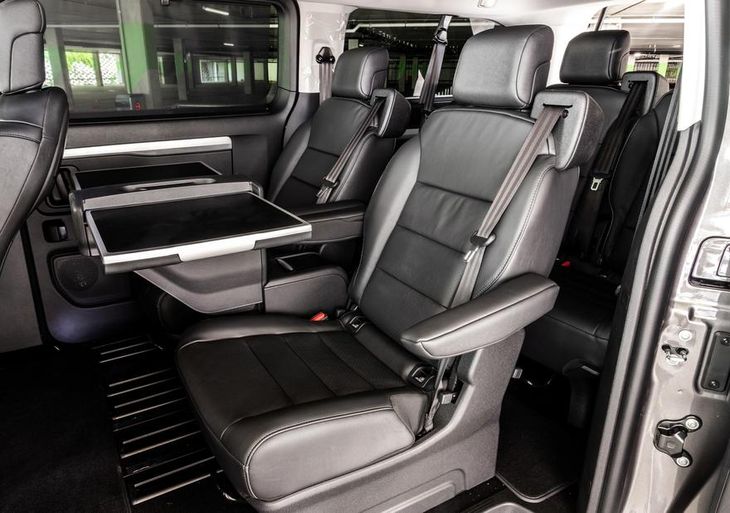
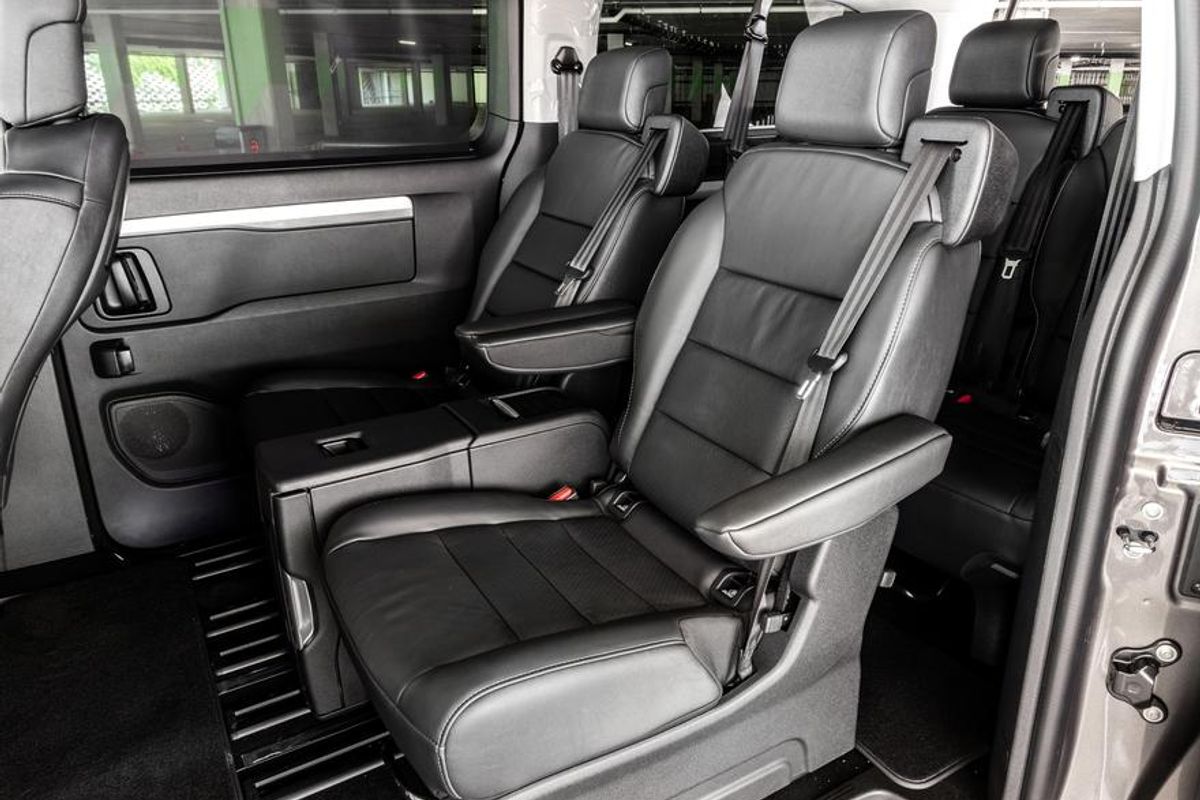
A cabinet is located between the two middle-row seats and it holds a fold-out table.
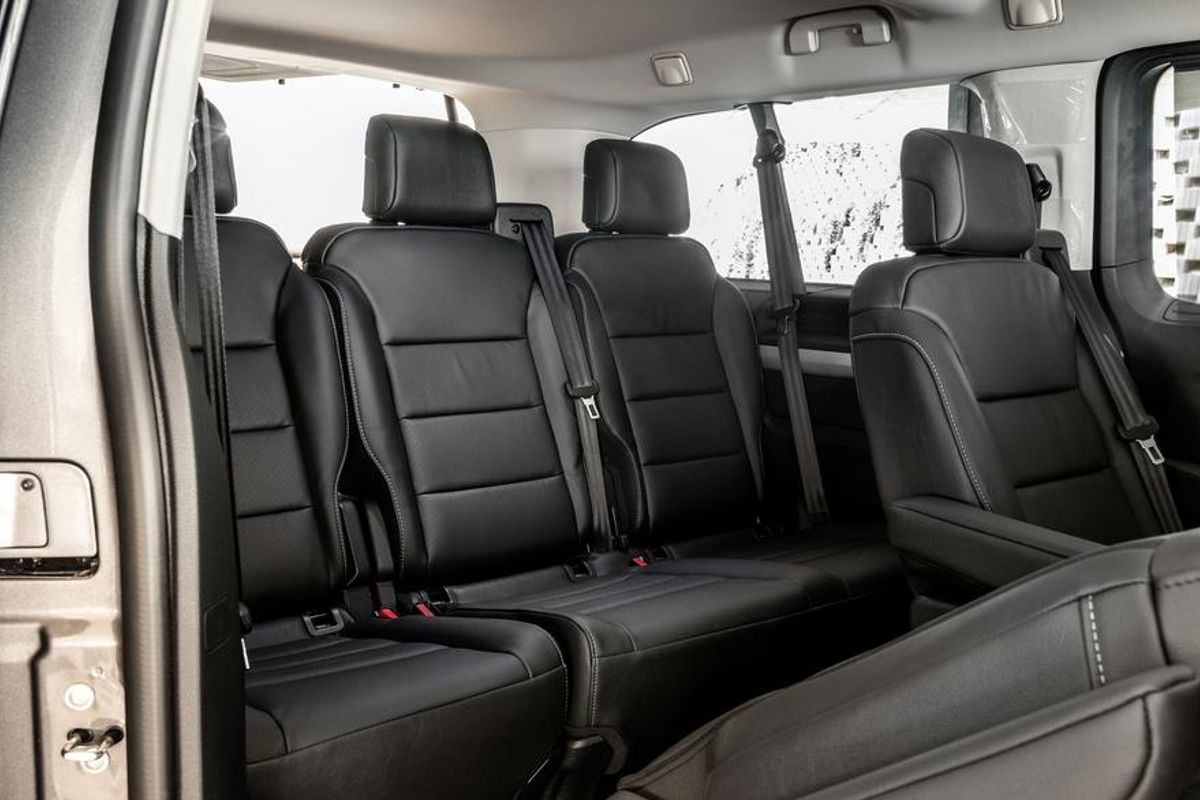
The 2.0TD Elegance’s 7-seat configuration is as follows: 2 front seats, 2 individual chairs in the middle row and space for 3 at the back. The seats are mounted on a rail system and can be slid fore or aft as required, removed entirely, or you can turn the pair of middle-row seats around to face those in the rear. Mounted between the 2 middle-row seats is a cabinet that holds a fold-out table that provides a solid base to work on, or in a leisure application (when it’s turned around), middle-row and rear-seat passengers can play card games on it, for example. Mounted on the front seatbacks are flip-up trays with built-in drink holders.
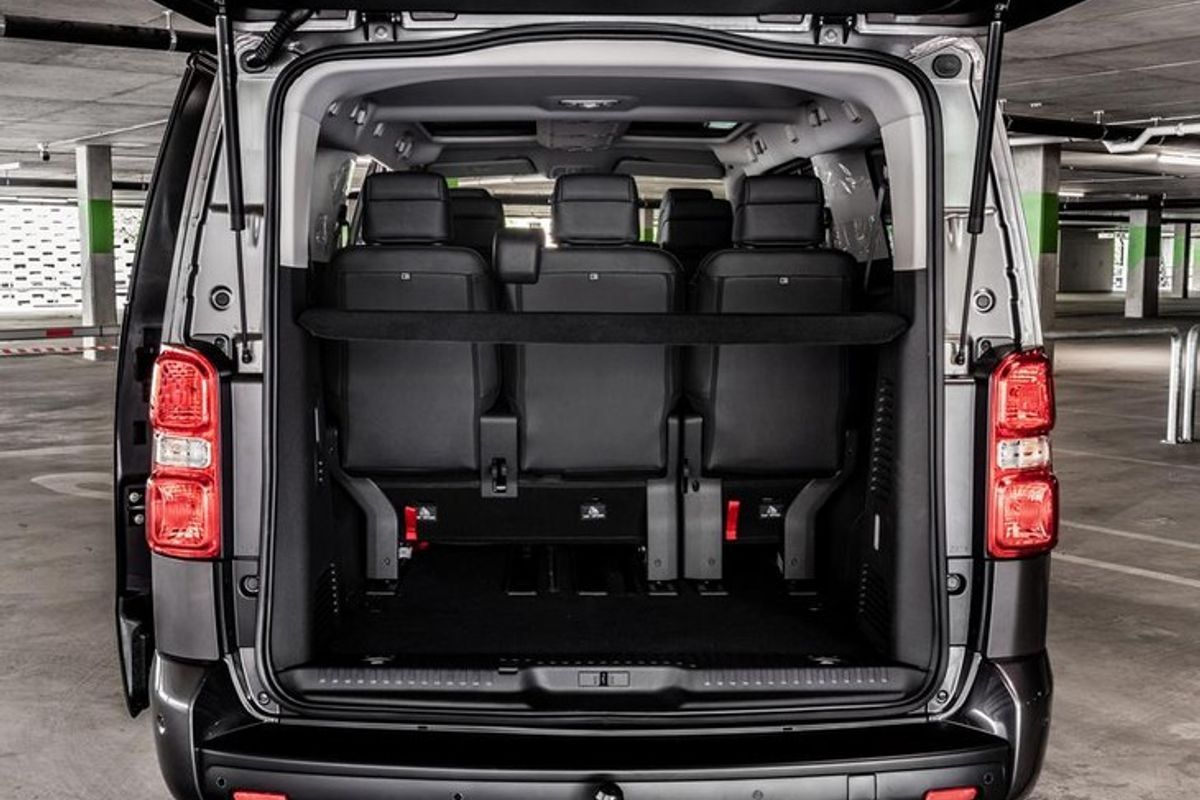
Importantly, the load bay is cavernous – even with all 7 seats taken – and so, unlike similarly-priced 7-seat compact or adventure SUVs, this is a genuine family car, with stretch-out space for all occupants and all their luggage. A minor criticism is that the Zafira Life is a little short on practical storage spaces. There is a handy felt-lined bin on top of the fascia, and the cubby is decently sized, but the drinks holders are small and mounted at the base of the A-pillars.
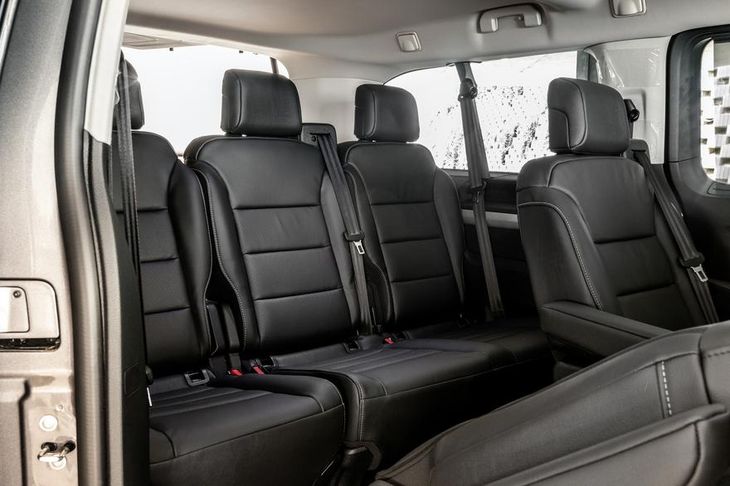
Instead of a solid rear bench, the Zafira Life is equipped with 3 chairs in the rear.
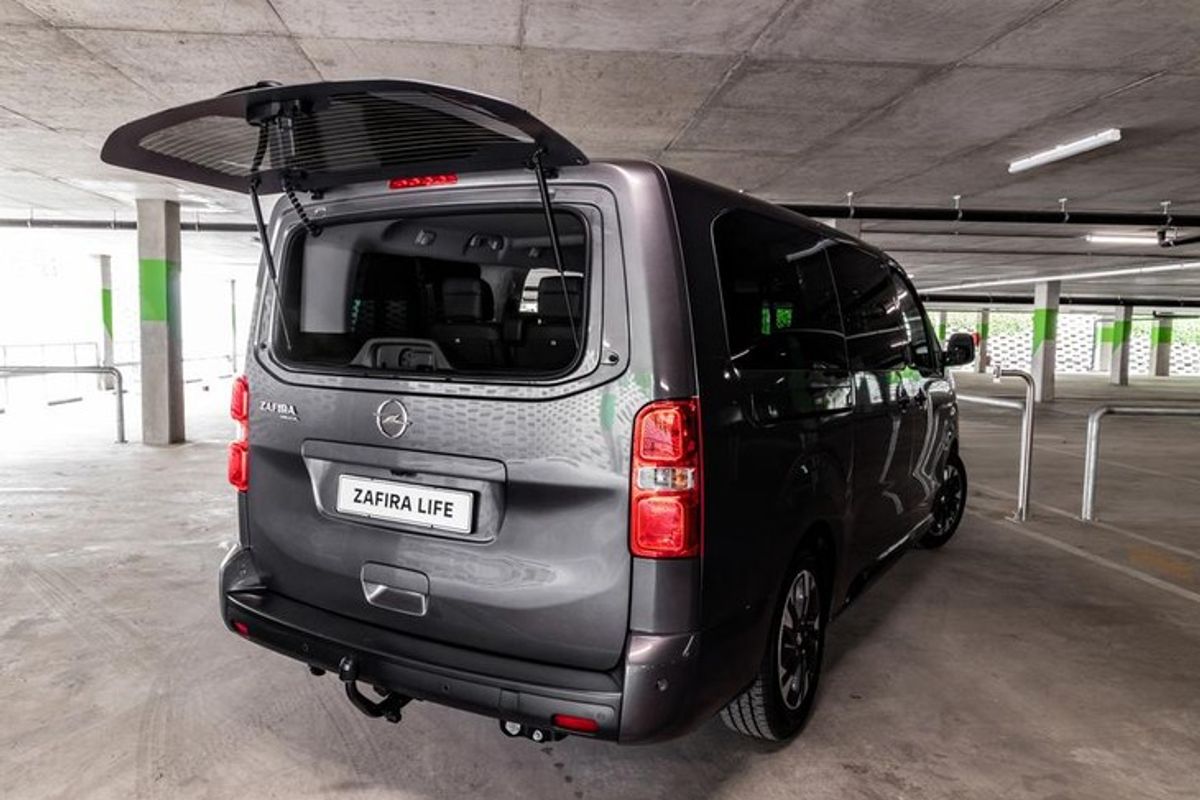
The door pockets are large, but not shaped to be practical drink holders either. And the few flat surfaces provided (to place your keys and/or smartphones) don’t have rubber linings, so items tend to rattle around or slide out. Oh, and a small criticism of the load bay – the tailgate is large and heavy, and manually operated, so it may prove difficult to open and shut for those of a smaller build.
Opel has also done well to give the Zafira Life’s cabin a luxurious and sophisticated ambience, with smart black leather upholstery, and cool dual sunroofs (with individual blinds), as well as satin-silver accents around the front of the cabin. Overall, the Opel’s interior seems well screwed together, but note that the plastics are almost entirely of the hard variety.
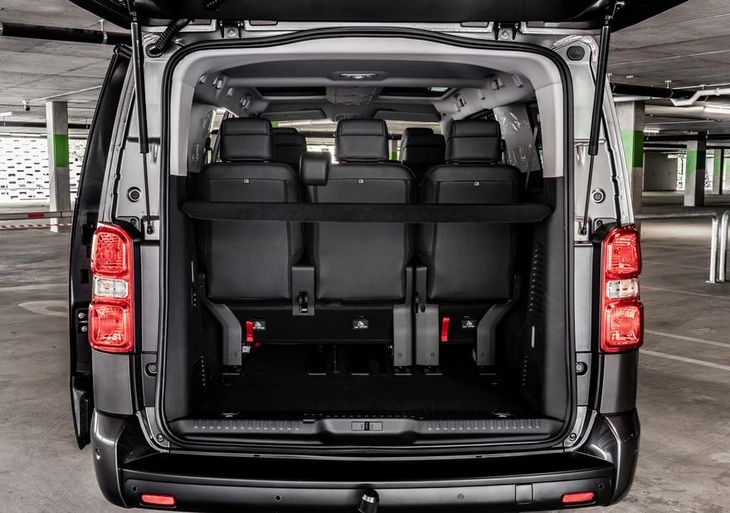
The Zafira Life may be a minibus, but 7-seat adventure SUVs can’t match the Opel’s luggage capacity when they’re fully occupied.
Performance and Efficiency
Powering the Zafira Life is a 2.0-litre 4-cylinder turbodiesel engine that delivers 110 kW and 370 Nm of torque (at 2 000 rpm). Power goes to the front wheels via an 8-speed automatic transmission, which is controlled via a rotary controller on the fascia, or sporty gearshift paddles behind the steering wheel (although the latter addenda seem rather unnecessary).
We expected the Opel to be a trifle underpowered, considering its bulk, but it proved more than capable on a long road trip, even when it was fully laden with passengers and their luggage. The best part of the drivetrain is undoubtedly the slick 8-speed automatic transmission, which is very well-matched with the torque characteristics of the engine. As a result, the big Opel is nicely sensitive to throttle inputs and there is sufficient overtaking grunt at, or near, the national speed limit.
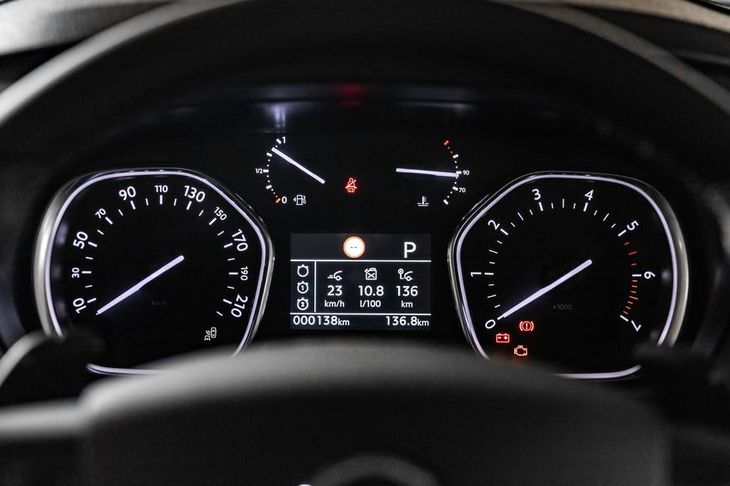
While the turbodiesel engine delivers workmanlike performance, it dovetails nicely with the 8-speed automatic transmission.
Opel claims an average fuel consumption of 6.3 L/100 km, which is highly optimistic, but the indicated average of 8.5 L/100 km (at the end of the Zafira Life’s tenure in our test fleet) is pretty good, particularly when considering the fact that we used the vehicle as intended – fully loaded and for long road trips. The tank capacity is 70 litres and so you should be able to achieve a range of just over 800 km before a refill is needed.
Oh, and should you want to tow a trailer, note that the maximum (braked) tow rating is a relatively meagre 600 kg.
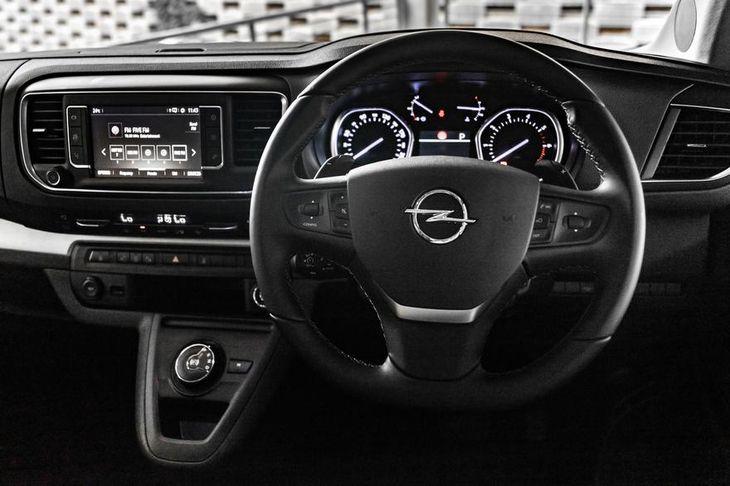
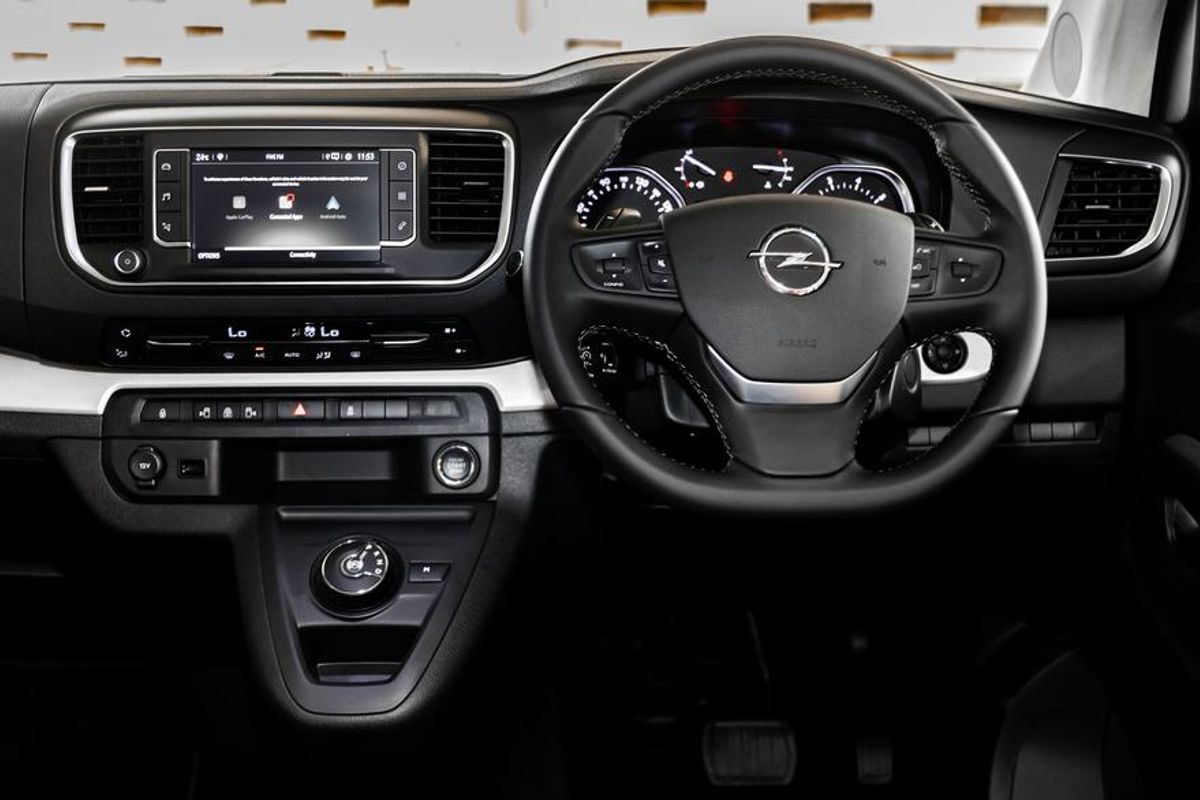
Despite the Opel’s commercial-vehicle origins, it has a neat, modern and car-like fascia design with tasteful finishes.
Comfort and Features
Opel is a relatively small brand in South Africa these days, so it probably couldn’t be too pushy when it came to selecting a specification level appropriate for our market. As a consequence, the Zafira Life Elegance has some really startling “surprise-and-delight” features, while lacking some basic necessities.
Let’s start with the seats. Opel has always been good at providing great seating comfort and the Zafira Life certainly continues the tradition. Both front seats feature electric adjustment (including height), as well as heating and even a massage function! The column of the leather-wrapped steering wheel is rake- and reach-adjustable and so a comfortable driving position will be very easy to find.
The instrumentation binnacle is comprehensive (including speed-sign recognition) and then it is complemented by a heads-up display. The latter seems superfluous, seeing as the instrumentation is clear and comprehensive anyway.
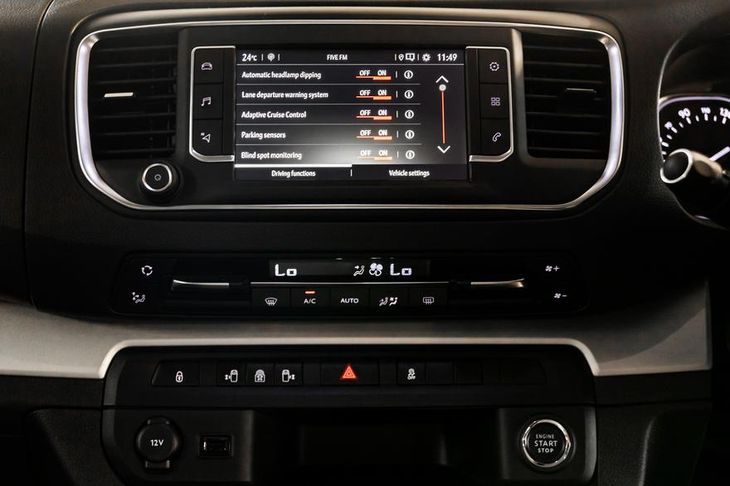
The infotainment system’s touchscreen seems a little dinky.
Infotainment access comes courtesy of what is – by current standards – a small 7-inch touchscreen. It’s easy enough to operate and features Apple Carplay and Android Auto compatibility, but it just feels a bit old-fashioned. When you hook reverse gear, it doubles as a display for the rear-view camera, while there is also a bird’s eye view of the vehicle – useful, but again, not as crisp and interactive as some other systems out there. Furthermore, there is a single USB outlet in the entire vehicle (in the front) and it also lacks a wireless charging pad.
Of course, any of the numerous 12V power sockets distributed throughout the vehicle could be turned into USB ports, but it nevertheless highlights a specification package that is not quite in tune with South African usage patterns. As if to highlight the issue even further, the 3-point power point mounted underneath the driver’s seat will require an adapter to be useful to South Africans.
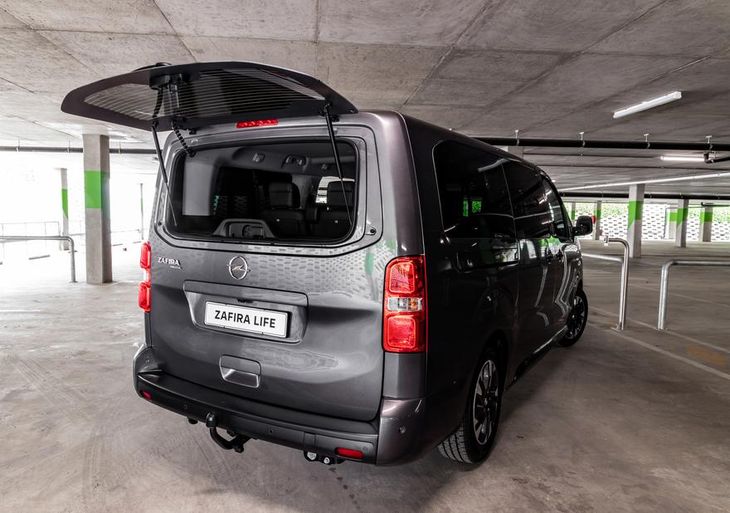
Although the tailgate is heavy, the rear screen can be opened separately.
All that said, there are some very nice, practical touches, too. As if the rear privacy glass isn’t enough, there are also retractable sunblinds. A separate ventilation control unit (for 2nd- and 3rd-row passengers) is mounted on the roof lining with outlets distributed throughout the cabin. Oh, and you can open and shut both the sliding side doors using the remote.
Sadly, the most disappointing aspect of the Zafira Life’s skewed specification level is the fact that it only has 4 airbags, which is odd, given that it comes with relatively high-tech features such as lane-keep assistance and blind-spot detection.
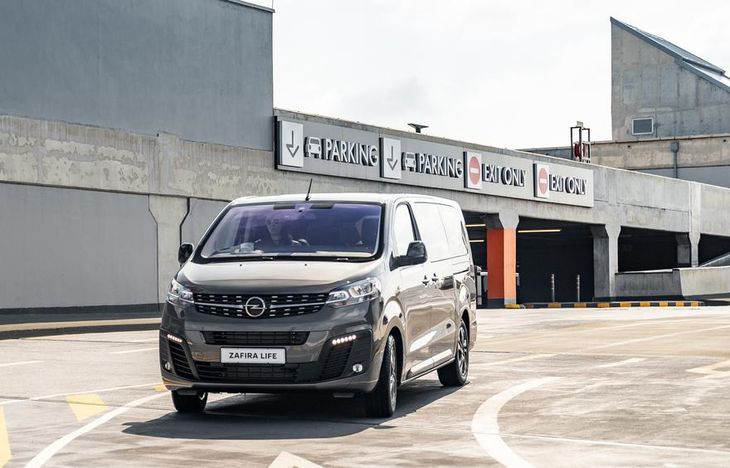
The Zafira Life’s driving experience is still bus-like, but it’s no worse than that of the Mercedes-Benz V-Class.
Ride and Handling
Much like the (significantly more expensive) V-Class, the Zafira Life’s driving experience is still very bus-like. At its core, it remains a commercial vehicle that has been turned into a luxuriously-trimmed minibus. And so, the driving experience is not nearly as car-like or refined as something like a Kia Carnival, for example, but relatively similar to what is offered by the ‘Benz, which should not be seen as a criticism… after all, the V-Class is more than R300k more expensive.
Engine noise is well-contained, but there is noticeable road rumble and you will, as expected, feel crosswinds. All that said, you (all passengers, actually) sit nice and high and have a great view out of the vehicle. The steering is well-weighted and the turning circle isn’t too laborious. The ride is generally supple around town, but can feel a little skittish at higher speeds on poor surfaces. Stopping power (ABS with EBD) is good, plus you have the safety net of stability control.
Dynamism is, of course, not a priority in a vehicle such as this. Simply set the adaptive cruise control, switch on the massaging function for the front seats, sit back and enjoy the journey, that’s what the Zafira Life driving experience is about.
Price and After-Sales Support
The Opel Zafira Life 2.0TD Elegance sells for R902 900. A 5-year/100 000 km warranty is included, as is a 5-year/100 000 km service plan. The service intervals are scheduled for every 12 months/15 000 km.
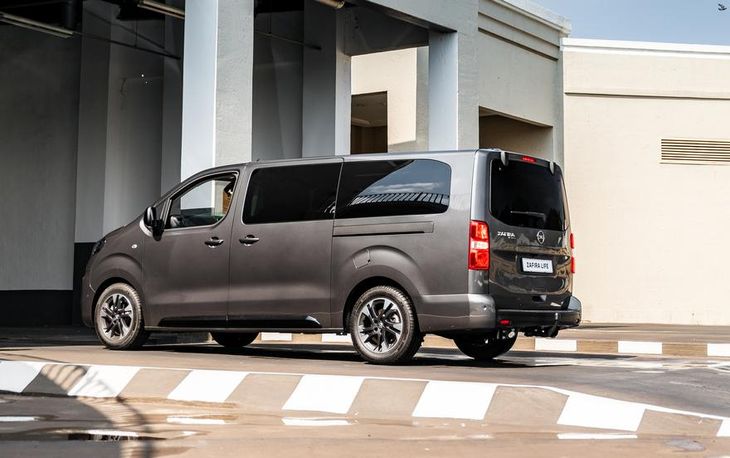
The Zafira Life is a fine example of a people carrier adapted from a commercial vehicle, but it has tough competition.
Verdict
At just over R900 000, the Opel Zafira Life 2.0TD Elegance is an interesting proposition, but one that left us scratching our heads. On the one hand, it provides a very similar experience to the popular Mercedes-Benz V-Class, but at a much more affordable price. On the other hand, it lacks the tech and number of seats of something like the Hyundai Staria. If you want a plush, spacious 7-seater, then there is no better vehicle than the Kia Carnival in our opinion, but if you want the load-carrying capability of a bus (with all its seats removed), then the Zafira Life is pretty much unbeatable.
So, ultimately, it will come down to what you need the vehicle for. If you require a dual-purpose people carrier for the family that can also haul some bulky items now and then, the Zafira Life is well worth considering, given its spec and size.
Hannes Oosthuizen

With the ultimate goal of spending his life writing about cars, Hannes studied journalism at the University of Stellenbosch. A brief stint as a sports editor for Paarl Post followed, before he joined CAR magazine in 2001. He eventually became the (youngest-ever) editor of CAR in 2011, a position he occupied for two years. During his career at CAR he became a member of the WCOTY (World Car of the Year) panel, wrote a book (Cranked Up: Confessions of a Petrolhead) and was named by the Mail & Guardian as one of the Top 200 South Africans to take to lunch in its 2008 Youth Day supplement, and by The Media magazine as one of the most influential media professionals under 40 (2012). He left CAR in 2013 to experience the \other\" side of the industry