To say the first-generation Mercedes-Benz A-Class had a problematic birth is to put it mildly. Not only did it tip over in that controversial Swedish Elk-test, the interior quality was never quite regarded as being up to Mercedes usual high standards, what with a curvy facia design executed in shiny grey plastics. Oh the horror! Consequently, the motoring public has looked down on Mercedes smallest offering from the start though, ironically perhaps, theyve had to actually look up to it, due to its elevated seating position. With the second-generation model a big emphasis was to correct the quality perception. So, How does the Mercedes-Benz A180 fare then?
A true Mercedes?
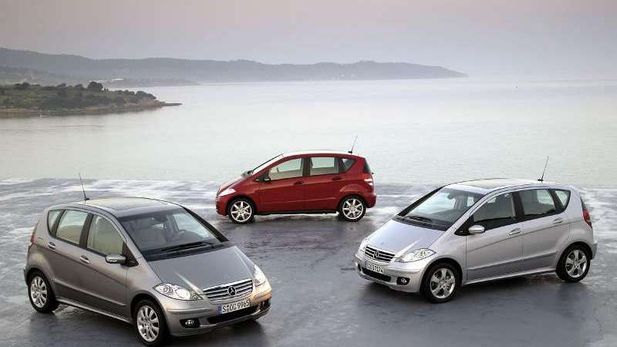
Visually, the Mercedes-Benz A180 model appears significantly more grown-up and less like a bloated Smart ForTwo. Sure, the monobox bodystyle is more-or-less the same, but the detailing is far more upmarket and the various design elements chunkier, more in keeping with current Mercedes design trends. In the right colour and on the right wheels, it looks suitably upmarket and far more deserving of the three-pointed star on the grille. Interestingly, this A-Class is both longer and wider than the long-wheelbase version of the previous model that was introduced late in the first-generation As lifetime. And yet, somehow, it looks as compact as the short-wheelbase model. This visual trick is simply the result of a more coherent overall design.
Inside, the changes have been even more radical. Gone are the curves and the budget-car plastics. In their place, a straight-faced facia with various controls and displays borrowed from current, more expensive Mercedes models, as well as luxurious soft-touch materials spread liberally through the cabin. It not only looks more upmarket, it even smells like a real Mercedes now. At the price, this is a very impressive achievement.
On the other hand, one can sense that the emphasis with this car was not so much on interior flexibility and space, but on upgrading the car to be a worthy Mercedes-Benz. As a result, its not quite as impressive at being a quasi-MPV as the previous model was. Rear legroom is still good, but not as impressive as on the Long version of the previous model. And the boot is quite small, too. Of course, its boxy shape means that, once the seats are folded down, utility space is truly cavernous, but make no mistake, a regular car such as a Volkswagen Golf comes close to matching the A-Class for truly usable interior space. Therefore, you have to consider the A-Class not so much because it is a cheap Mercedes-badged MPV but, simply, because it is a (relatively) cheap Mercedes, full stop.
On that front the news is surprisingly good. The quality for the Mercedes-Benz A180, as mentioned before, is really good, and the standard specification also surprisingly generous. The Classic trim line includes air-conditioning, electric windows all-round, a radio/CD system and even cruise control. Undoubtedly partly as a result of the previous cars safety woes, the new model features not only dual front and side airbags, but also ABS with BAS and an electronic stability system (ESP) which, surprise-surprise, cant be switched out just in case youre ever faced with swerving out to avoid hitting an Elk
High and mighty
The A-Class retains the much-publicised sandwich floor design. According to Mercedes the benefit of this is not only that the engine can be channelled away from the passenger compartment in the case of an accident, but also that, theoretically, an alternative energy powertrain could fit in there a layer of batteries, perhaps. Whatever the packaging has a significant impact on the A-Class driving experience because it dictates the seating position. Due to the high floor, the driver sits with fairly high knees and stretched-out legs and arms. For some, this will actually be desirable. If, however, you typically like to feel one with a car, rather than sitting on top of it, the A-Class will feel awkward. Then again, as market research will tell you, there is a big percentage of buyers (particularly female), who prefer a higher seating position due to the perception of greater visibility and safety.
However, while the basic design has stayed much the same, the driving experience is significantly improved compared with its predecessor. The steering has more feel and communicates more faithfully. Although theres still a top-heavy feel in the corners compared with a normal car, its less accentuated in this model than before. And while the ride is fairly firm at low speeds (tyre sensitive, bigger sidewalls are best), it does smooth out at speed.
Power and economy
First things first, the Mercedes-Benz A180 CDI moniker is somewhat misleading. Under the bonnet is in fact a 2,0-litre turbodiesel that features common-rail direct injection and intercooling. Yet, the power output is a fairly conservative 80 kW. Torque, however, is claimed to be 250 Nm, on tap from as low as 1 600 rpm, so the A180 CDI pulls strongly from the get-go. The engine is, as is the case with many direct injection diesels, somewhat noisy at first, but also quietens down as the speeds rise. Performance is good, aided by a slick (for a Mercedes) six-speed manual transmission. Even more impressive is the fuel economy Mercedes claims a figure of 5,2 litres/100 km and, if you behave yourself, this should be attainable. However, expect a figure of around 6,5 litres/100 km for normal driving, which is astonishing.
Mercedes-Benz A180 – Verdict
While Mercedes connoisseurs could easily find reasons to poke fun at the previous A-Class, theyll have more trouble with the new-generation model. Certainly, the interior feels just as well built as a C-Class. It retains much of its predecessors flexibility and boasts an impressive performance/economy balance. Most importantly, perhaps, the Mercedes badge on the nose appears to have gained some extra lustre this time round, because the A-Class has matured into a proper Benz. For many, this will be the clincher. Its still not flawless, but with that badge, the market will forgive it a lot once again.
We like:
- Interior quality
- Standard specification
- Comfort
- Fuel economy
- Likely resale value
We dont like:
- Top-heavy feel
- Small-ish boot
- Surprisingly firm ride
Fast facts
Engine: 2,0-litre, four-cylinder, turbodiesel
Power: 80 kW @ 4 200 rpm
Torque: 250 N.m @ 1 600 2 600 rpm
Transmission: Six-speed manual
Wheels: 15-inch alloy
Top speed: 186 km/h
0-100 km/h: 10,8 seconds
Fuel economy: 5,2 litres/100 km
Source: www.um.co.za
Also consider:
- Opel Meriva 1,7 CDTI Elegance: Dont laugh, the Opel is quite a competent rival, even if it lacks a premium badge on the nose. The space utilisation is excellent and the 1,7-litre turbodiesel engine punchy and economical, if a little gruff.
- Volkswagen Golf 1,9 TDI Comfortline: Again, theres no premium snob appeal here, but the Golf is an upmarket product nevertheless. Cant quite match the Mercedes cabin flexibility, nor its premium finish, but is ahead in terms of the ride/dynamics balance.
- Renault Scenic II 1,9 dCi Expression: If its true versatility youre after, a typical, full-blown MPV is still best, and the Renault Scenic arguably the best of the lot. Impressive cabin flexibility and a focus on occupant comfort (all occupants) make it a winner.