There’s a lot riding on the success of the Freelander 2. As impressive as the latest-generation Discovery and Range Rover models may be, the money making machine is the Freelander, the SUV that brings the desirable Land Rover badge within reach of far more people. But it’s got some convincing to do. You see, the previous (first-generation) model sold well, but it has left a legacy of relatively poor quality that could seriously damage the chances of its successor to fend off a number of new rivals. We tested the mid-spec petrol version to find out whether Land Rover has successfully banished the quirks and niggles of Freelander I.
Bigger, mini-Disco looks for Freelander 2
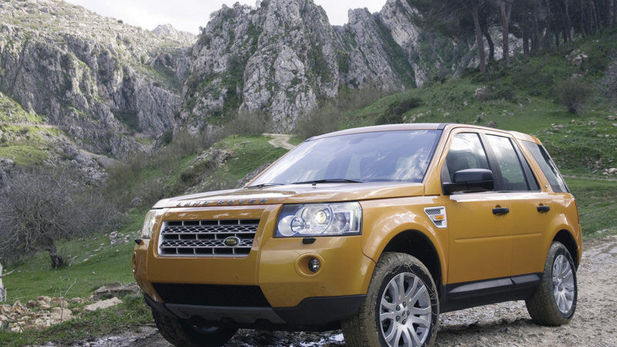
In wheelbase alone the new Freelander 2 is a significant 100 mm longer than its predecessor. Now add substantial growth in every direction, and it’s clear that Freelander has evolved into a less dainty offering, and into one with a fair degree of presence. Some traits of the previous car remain such as the slight bump in the roof line towards the rear, but overall Freelander 2 borrows more from such new vehicles as Discovery 3 and the latest Range Rovers. The rectangular headlamps are large and contain pronounced circular detailing within their borders. The grille is square cut and the bumpers chunky. At the rear, the spare wheel no longer appears on the tailgate in classical SUV fashion, but has moved into a position underneath the boot board, it’s a full-size item, by the way. Riding high on smart 17-inch alloy wheels and boasting a ground clearance of 210 mm, the newcomer looks both suitably posh, and serious SUV. It’s a combination that not many compact SUV’s successfully manage to accomplish.
The most dramatic improvement to the Freelander 2, however, has occurred inside, where the Freelander 2 now arguably boasts the type of perceived quality, upmarket design and modern features that most people would expect from a premium brand. Those familiar with the Land Rover experience will enjoy the high seating position and relatively low facia, affording a great view over the facia. The controls for the electric windows are placed on the window sill, in similar fashion to larger models from this stable. And many of the controls have a familiar feel, too.
The most obvious of these is the much-talked about Terrain Response system, which is accessed via a rotary dial placed on the centre console. It allows drivers to select one of four driving modes, suited to the prevailing off-road situation, such as sand, mud, rocks or even ruts. More about how it works later, but suffice to say, it is integral to the appeal of the vehicle, as it offers access to astonishing off-road adventures, but in a sophisticated fashion.
Land Rover’s designers have used the bigger dimensions to create a far more comfortable, relaxing cabin environment, with lots of rear legroom, for example, and even a large boot, notwithstanding the fact that it now has to accommodate a rather large spare wheel. Another Land Rover tradition is the positioning of the rear seats slightly higher than those in the front, to afford those seated in the back a better view. Still, headroom is impressive all-round, and in SE specification a sunroof is fitted, with a mesh cover that lets through a lot of light, which contributes to the airy cabin environment.
Freelander 2 offers off-road prowess
This Freelander 2 is powered by a straight-six cylinder 3,2-litre engine that develops an impressive 171 kW and 317 Nm of torque. Being an all-wheel drive vehicle with a Haldex centre coupling, the Landy runs in a predominantly front-wheel drive mode most of the time (to save fuel), but the system will apportion torque to whichever wheels have the most traction. Using the Terrain Response system, one can then fine-tune not only how the power gets distributed, but also influence the set-up of the transmission and even the brakes to some extent, for maximum ability. The result is that you don’t need low-range, because the Freelander 2 will adjust its power delivery according to the driving situation. And boy does it work! It takes a lot of thinking out of off-roading, which will make some amateurs feel particularly confident off the beaten track.
On tar the latest Freelander 2 is similarly impressive. The ride is soft and absorbent, which combined with the refined nature of the engine and transmission (a slick six-speeder) as well as the well-insulated cabin, result in a very relaxing drive. This is a great long-distance cruiser, boasting superb comfort levels, lots of overtaking power and plenty of interior creature comforts. There really are only two major downsides, for one, the fuel economy suffers, as is to be expected from a large-capacity six-cylinder petrol engine. And, secondly, the soft suspension results in some pitching and diving of the body under hard acceleration or braking.
Freelander 2 – Verdict
Wow, what a change. Although there are some aesthetic similarities between this new model and its forerunner, Freelander 2 is so different in perceived quality, refinement, comfort and sophistication to the first-generation machine, it appears to compete in an entirely different, more premium segment. It sets a new standard for compact SUVs, and boasts a quite superb combination of on- and off-road ability that is currently unmatched. Judged by this newcomer, the future for Land Rover looks bright.
We like:
· Off-road ability
· On-road ride comfort
· Quality improvement
· Performance
· Badge appeal
We don’t like:
· Pitch/diving of body under acceleration/braking
· Fuel consumption
Fast facts
Engine: 3,2-litre, six-cylinder, petrol
Power: 171 kW @ 6 300 rpm
Torque: 317 Nm @ 3 200 rpm
Transmission: Six-speed automatic
Wheels: 17-inch alloy
Top speed: 200 km/h
0-100 km/h: 8,9 seconds
Fuel economy: 11,2 litres/100 km
Source: www.um.co.za
Also consider:
· Subaru Forester 2,5 XT Premium Auto: Yes, the Forester isn’t as good off-road as the Freelander 2, but for many consumers this won’t matter. On the road, it will run rings around the Land Rover. Then again, it lacks the brand cachet of the Landy.
· Nissan X-Trail 2,0 dCi LE Automatic: Significantly cheaper and delivers similar performance/economy. While reasonably good off-road, it also can’t match the Freelander 2 in that respect. The interior is well-put together, but ultimately the Nissan doesn’t have the same badge appeal as the Land Rover.
· Toyota Fortuner 4,0 Auto: The Fortuner is a bakkie-based vehicle and feels far less car-like from behind the wheel than the Freelander 2, but it does have its charms, including seven seats… The 4,0-litre engine packs a punch, but the fuel consumption is atrocious.