As a respected manufacturer of quality compact vehicles, Daihatsu must be well-positioned to capitalise on the markets swing to more economical, efficient and smaller cars. Finding a disappointed Daihatsu owner is exceedingly difficult. Unfortunately, that statement must be immediately contextualised by this finding a Daihatsu owner is rather difficult full stop. Perhaps as a result of its wilfully quirky design strategy this Japanese marque has thus far failed to reap the benefits of not only being closely associated with Toyota, but also of making excellent vehicles. With the latest Daihatsu Sirion, it may finally have a strong contender.
Quirk factor remains for Daihatsu Sirion
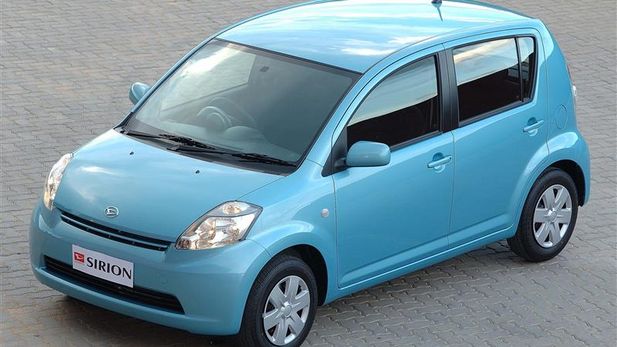
Whereas the previous Daihatsu Sirion was beaten into shape by a design team wielding ugly sticks, this new model looks positively futuristic, with a square overall shape meeting dramatically oversized wheelarches. At the front theres a gaping two-tier airdam flanked by oversized foglamps. Its certainly eye-catching, but once again Daihatsu has come up with a look that will polarise.
The interior of the Daihatsu Sirion is similarly quirky, but certainly modern. Theres a pod-like rev counter that sits on top of the facia a la Mini Cooper. Almost the entire instrument panel is taken up by a huge, almost retro-futuristic speedometer. Daihatsu has done well to break the monotony of grey plastic that is so prevalent at this side of the market. The lower part of the cabin is finished in a lighter hue, and the centre section of the facia which houses the ventilation controls and audio system is trimmed in shiny metallic silver. In typical Daihatsu fashion, the plastics are all hard, but the fit and finish superb.
Stretch-out space
Daihatsus small-car expertise really shines through in the cabin. The box-like shape and wheel-at-a-corner design translate into massive passenger space. Certainly, youll struggle to find another car of this size with so much rear legroom. Even shoulder room is impressive, given the cars relatively compact dimensions. There are also numerous hidey-holes for storing keys, wallets and the like.
Although the drivers seat as well as the steering wheel boasts manual height adjustment, the overall seating position remains fairly high. Of course, some drivers may prefer it this way, but coupled with the lack of lateral support from the seats, and some bodyroll in the corners, the sensation of sitting on top rather than inside the car is pronounced.
Where Daihatsu has been less successful is in the luggage area. Considering the fact that theres potentially wasted space in the second row, a sliding rear bench would have made more sense, particularly as boot space is limited. The rear seatbacks are split 60/40, though, and fold forward to unlock useful loading space. The lack of rear seat flexibility is quite a disappointment, especially seeing as the space is certainly there to introduce a cleverer sliding/folding arrangement.
This particular Daihatsu Sirion model has a very decent standard specification level. Air-conditioning, a neatly integrated sound system, electric windows, power steering, an airbag for the driver and ABS with EBD are all part of the package.
Wheres the Sport?
You dont have to be an automotive expert to understand that a 1,3-litre petrol engine with 64 kW, coupled with a four-speed automatic box, is never going to result in fireworks. The Sport badge, therefore, is a bit unfortunate and certainly only in reference to the cars appearance, because with a 0-100 km/h time of around 14 seconds, youre not going to get anywhere fast.
That said, the four-speed gearbox is generally well-matched to the engine, but fourth is a bit of a cruising gear. It is, however, possible to lock out the top ratio, which improves the Sirions about-town sprinting abilities considerably, and also cuts back on the transmissions tendency to hunt through the gears. Driven in a relaxed manner, though, the Daihatsu Sirion engine and transmission work well together and also deliver good fuel economy. Daihatsu claims a fuel consumption figure of 6,4 litres/100 km, but generally speaking youll be looking at around 8 litres/100 km for predominantly town use.
Raising further questions marks about the suitability of a Sport label is the cars dynamic ability. Theres nothing inherently wrong with the way it goes about its business, and for the majority of potential customers, the emphasis on comfort and safety will be a positive, but the sporty looks do make promises of entertainment and fizz that this Daihatsu Sirion struggles to live up to. The wheelbase is quite long for such a small car, so theres little of the choppiness that affects many small cars. The steering is electrically assisted, exhibits little feel and is also very light. Overall, then, the Daihatsu Sirion 1,3 Automatic is a very easy and comfortable car to pilot around town. But if youre looking for something sporty go look elsewhere.
Daihatsu Sirion – Verdict
This is a very solid little product by Daihatsu. You can ignore the Sport badge, though, because in reality its a straightforward automatic city car with numerous talents, including passenger space, decent standard specification and good ride comfort. Sadly, however, due to Daihatsus confusing labelling as well as still-polarizing design, it is unlikely to gain the mainstream traction it deserves.
We like:
- Passenger space
- Quirky design
- Fuel economy
- Build quality
We dont like:
- Small boot
- Four-speed auto tends to hunt
Fast facts
Engine: 1,3-litre, four-cylinder, petrol
Power: 64 kW @ 6 000 rpm
Torque: 120 Nm @ 3 200 rpm
Transmission: Four-speed automatic
Wheels: 14-inch alloy
Top speed: 175 km/h
0-100 km/h: n/a seconds (approx. 14 sec)
Fuel economy: 6,4 litres/100 km
Source: www.um.co.za
Also consider:
- Honda Jazz 1,4i CVT: A fair bit more expensive compared to the Daihatsu Sirion, but if you can afford it, it is by far the best small automatic on the market, though CVT is always an acquired taste. Excellent space utilisation, build quality and a very decent standard specification.
- Hyundai Getz 1,6 Automatic: A popular choice and with good reason. Boasts a well-made and spacious cabin, good performance from the most powerful engine in this segment and a comfortable ride. Lacks safety specification, though theres no ABS.
- Daihatsu YRV Automatic: An enemy from within. The YRV is powered by the same engine and features the same specification level as its Sirion brother, too. So, why choose this? It looks sportier and offers more boot space and its very different.