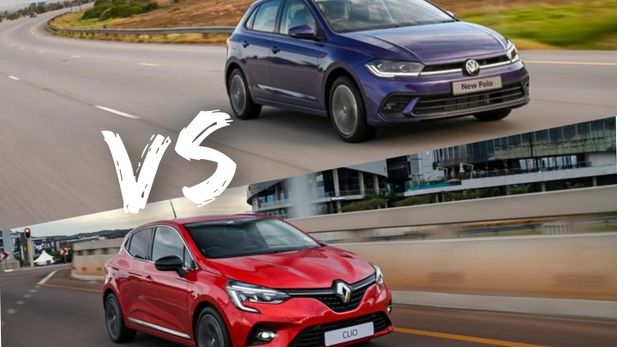
The Volkswagen Polo – one of the most popular compact hatchbacks in our market – recently received an update, but in the meantime, an all-new Renault Clio has arrived to entice local buyers to purchase the French newcomer instead. Does the stylish Clio pip the Polo and, more importantly, which one should you buy?
The Polo is the second most popular model in the Wolfsburg-based firm’s global portfolio (after the Tiguan family car) and Volkswagen South Africa’s (VWSA) 6th-generation compact hatchback recently underwent an update. With the revised model, the German brand seeks to consolidate – and expand on – the model’s sales success, not only in Mzansi, but in other markets, all around the world.
However, success for the more sophisticated (and, therefore, pricier) Polo isn’t necessarily guaranteed – the arrival of the stylish new Renault Clio 5 will certainly give local buyers something else to consider. The new Clio was revealed in 2019, but its arrival in the local market was delayed because of various factors. However, the Clio is here now and it’s raring to take the fight to its German rival.
The main aim of this article is to help you, the consumer, make an informed buying decision if you are considering both of these models. To help you, we will provide need-to-know information about the models, as well as our insights (based on available vehicle information) and our experience with the cars in question.
This article will cover key aspects including Engine Performance, Efficiency & Handling, Interior Features & Safety, Dimensions & Practicality and Pricing and Warranty details.
Please note that because design and styling are subjective, we will not pass judgment on the Polo and Clio’s exterior styling – you can decide for yourself which of the 2 cars looks best.
If, by the time you reach the end of this article, you are still undecided as to “What To Buy”, you are very welcome to reach out to us for additional information or advice via Twitter, Facebook or Instagram.
How the VW Polo and Renault Clio compare in terms of…
Engine Performance, Efficiency and Ride Quality
| Volkswagen Polo | Renault Clio | |
| Engines | 1.0-litre, 3-cylinder turbopetrol in 2 states of tune 2.0-litre turbopetrol (Polo GTI) | 1.0-litre, 3-cylinder turbopetrol (1.3-litre turbopetrol expected later in 2022) |
| Power Output | 70 kW / 85 kW / 147 kW | 74 kW |
| Torque Output | 175 Nm / 200 Nm / 320 Nm | 160 Nm |
| Transmission | 5-speed manual / 7-speed DSG / 6-speed DSG | 5-speed manual |
| Fuel Consumption (claimed) | 5.3 L/100km / 5.4 L/100km / 6.4 L/100km | 5.7 L/100km |
Volkswagen Polo
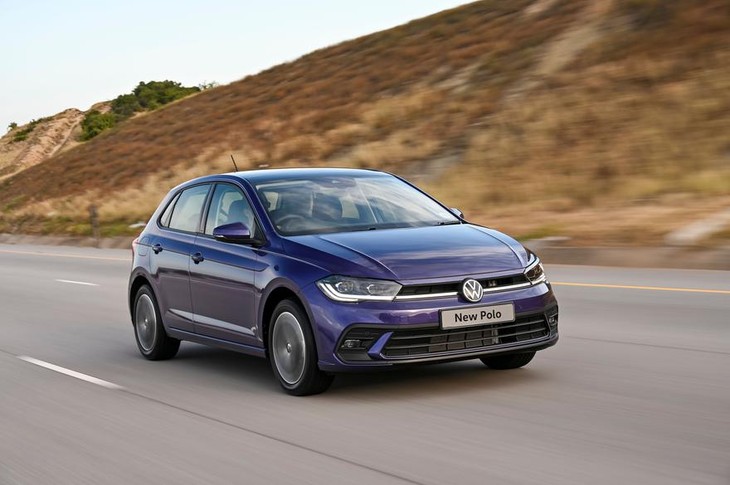
The Volkswagen Polo is widely regarded as the benchmark in its segment in terms of its performance and ride and handling characteristics. Volkswagen’s 1.0-litre turbopetrol engine (in both states of tune) offers an appealing combination of performance and efficiency with Volkswagen claiming consumption figures of 5.3- and 5.4 L/100km. The 85 kW Polo Life is the sweet spot in the range, while the range-topping GTI will appeal to buyers who seek “the fastest Polo of the lot”. With that said, however, the 75 kW Polo’s performance is far from lacking; this engine is an excellent entry point into the Polo range.
As far as the Volkswagen’s ride/handling balance is concerned, the Polo 6 has frequently proved itself particularly adept at providing surefooted and sharp handling without sacrificing much in the way of ride comfort (especially when fitted with 15- or 16-inch alloy wheels) – it’s arguably the best-in-class in that regard. Ride comfort in the range-topping Polo GTI, however, isn’t as forgiving, as the flagship version is more firmly sprung to match its sporty, performance intent. Fuel consumption for the Polo GTI is also higher with Volkswagen claiming a combined-cycle figure of 6.4 L/100 km.
Read our Volkswagen Polo (2022) Launch Review
Renault Clio
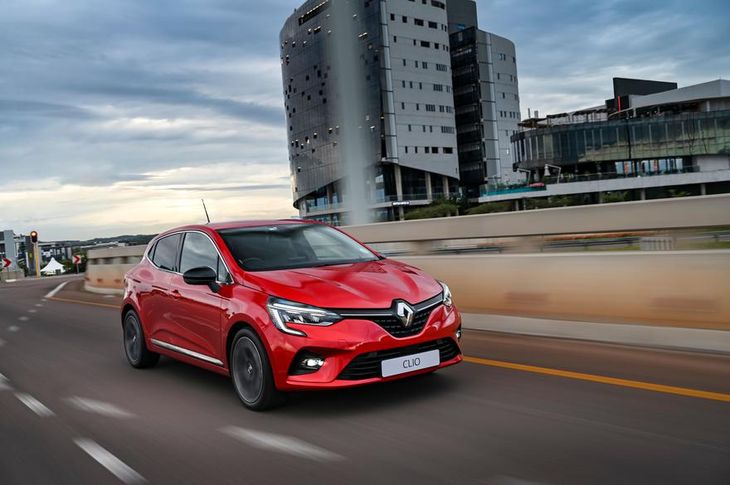
At the moment, the Clio 5 is only offered with a 3-cylinder, 1.0-litre turbopetrol engine mated with a 5-speed manual transmission. This thrummy engine’s outputs (74 kW / 160 Nm) are comparable with those of the entry-level Polo motor and buyers will, unfortunately, have to wait for a more powerful (1.3-litre turbopetrol) engine and continuously variable (automatic) transmission to arrive later this year.
Nonetheless, the new Clio delivers relatively punchy performance and its manual ‘box has a positive shift feel, which contributes to an engaging driving experience. Fuel economy is claimed at 5.7 L/100km.
Renault has also tweaked the Clio’s chassis to deliver sharper handling ability. Not only is the new model wieldier than before, but it also manages to offer a good balance between ride comfort and sportiness.
Read our Renault Clio (2022) Launch Review
Interior Features and Safety
For this section, we will compare key specifications of the equivalent top-spec derivatives from each model range.
You can, however, use our handy Cars.co.za Compare Tool to compare any vehicle derivative you like.
| Volkswagen Polo 1.0TSI 85kW Life | Renault Clio 1.0 turbo Intens | |
| Infotainment | 6.5-inch Composition Colour | 9.0-inch Easy Link touchscreen |
| Digital instrument cluster | 8-inch Digital Cockpit | 7-inch TFT digital display |
| Android Auto and Apple CarPlay, Bluetooth, voice control, USB | Yes, USB-C ports, no voice control | Yes |
| Rear View Camera | No (optional) | No (optional) |
| Cruise Control | Yes | Yes |
| Air conditioning | Manual | Climate Control |
| Front and rear park distance control | Front and rear | Rear only (front optional) |
| Panoramic sunroof | Optional | No |
| Upholstery / Electric seats | Cloth, manual | Cloth, manual |
| Safety Features | 6 airbags, ABS with EBD, brake assist, electronic stability control with traction control, tyre pressure monitoring | 6 airbags, ABS with EBD, brake assist, electronic stability control with traction control, Lane Departure Warning |
Feature Summary
As the table above illustrates, the equivalent Polo and Clio derivatives are fairly evenly matched in terms of standard specification. Even so, the Clio does offer slightly better feature value, because its touchscreen infotainment system has a larger display and incorporates more features than what’s available from the Polo’s setup. Automatic aircon (climate control) is also standard in the Renault.
The Polo’s infotainment system can be upgraded at extra cost and a host of other nice-to-haves can also be ticked on Volkswagen’s optional feature list. As for the Clio, Renault does offer an option pack that adds features such as front park-distance control, reverse-view camera, a larger 9.3-inch infotainment system, wireless charging and larger (17-inch) alloys, for an additional R15k, which is worth considering.
As far as fit and finish is concerned, the Clio’s perceived interior build quality has been elevated significantly with the use of higher-quality materials to offer a more upmarket look and feel. The new Clio’s cabin, therefore, marks a major improvement over that of its predecessor.
By comparison, the updated Polo’s perceived interior fit-and-finish is very good indeed and the overall cabin design/layout exudes a modern, tech-forward design approach. Harder (somewhat scratchy) plastic trim is, however, evident throughout the Volkswagen’s cabin. Still, despite that evidence of cost-cutting, it remains a solidly constructed interior.
Overall, the new Clio’s interior is very much competitive and arguably superior to what’s offered in the Polo (it must be the first time that could be said in the long history of the Polo-Clio rivalry). While both interiors are aesthetically-appealing, you will have to decide which design approach you most prefer.
Take note that the mid-spec Polo 1.0TSI 70kW Life is similarly priced (R350 000) to the top-spec Renault Clio (R349 900).
Practicality
| Volkswagen Polo | Renault Clio | |
| Length | 4 074 mm | 4 050 mm |
| Width | 1 964 mm | 1 988 mm |
| Height | 1 451 mm | 1 440 mm |
| Wheelbase | 2 552 mm | 2 583 mm |
| Rear Seating Configuration | 60:40 split | 60:40 split |
| Load Bay Capacity | 351 Litres | 391 Litres |
While the Volkswagen Polo and Renault Clio are similarly-sized, the latter benefits from a slightly longer wheelbase, which translates into a more spacious cabin overall – rear passengers are likely to feel more comfortably ensconced in the back of the Renault. The Clio’s load capacity is also superior to that of the Polo; both have split rear seats, which adds flexibility for when you need to load bulkier items.
Pricing and Warranty
*Prices are accurate as of February 2023
| Volkswagen Polo | Price | Renault Clio | Price | |
| Base | Polo 1.0TSI 70kW | R334 400 | Clio 1.0 Turbo Life | R309 900 |
| Mid | Polo 1.0TSI 70kW Life | R375 400 | Clio 1.0 Turbo Zen | R324 900 |
| Top | Polo 1.0TSI 85 kW Life | R397 500 | Clio 1.0 Turbo Intens | R364 999 |
| Polo 1.0TSI 85 kW Life R-Line | R445 500 | |||
| Polo GTI | R522 500 | |||
| Warranty | 3-year / 120 000 km | 5-year / 150 000 km | ||
| Service Plan | 3-year / 45 000 km | 2-year / 30 000 km |
As evidenced in the table above, the new Renault Clio range is priced very competitively against that of the Volkswagen Polo (especially in terms of the mid-range derivatives). The French contender also comes with a more comprehensive warranty, which sweetens its purchasing proposition. The Polo, however, does offer a more comprehensive service plan.
If resale and after-sales servicing feature highly on your priorities then note that the Polo will hold better value and fetch a better price in the used car market down the line. As the Polo is also assembled locally, you’d expect that parts supply would be readily available. Renault has worked tirelessly over the past decade to improve its after-sales service and lead time on parts supply. It’s certainly better than it was and the brand continues to make positive ground in this regard.
What to Buy?
The Volkswagen Polo was once the default “first new car” that people bought, but, like most compact hatchbacks, it has become progressively more expensive as its packaging, onboard technology and safety features have advanced (mostly to satisfy markets to which the Polo is exported). Even so, the Polo is arguably still the segment leader when it comes to performance and perceived quality and will, therefore, continue to appeal to those who can afford to buy one. Furthermore, with a choice of 3 powertrains (with manual and auto transmissions available), the Polo caters well for local buyers’ needs.
As for the Renault Clio 5, it’s a much-improved product compared to its predecessor and the combination of the newcomer’s keen pricing, generous specification and long warranty will be particularly attractive to buyers on a tight budget. However, the chink in the French contender’s armour is the fact that there’s no automatic transmission available in the range (as of March 2022 but one is expected later this year) and that fact alone will force many potential customers (many of which commute) to look elsewhere, at least until such time that Renault introduces a self-shifting derivative. A more powerful engine will also enhance the Clio’s popularity.
That said, if a car with an automatic transmission is not a priority for you, the new Clio should be on your shortlist, especially if your budget for a new compact hatchback stretches no further than R350k.
Buy a used Volkswagen Polo on Cars.co.za
Buy a used Renault Clio on Cars.co.za
Related Content
Toyota Corolla Cross vs Haval Jolion – Which should you buy?
Toyota Urban Cruiser vs Chery Tiggo 4 Pro – Which should you buy?
Gero Lilleike

Gero Lilleike is a published writer and photographer with most of his work appearing in the fields of travel and motoring. Gero has worked as a motoring journalist for Cars.co.za for the past 8 years and takes every opportunity to go on an adventure whether it be offroad or in the ocean. For Gero, a car's worth is measured by how many surfboards it's able to carry.