Toyota South Africa Motors has finally introduced the Hilux GR Sport III, replete with a striking widebody kit and uprated suspension that amplifies the bakkie’s off-road capability. Gero Lilleike attended the local launch to put the newcomer to the test.
Even though the 8th-gen Toyota Hilux is now in the twilight of its product lifecycle, it remains a stalwart of the highly competitive leisure double-cab market – and the Hilux GR Sport III is its new halo model.
While the Hilux is the best-selling bakkie in South Africa, it faces stiff competition from the new Ford Ranger and a rapidly increasing number of new offerings in the double-cab bakkie market. Recently, LDV, a sub-brand of SAIC, introduced the T60 double-cab bakkie in Mzansi with competitive power outputs (plus keen pricing) and GWM will soon welcome the P500 bakkie that’s expected to offer up to 255 kW.
Nonetheless, Toyota’s widebody GR Sport III has arrived to stamp its authority on the bakkie market! We joined Toyota South Africa Motors (TSAM) at the GR Sport III’s media launch event in George, Western Cape, to experience the locally assembled newcomer in the metal and to put its capabilities to the test.
What sets the Hilux GR-Sport III apart from a standard Hilux?
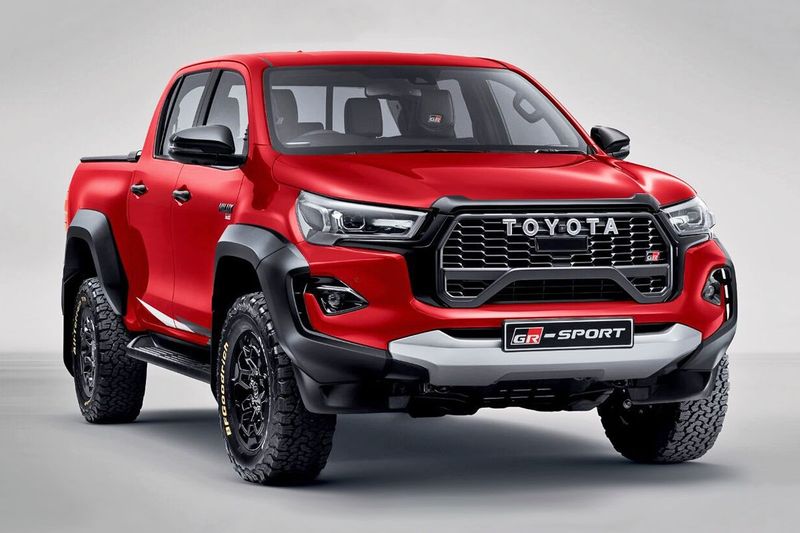
The Hilux GR Sport III was conceived, first and foremost, as an off-road-biased double-cab bakkie (it’s only offered in 4×4 guise) and its mechanical enhancements primarily serve that purpose.
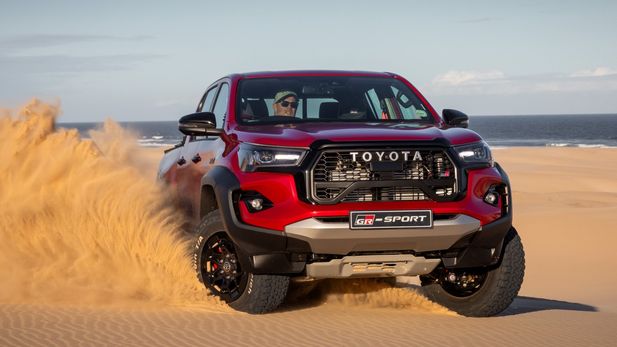
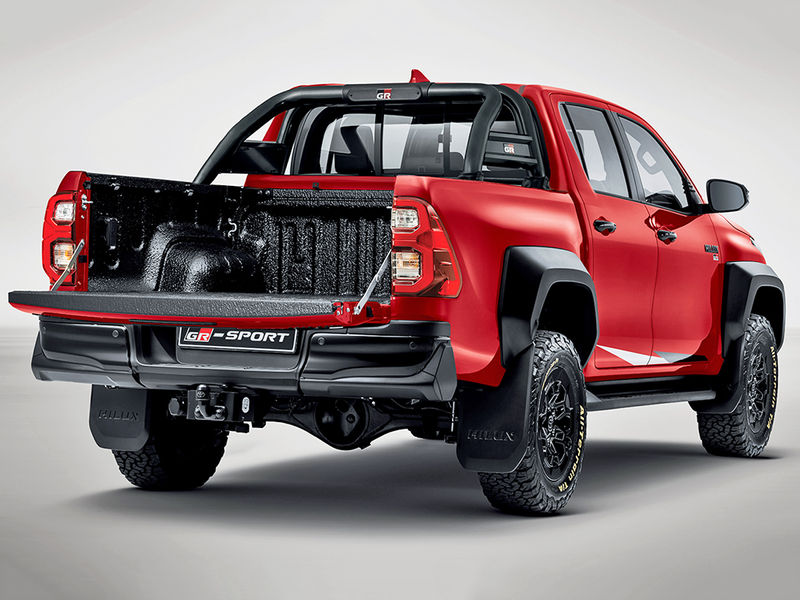
But it also looks the part… The new Hilux GR Sport III is distinguishable by its chunky widebody kit, including large over-fenders and a beefy bumper, all of which considerably enhance its visual appeal.
Other styling enhancements include a unique black grille with TOYOTA lettering, a silver underbody bash plate and a tubular sports bar, which is an SA-specific feature (an aero bar is fitted in other markets).
Notably, the widebody Hilux GR Sport III stands 2 020 mm wide, making it 30 mm wider than a standard Hilux (1 900 mm), while also standing some 20 mm higher by comparison.
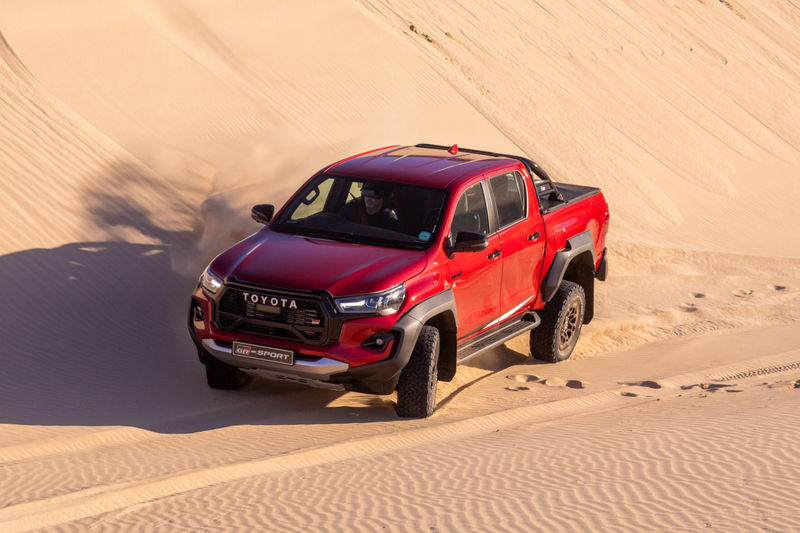
Moreover, the Hilux GR Sport III’s tracks have been increased by 140 mm (front) and 155 mm (rear) to enlarge the bakkie’s footprint, thereby improving its on-road manners, specifically in terms of handling (but more about that below). The revisions are also said to provide greater stability when the Toyota – fitted with BFGoodrich all-terrain tyres (265/65 R17) as standard – traverses major off-road obstacles.
From a mechanical standpoint, the GR Sport III’s suspension and braking system have been beefed up; Toyota says new monotube dampers offer better off-road performance than the previous twin-tube units.
As far as engine outputs are concerned, Toyota’s familiar but uprated 2.8-litre 4-cylinder turbodiesel produces peak outputs of 165 kW and 550 Nm of torque (compared with the standard 2.8GD-6 engine’s figures of 150 kW and 500 Nm) and is exclusively paired with a 6-speed automatic transmission.
Any changes to the interior?
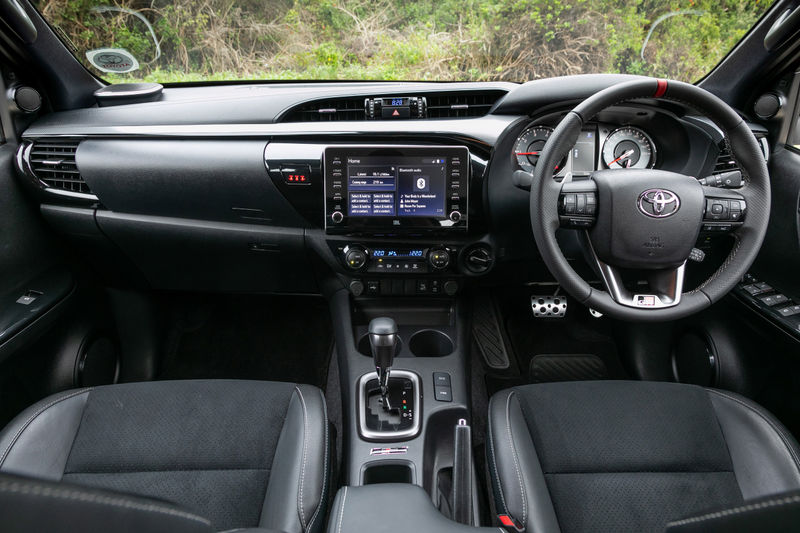
The interior architecture of the Hilux GR Sport III is carried over from the standard Hilux, but the cabin has been enhanced with a combination of suede and leather trim. GR badges appear on the steering wheel (with a red 12 o’clock marker), seat headrests, carpets and of course, on the engine start button.
Red seatbelts add further contrast to the cabin and Toyota has fitted “Technical Mesh” inserts to the dashboard and door cards to further differentiate the newcomer from its standard Hilux stablemates.
In terms of infotainment, Toyota’s Display Audio touchscreen setup features Android Auto and Apple CarPlay functionality, while superb sound delivery comes courtesy of a 9-speaker JBL audio system.
As expected, the perceived build quality of the Hilux’s interior is admirable; it has a level of solidity that buyers will appreciate. Nonetheless, the Hilux’s cabin design/architecture shows its age, especially when compared with the new Ranger. Our biggest gripe is the shortage of USB charging ports in the Hilux – there is only one! So, be prepared to fight other passengers for “charge juice” on those longer trips.
See specification details for the new Toyota Hilux GR Sport III
What’s the Hilux GR Sport III like to drive?
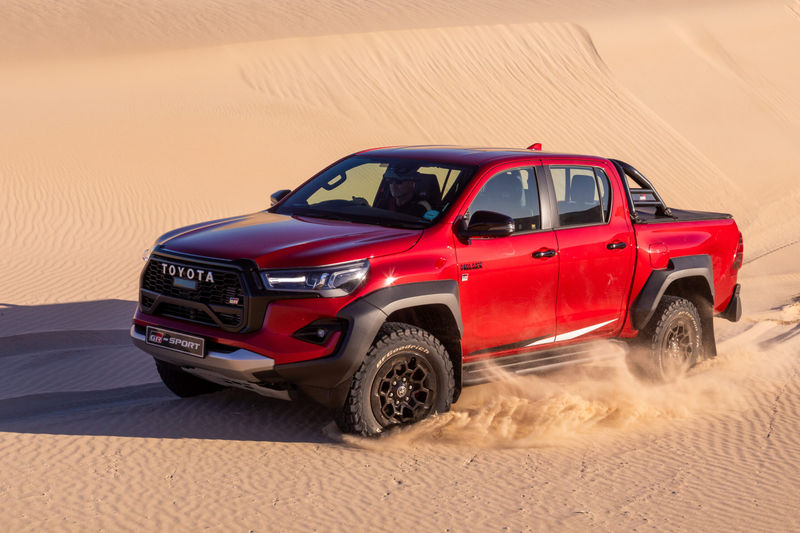
During the launch event, we drove the Hilux GR Sport III on various road surfaces (tar, as well as dirt) and even on dunes, all of which gave us a fairly good opportunity to experience the capability of the bakkie.
The added width of the GR Sport III is immediately noticeable when you’re seated behind its ‘wheel, so much so that you need to be extra vigilant when cornering with – or parking – the double-cab (to avoid incurring unwanted scuffs and bumps). The wider tracks and revised suspension setup do, however, contribute to a more “planted” driving experience; the bakkie’s handling exhibits notably less body roll.
Overall ride comfort, especially when driving on tarred roads, has improved too. Considering that the bakkie is fitted with large all-terrain tyres, we were expecting them to generate higher levels of road noise (compared with the tyres fitted to a standard Hiluxes), but we were pleasantly surprised by the Hilux’s impressive sound deadening, which contributes to a higher level of driving refinement.
Better stability on dirt roads
And, when traversing dirt roads, the Hilux’s improved road holding/stability instils more confidence than before. Having said that, while we applaud the improved suspension setup, the ride quality still degrades markedly over rough and/or uneven dirt roads. When the Hilux is not carrying cargo in its load tray, the bakkie’s rear does become quite jittery, particularly over corrugations, but that’s par for this segment.
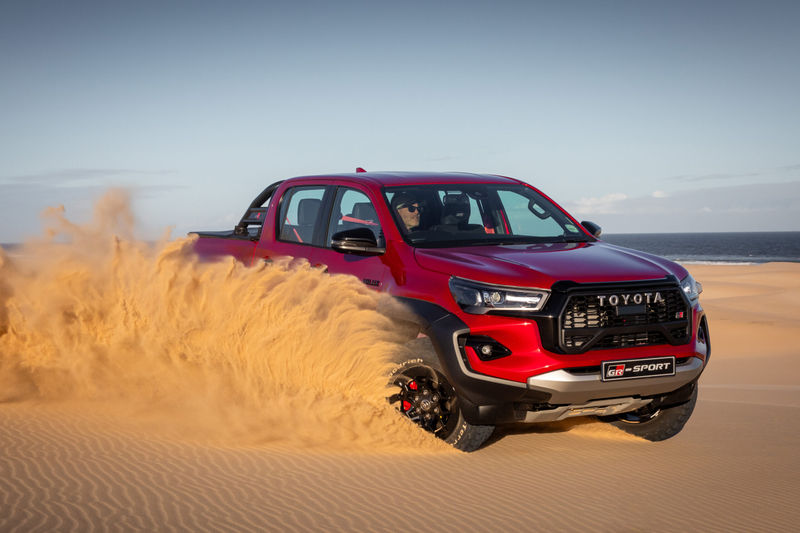
On a private beach on the outskirts of Jeffreys Bay in the Eastern Cape, we made the most of an opportunity to test the rugged Hilux’s sand-driving ability. With tyre pressures reduced to 0.8 bar and low-range engaged, the convoy of Hilux GR Sport III units set off into the dunes for some sandy fun.
The Hilux’s off-roading prowess truly came to the fore; it made light work of soft sand and glided along with minimal exertion of the powertrain. The dunes may have been no match for the GR Sport III, but we look forward to putting the bakkie to the test on a technical 4×4 course as part of a more detailed review.
Well-proven engine offers great power/efficiency balance
Toyota’s venerable – but uprated – 2.8-litre 4-cylinder turbodiesel, remains a highlight of the GR Sport III package. Not only is it refined i.e. not as noisy as some other engines in this segment, but in combination with a 6-speed automatic transmission, it delivers meaty performance. Its ability to dish out mid-range acceleration is excellent – and rather useful when you need to execute urgent overtaking manoeuvres. Any off-road vehicle worth its salt needs a strong engine and the Hilux GR Sport III doesn’t disappoint.
Moreover, the “tried and tested” GD-6 motor still strikes an admirable balance between performance and economy. Our GR Sport III unit was given a proper workout during the event, yet its trip computer showed fuel consumption figures of around 10.2 L/100 km. In normal driving conditions, we would expect to see figures of between 9.5- and 10 L/100 km, which would be impressive for any double-cab 4×4 bakkie.
Who should consider buying the new Hilux GR Sport III?
Priced from R999 000, the new Hilux GR Sport III will appeal to Toyota 4×4 loyalists who are looking for a distinctively packaged Hilux with added off-roading capability “fresh from the factory”. Not only does the GR Sport III look purposeful, but its mechanical upgrades have elevated the bakkie’s on-road handling and off-road ability. As for engine performance, reliability and after-sales support, the Hilux is sorted.
The widebody GR Sport III rivals Ford Ranger double-cab derivatives such as the 2.0 BiTurbo Tremor 4WD (R978 600) and 2.0 BiTurbo Wildtrak X 4WD (R1 040 600). Buyers considering these products are best advised to arrange test drives to determine which of the derivatives is most suitable to their needs, as there are styling and specification differences between them that could sway their buying decision.
Compare the specs of the Toyota GR Sport III, Ford Ranger Tremor and Ford Ranger Wildtrak X
How much does a Hilux GR-Sport III cost in South Africa?
| Toyota Hilux GR Sport III | R999 000 |
The price includes a 3-year/100 000 km warranty and a 3-year or 9 services/90 000 km service plan.
Buy a used Toyota Hilux on Cars.co.za
Summary
Overall, the Toyota Hilux GR Sport III is a welcome and competitive addition to the Hilux range – one that is likely to fulfil most of the dyed-in-the-wool 4×4 enthusiasts’ requirements. For just under R1 million, the “Widebody” makes a strong case for itself; even if it’s based on an ageing model, you should add it to your shortlist if you are looking for an off-road-biased double-cab 4×4 with head-turning looks.
Related content:
All-New 2025 Toyota Hilux Early Details Emerge
Gero Lilleike

Gero Lilleike is a published writer and photographer with most of his work appearing in the fields of travel and motoring. Gero has worked as a motoring journalist for Cars.co.za for the past 8 years and takes every opportunity to go on an adventure whether it be offroad or in the ocean. For Gero, a car's worth is measured by how many surfboards it's able to carry.