In a world of ever-shorter product cycles, Toyota has proven that with an uncompromised design, you can triple that – and remain relevant.
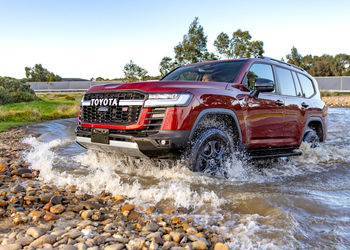
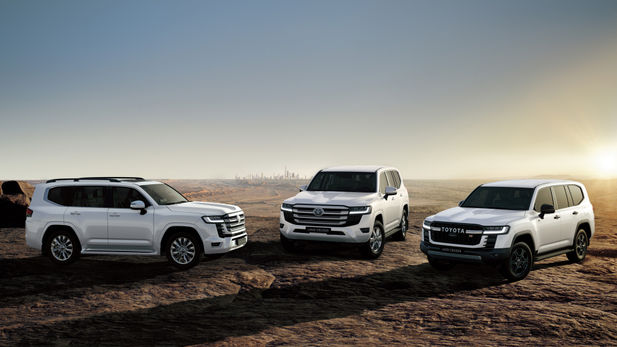
The Japanese brand’s new Land Cruiser 300 has now finally been revealed and it replaces the 200-series, which has been on sale since 2007. If you require context, the Land Cruiser 200 is as old as Apple’s iPhone. It’s largely the same product as 14 years ago, yet it still attracts huge demand right at the end of its lifecycle; compare that with the iPhone, which is now in its umpteenth generation.
But where does the idea of a large luxury Land Cruiser come from? Although it is one of Toyota’s oldest nameplates, the Land Cruiser range was entirely utilitarian for the first 5 decades. There were station wagons, sure, but they mostly rode on leaf-sprung live axles and had military-grade cabin comfort
Toyota makes a break for luxury – with the 100 VX
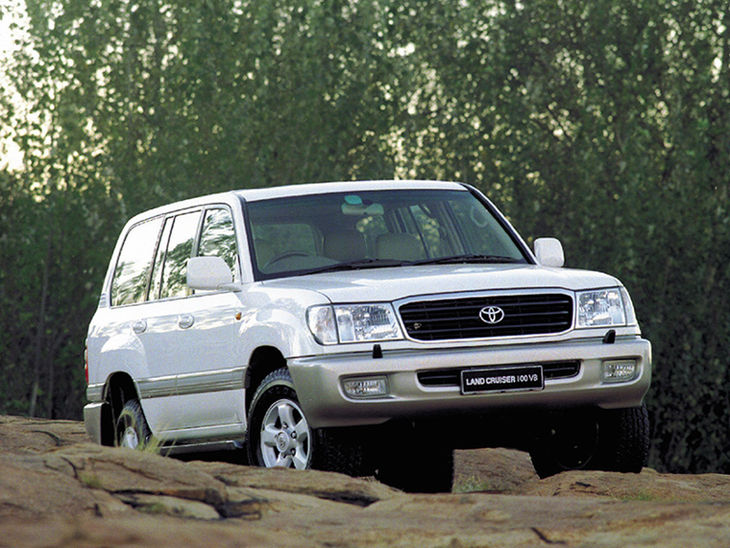
By the latter half of the 1990s, luxury SUVs promised huge profits, with mild customer expectations. Range Rover’s quarry was suddenly overrun with Cayennes, MLs, X5s and Touaregs.
Toyota took notice and realised that its Land Cruiser product team could easily make the bombproof station wagon 4×4 platform a bit more luxurious and at a low cost.
Air suspension and the ability to cruise with stability at speeds beyond 200 kph were marks of distinction for the first-generation of German luxury SUVs. But the R&D they required was expensive; in African conditions, survivability and slow-speed off-road prowess, using nearly granular diesel fuel no less, are more important requirements, so Toyota did a Cheslin Kolbe… and stepped around everyone.
The 100-series marked Toyota’s first luxury Land Cruisers. If you want to be specific, the nomenclature distinction was between the luxurious “100” and more utilitarian “105”. For South African farmers and rural business people, who would never seriously consider a Range Rover or any German luxury SUV, the 100 VX was a dream.
If you want any indication of how durable and valuable they are, try to find an (even well-used) example at a reasonable price…
Stepping it up – to Land Cruiser 200
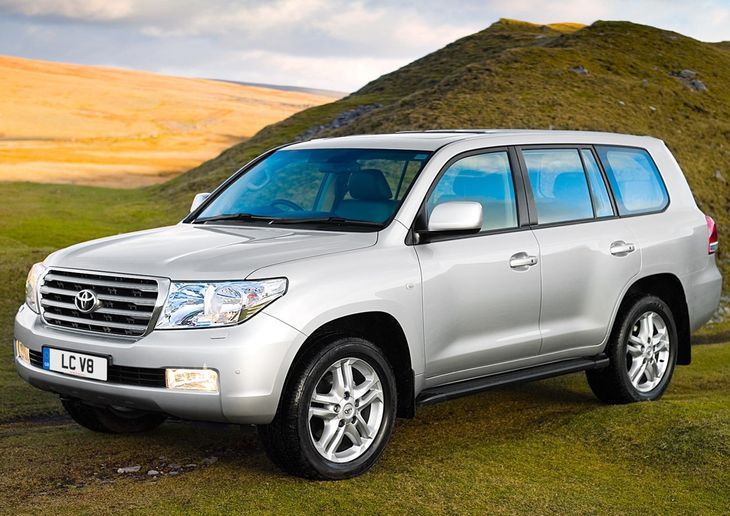
The only issue that Land Cruiser 100 VX owners encountered was the model’s middling engine output. The 4.2-litre inline-6 turbodiesel was terrifically reliable and, with its low-range gearing, capable of crawling up anything. But dune driving requires huge power – as does long-distance cruising.
When the 200 VX arrived it added two cylinders to the diesel powertrain. Toyota’s 4.5-litre V8 turbodiesel was exactly what Land Cruiser customers pined for, finally giving the huge adventure station wagon adequate power for safer high-speed overtaking.
The 200 VX added a treasure of off-road driving assistance gadgets, all with robust redundancy systems. To make the most of that V8 engine’s torque, Toyota developed a crawl-speed control system that acted on all four wheels.
Land Cruiser 200 VX was a huge vehicle, and heavy, which could intimidate novice off-road drivers – especially in tight and technical terrain. With the crawl system, you could select a very low rolling speed, and concentrate all your driving effort on steering and placing the 200 VX, without having to suffer any anxiety relating to throttle modulation.
Toyota continued to resist the temptation of fitting an air suspension, which by then was an option on nearly all of the Cruiser’s rivals. The Japanese marque believed that air suspension was a vulnerability on a vehicle of the 200’s size. Because a Land Cruiser is often required to travel for thousands of kilometres at a time in severe conditions, its maker opted for a simpler compromise.
The solution was a simple hydraulically linked sway-bar disconnect system. It added a touch more wheel articulation, but didn’t improve approach angles or reduce snag points – both notable benefits for an air-suspension-equipped SUV.
Why nothing much has changed – 300
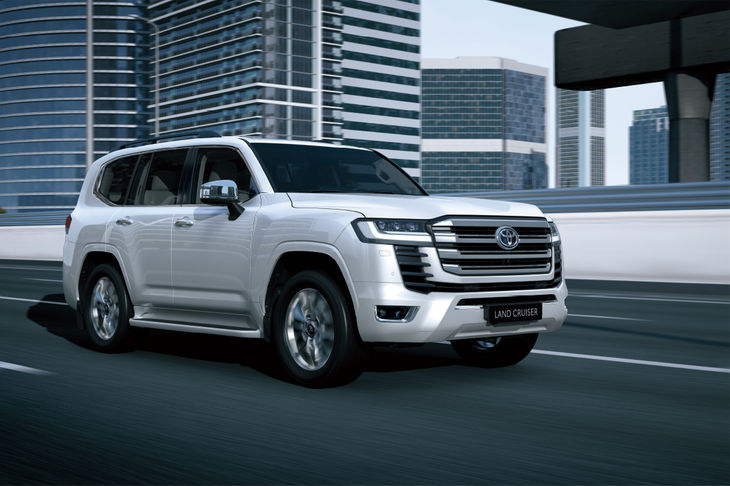
The Land Cruiser 300 is evolutionary. This is not a radical redesign.
Despite the market for large SUVs changing at a rapid pace, demand for the Land Cruiser’s ladder-frame-luxury motoring formula has never ebbed. And Toyota has been mindful that it offers something nobody else can – and is respectful of its loyal Land Cruiser customers.
By far the most significant change has been its engine offering. Many will bemoan the lack of a V8 turbodiesel, but in truth, the new 3.3-litre V6 diesel is a great replacement. It makes more power and torque while benefiting from having a transmission with 4 additional gears. There’s also a twin-turbocharged 3.5-litre petrol V6 on offer.
Read more: Toyota Land Cruiser 300 has arrived plus a GR Sport model
Weight-saving is something that rarely happens in the realm of luxury off-road vehicles, but Toyota’s engineering team managed to diet 100 kg out of the Land Cruiser platform with the 300. With 27 kW more power and 50 Nm more torque, aided by a 100 kg lower kerb weight, the 300 will be faster, lighter on diesel (equalling greater range) and also more agile off-road, especially when dune driving.
The 10-speed automatic transmission will dramatically improve the big Toyota adventure vehicle’s roll-on acceleration and overtaking prowess. You’ll never be hunting between gears, or waiting for the transmission to kick down (as could occasionally be the case with 200 VX’s 6-speed auto’ box).
If you evaluate the core changes between the 200 and 300, you’ll notice how remarkably similar they are. That’s what Toyota did when it updated the 100 to the 200: more power and a better drivetrain.
The KISS principle – even with this most expensive Toyota
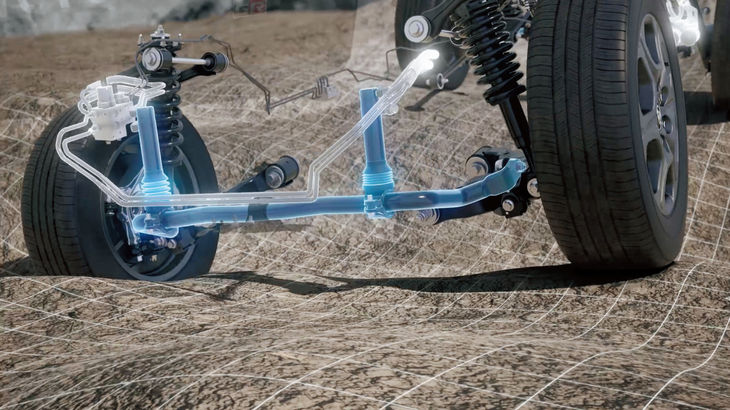
Toyota has not messed with the fundamentals that make its Land Cruiser luxury SUV range unrivalled. It still uses a ladder frame platform and doesn’t have air suspension.
Owners will be willing to live with the 300’s pitch and roll when cornering at high speeds in return for the durability of a suspension system that’s disinclined to fail or lock itself at “access height” in the middle of a Namibian off-road vacation.
If you need a bit more wheel articulation and traction when navigating through potential cross-axle obstacles, the Kinetic Dynamic Suspension System (e-KDSS) from the 200 has been updated with an electronic interface. Crucially, this sway-bar disconnect system is still fundamentally hydraulic – and failproof.
You could argue that Mercedes-Benz’s Geländewagen is a rival, but it is way too small inside. Nissan Patrol? No diesel option.
Lance Branquinho

Lance Branquinho is a Namibian-born writer and photographer who has won numerous motoring journalism awards. He once smuggled parts to South America, in a minor contribution to help Giniel de Villiers finish on the podium at the Dakar. He fears for the eventual collapse of the air-cooled Porsche 911 market – and keenly awaits, in vain, the return of the brand's 928.