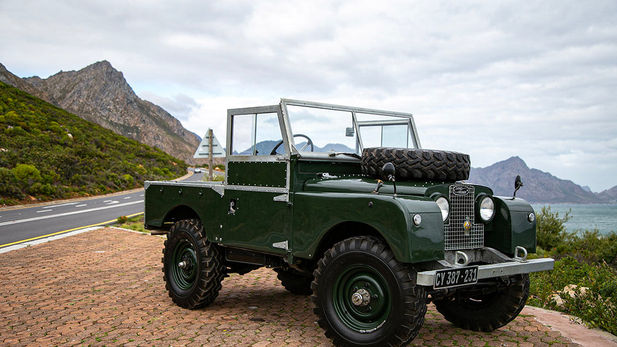
Fitted with a slightly more modern drivetrain, this Land Rover Series 1 offers perhaps the best combination of a truly classic Landy experience with a touch of modern convenience. We drove the British icon along Cape Town’s scenic Clarence Drive.
I hadn’t even driven a kilometre down the road from the property where I collected the Land Rover Series 1, when a fellow Land Rover driver flashed his vehicle’s lights and waved at me. It doesn’t happen often when you’re going about your business, but it does to Defender drivers, and it’s only polite to wave back.
It’s as if driving a classic Land Rover immediately makes you friends with every other Landy owner, and it goes along with a sense of humour… Several owners have told me you need to wave “to show the other driver that your hands are clean” (as proof that you haven’t recently had to work on your Land Rover)!
Joking aside, within the 1st few hundred metres of driving this Series 1, I already felt part of the “club”.
Modernising the Land Rover Series 1
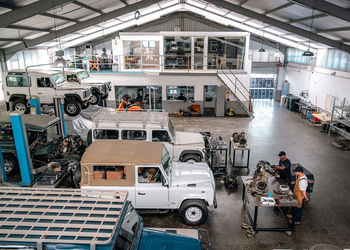
Six years ago, this Landy was not in this great condition, however. When the Series 1 arrived at Land Rover Worx in Helderberg, it needed a lot of attention. Then the team began restoring it piece by piece.
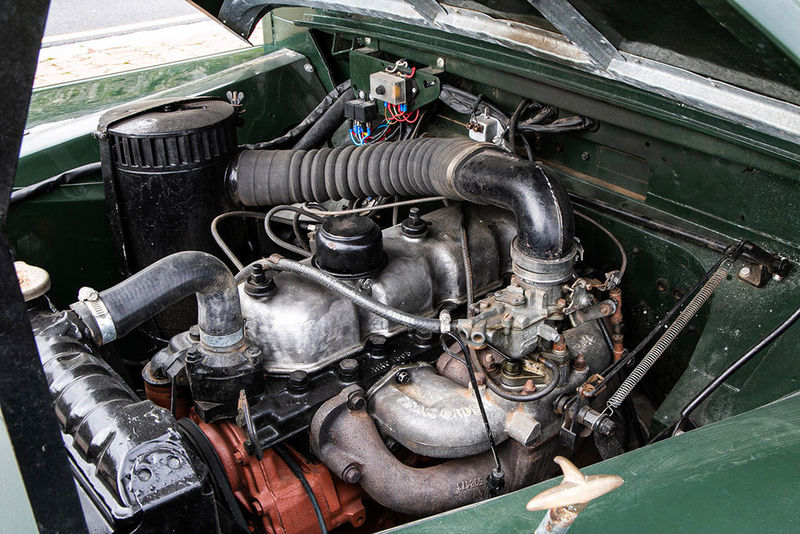
Stefan from Land Rover Worx explains: “The engine is the later 2.5-litre 4-cylinder petrol engine that was fitted to the Defender from around 1987 onwards. The synchromesh gearbox is from a Series III, just to make it a little more drivable. The brakes, wiring and body were redone, and the body was completely repainted. Often, when we receive these cars, there is very little you can use from the original sample.”
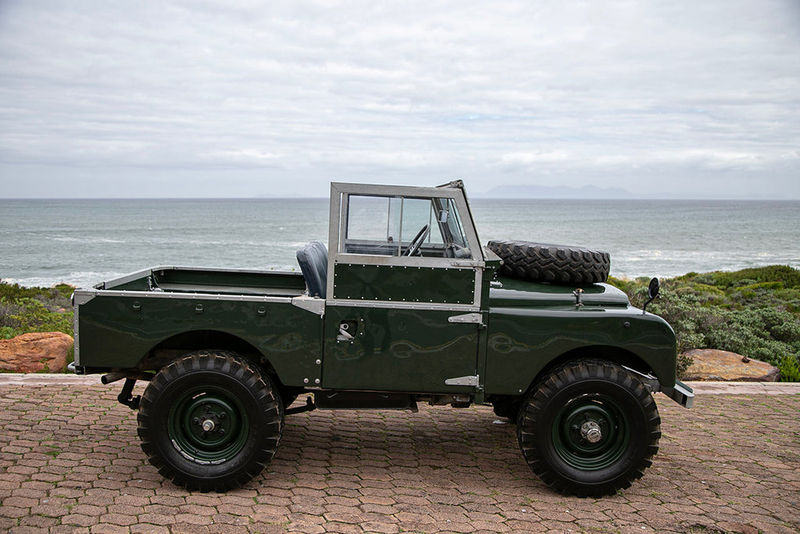
The team kindly removed the roof, which makes the Land Rover appear even more purposeful – and ready for action. Even though it is a chilly 14°C, I am wearing “long johns” underneath my jeans, am triple layered at the top and even have a woolly beanie on my head… The nip in the air won’t affect me today.
Specifications:
- Model: 1956 Land Rover Series 1, 86-inch (with upgraded drivetrain)
- Engine: 2.5-litre, four-cylinder petrol
- Power: 83 kW at 4 000 rpm
- Torque: 265 Nm at 1 800 rpm
- Transmission: 4-speed manual, with low-range transfer case
- Weight: ± 1 100 kg
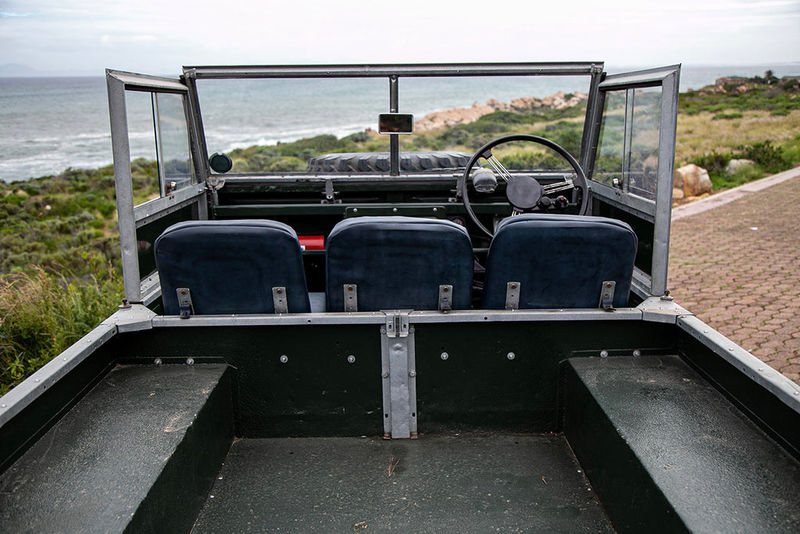
If you really want the full al fresco experience, the windscreen can be removed (or folded flat when the spare wheel is removed). Suffice it to say, it affords you a near 360-degree view from the driver’s seat.
What is the Land Rover Series 1 like to drive?
The more modern engine and gearbox are indeed welcome additions to this Series 1; they perfectly fit the model and also make it more drivable. Originally, this Landy was fitted with a 2.0-litre engine, as was the case with many later Series 1 Land Rovers. A 2.0-litre diesel motor was also available at the time.
The upgraded gearbox removes the hassle and challenges of a non-synchronous gearbox (also known as a crash box). The updated ‘box still feels its age, yet it shifts positively, with a short and mechanical action from 1st to 2nd gear. The up-right-up action when shifting from 2nd to 3rd takes slightly longer.
There is some play in the ‘wheel, which, to be fair, applies to most cars I’ve driven from this era, but the larger-displacement engine makes a significant difference: the Landy easily accelerates past 60 and on to 80 kph. Had it been powered by its original motor, this Series 1 would have delivered far more leisurely acceleration; it would have been more of a chore to drive (as it battled to keep up with traffic in town).
Make no mistake, there are rattles, and the off-road-biased tyres generate a lot of noise, but I wouldn’t want it any other way. As expected – again, as with other vehicles from the Fifties – you need to reduce speed and apply the brakes earlier than usual when you need to stop the Landy at an intersection.
As I head along the beautiful Clarence Drive in the Land Rover Series 1, I’m thankful that on this weekday in the heart of winter, there are no high-performance cars or motorcycles in a rush to overtake me.
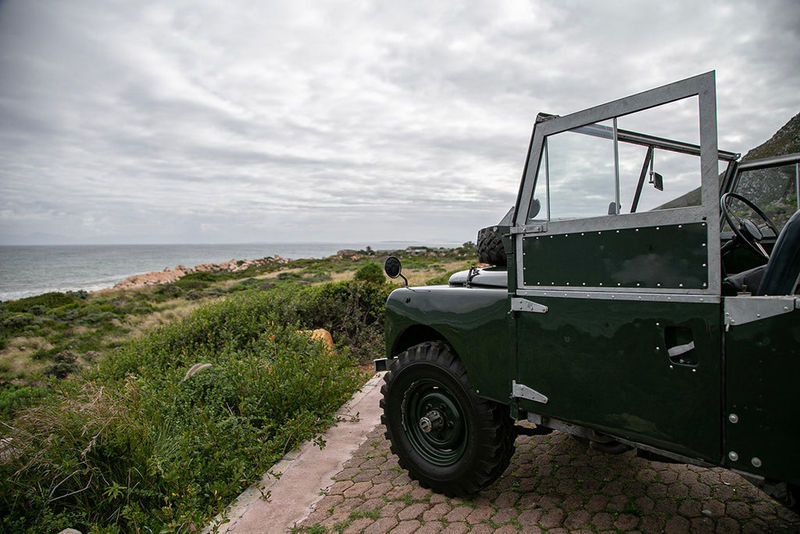
The massive swells of the ocean make for a picturesque sight, and as the Landy trundles around bends, its knobbly tyres scrabble just to remind you that they’re there. It is quite strange to see the spare wheel in front of you, but after a while, you forget about it – or it simply becomes part of the scenery.
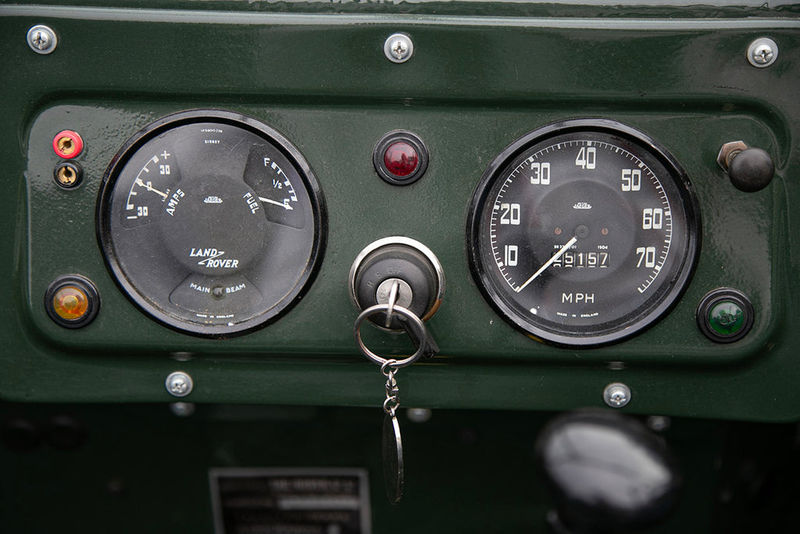
There is no rev counter, but knowing that the engine is a low-revving unit, you tend not to hang on gears for too long. I quickly change up into 4th gear to potter along as, well, “serenely” as possible.
In terms of kerb presence, there is no mistaking this vehicle for anything but an off-road Land Rover. There is ample space in the short load bin to load equipment/camping gear for an off-road excursion.
Occupant comfort is of little concern
If you are okay with sitting close to one another, there are 3 small seats up front. Embarrassingly, a fuel attendant had to show me how to move the driver’s seat to gain access to the fuel tank beneath it.
Halfway along Clarence Drive, I turn around and head back to Gordon’s Bay. I first pull over at the now well-known Pit Stop Lodge, where it comes as no surprise that a few of the visitors make some positive comments about the green Land Rover Series 1 – after all, it is not a car that you see on the road often.
Summary
On the final stretch back to Gordon’s Bay, I’m again reminded of how agricultural and military-grade the Land Rover Series 1 (and other vehicles of its type) are. It was built to be fit for purpose – a far cry from luxurious modern Land Rover models (even Defender variants) with all their soft creature comforts.
At the same time, I could have easily driven another 200 km (with a stop or 2 along the way) to enjoy the other talent (legendary off-road capability) the Series 1 offers. It is a back-to-basics driving experience, and the knowledge that you can tackle off-road routes with confidence only boosts the Landy’s allure.
Find a new or classic Land Rover listed for sale on Cars.co.za
Find exclusive car-themed merchandise at the SentiMETAL Shop
Related content:
Profile: Journeymen Workshop in Cape Town
Mercedes-Benz 300 GD Cabriolet: Classic 4×4 Drive